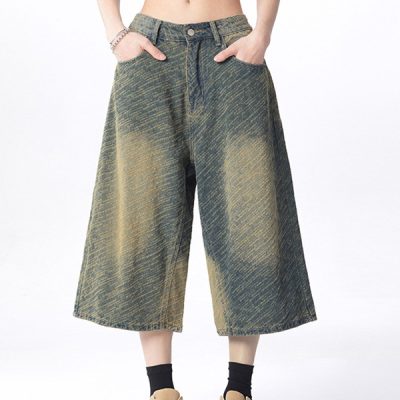
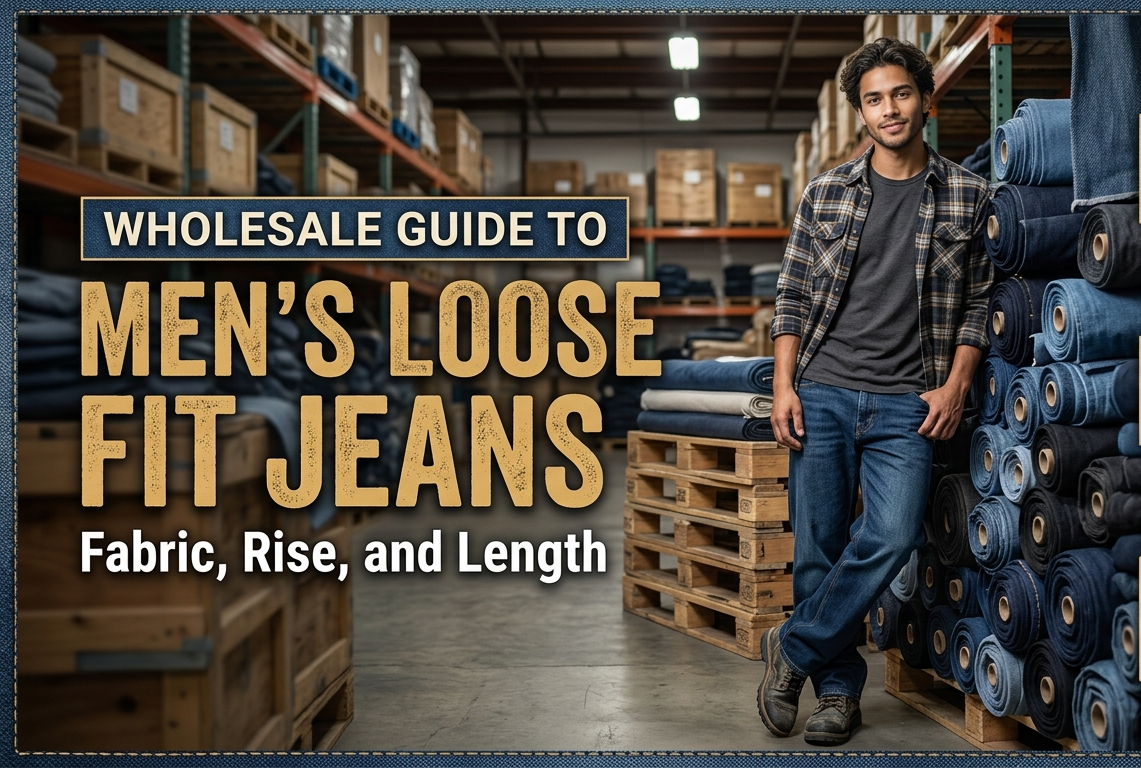
The men’s loose fit jean is a dominant silhouette in current menswear collections. However, successfully executing this style for bulk production requires more than just scaling up standard patterns. For private labels, importers, and wholesalers, the difference between a premium product and a poorly fitting garment comes down to precise technical engineering.
When developing tech packs for loose fit denim, buyers must carefully calibrate three core variables: the fabric structure, the rise, and the inseam length. This guide breaks down exactly what to look for when planning your next production run.
What Fabric Specs Ensure the Right Drape for Loose Fit Jeans?
The defining characteristic of a loose fit jean is its drape. If the fabric is too light, the jeans look flimsy and lose their shape; if the fabric is too stiff, the wide leg panels will flare unnaturally.
- The Weight Sweet Spot: For a classic, authentic vintage feel, 12oz to 14oz denim is ideal. This mid-to-heavyweight range has enough structural integrity to hold a wider leg shape while allowing the fabric to fall straight down from the hip. For summer collections, a lighter 10oz to 11oz denim can work, provided the weave is tight enough to maintain the garment’s structure.
- Composition Matters: 100% cotton rigid denim is the industry standard for loose fits. The lack of stretch ensures the wide panels don’t bag out or distort over time. If your brand requires stretch for consumer comfort, limit the elastane content to a maximum of 1% to 2% to preserve the structural “block” of the jeans.
- Wash Implications: Keep in mind that heavy enzyme washes or bleaching processes will soften the fabric. You must account for how the wash will alter the final drape of the chosen denim weight.
How Does Rise Affect the Silhouette of Loose Fit Denim?
Rise—the distance from the crotch seam to the top of the waistband—dictates how the jeans anchor to the body. In loose fit denim, getting the rise right is critical because the rest of the garment carries extra volume.
- High Rise vs. Mid Rise: A mid-to-high rise (typically 11 to 13 inches for a standard sample size) is generally preferred for loose fits. It anchors the jeans securely at or just below the natural waist, preventing the extra fabric from pulling the pants down.
- The Crotch Drop: Buyers need to specify the drop crotch measurement carefully. A slightly lowered crotch adds to the relaxed aesthetic, but too much drop combined with wide legs can result in a sloppy, ill-fitting appearance. The transition from the rise through the hip and into the upper thigh must be graded smoothly in the pattern.
What Inseam Lengths Prevent Hem Drag in Wider Fits?
Standard inseam grading rules do not always apply to loose fit jeans. Because the leg opening (hem) is significantly wider, the hem interacts differently with footwear.
- Stacking vs. Breaking: If your brand aesthetic leans toward streetwear, you might want the denim to “stack” over the shoe. This requires a slightly longer inseam. For a cleaner, more tailored loose fit, the inseam should be engineered to break exactly at the top of the shoe.
- The Leg Opening Ratio: A standard slim jean might have a 14-inch leg opening, while a loose fit can range from 18 to 22 inches. A wider opening means the fabric will easily cover the shoe and hit the ground if the inseam is too long. Buyers should consider offering standardized inseams (e.g., 30″, 32″, 34″) but rigorously test the sample lengths with the specific leg opening width to avoid excessive hem drag and fraying in consumer use.
Why Choose Xinen Garment as Your Denim Manufacturing Partner?
Scaling a custom denim line requires a factory that understands the technical nuances of pattern making, fabric sourcing, and wash control. Xinen Garment operates as a specialized, direct manufacturer for B2B clients, including apparel importers, wholesalers, and private labels.
- Technical Fit Engineering: We don’t just use standard templates. Our pattern makers specialize in translating your tech packs into precise, graded blocks, ensuring your loose fits, wide-legs, and cargo styles drape exactly as intended across all sizes.
- Strict Wash and Shrinkage Control: Loose fit patterns require more fabric, meaning wash shrinkage compounds faster. We conduct rigorous shrinkage testing prior to bulk cutting to guarantee sizing consistency, whether you order raw denim or a heavily distressed vintage wash.
- Streamlined B2B Sourcing: As a professional denim factory, we handle the complexities of production—from sourcing specific hardware and 100% cotton fabrics to final quality control and packing—allowing you to focus on branding and sales.
Frequently Asked Questions (FAQ)
What is the minimum order quantity (MOQ) for custom loose fit jeans?
Our MOQ is structured to accommodate both emerging private labels and established wholesalers. Please contact our sales team with your specific design and quantity requirements for a customized quote.
Can Xinen Garment replicate a specific vintage wash on heavy denim?
Yes. If you provide a physical reference sample or detailed high-resolution images, our wash technicians can match specific fading, whiskering, and enzyme treatments while ensuring the fabric retains its required durability.
How do you handle sizing and grading for loose fit styles?
We follow the specific grading rules provided in your tech pack. During the pre-production sample phase, we provide a full size run (if requested) to ensure the proportions of the rise, thigh, and hem remain balanced as the sizes scale up or down.
Do you supply custom hardware and branding materials?
Absolutely. We offer complete one-stop customization, including sourcing and applying branded leather patches, custom shank buttons, rivets, and woven internal labels to fully align the product with your brand identity.