

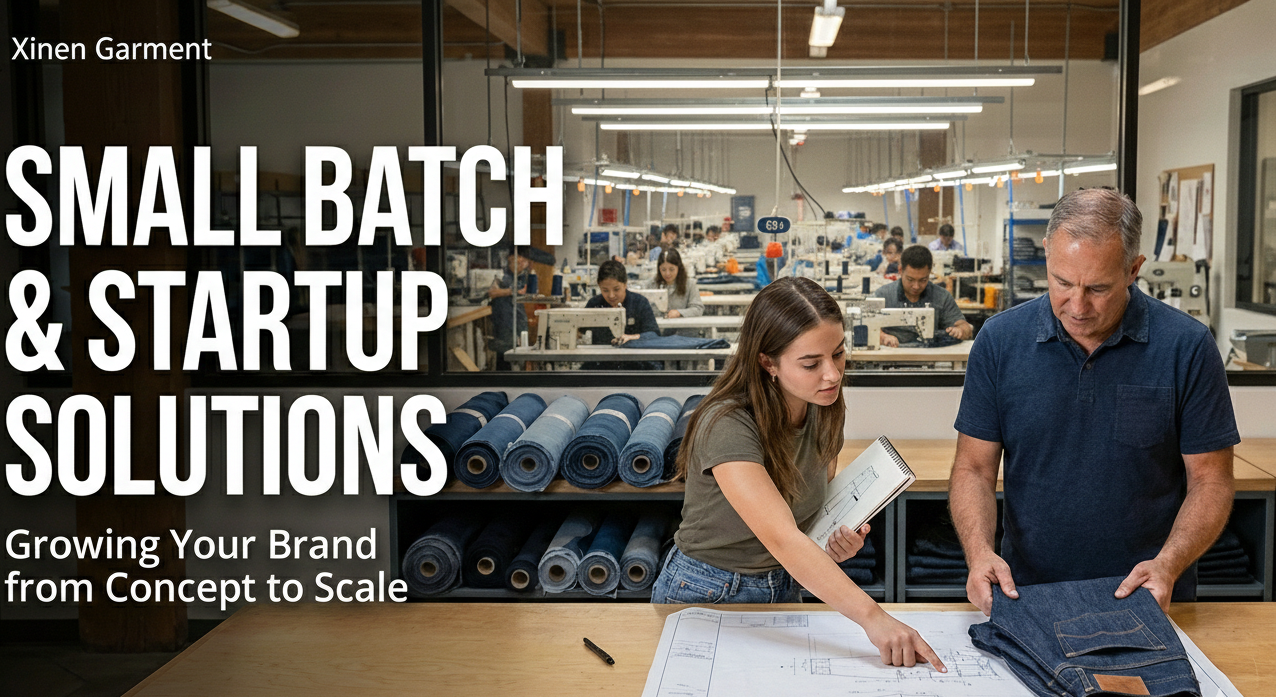
Private Label Jeans Manufacturing Capabilities
Producing custom denim at 200 pieces raises specific production challenges that do not exist at higher volumes: fabric minimums, wash consistency in small batches, and hardware setup costs that are normally spread across larger runs.
This page explains the systems we use to make 200-piece production viable without compromising on fit accuracy, wash consistency, or branding quality. The production line, wash facility, and QC process are the same as our larger orders. What changes is how we source fabric and structure the wash batches.
If you want to understand whether low MOQ production is right for your specific situation, see our [For Startups / Low MOQ Buyers] page in Who We Serve.
How We Make 200-Piece Production Work
Most factories set high minimums because of two constraints: fabric mill minimums and wash machine load requirements. We resolve both through specific systems built into our production process.
Fabric: the stock fabric system
Fabric mills supply denim in rolls, typically with minimum order quantities of 300–500 meters per color. For a 200-piece jeans order, you need roughly 90–100 meters of fabric. The gap between what you need and what mills require is where most factories stop.
We maintain a stock fabric inventory across a range of weights, stretch levels, and base colors. This inventory absorbs the fabric mill minimum — we carry the stock, and your order draws from it.
What this means in practice:
| Spec | Stock Fabric Range |
|---|---|
| Weight | 9oz, 10oz, 11oz, 12oz, 13oz, 14oz |
| Elastane | 0%, 1%, 1.5%, 2%, 3% |
| Base color | Indigo (light to dark), black, grey, ecru |
| Cotton content | 98–100% cotton, 97% cotton blends |
Stock fabric options cover the majority of what B2B buyers need for standard denim programs. If your specification requires something outside this range — a specific yarn construction, a custom-dyed base, or a certified organic option — we discuss fabric sourcing separately, which involves mill lead time and minimum requirements.
Wash: batch management at low volume
Industrial washing machines operate most consistently at 80–100 pieces per cycle. For a 200-piece order, we run two wash cycles of 100 pieces each. Both cycles use the same settings, same chemical ratios, and same cycle time, logged against the approved wash standard.
This is the minimum volume at which we can control wash consistency reliably. Below 100 pieces per cycle, the mechanical dynamics inside the drum change — stone impact, chemical concentration, and friction all become less predictable. This is why we set 200 pieces as our standard MOQ and do not routinely take orders below this threshold for washed denim.
For rinse wash and enzyme wash styles — treatments that do not rely on mechanical abrasion — we can sometimes work with lower quantities on a case-by-case basis. We flag this during the initial brief review.
Hardware and trim minimums
Woven labels, care labels, and patches: minimums are typically 200 pieces per design, which aligns directly with our production MOQ. In most cases, a 200-piece order meets these minimums without issue.
Custom-engraved buttons or die-stamped rivets require tooling setup and a hardware minimum of 200–300 pieces. A 200-piece garment order uses approximately 200 buttons, which meets the hardware minimum. We confirm all hardware minimums during the brief review stage before sampling.
Pattern and Fit at 200 Pieces
Small batch orders receive the same pattern development process as larger orders. There is no simplified or abbreviated version for low MOQ clients.
What the pattern process includes:
- Pattern drafted from your tech pack or reference garment
- Shrinkage compensation built in for the specific fabric and wash combination — post-wash measurements match the spec, not the pre-wash cut
- Fit tested on the first sample before bulk production is approved
- Grading across your specified size run confirmed before bulk cutting
Size distribution at 200 pieces:
200 pieces across a full size run averages 28–30 pieces per size if spread across 7 sizes. This is enough for market testing but limits the sales data you get per size. We often recommend concentrating on 4–5 core sizes for a first order to get more useful sell-through information.
Suggested size distribution for a 200-piece men’s jeans order:
| Size | Pieces |
|---|---|
| 28 | 15 |
| 30 | 35 |
| 32 | 55 |
| 34 | 55 |
| 36 | 30 |
| 38 | 10 |
| Total | 200 |
This concentrates volume in the mid-sizes where sell-through is typically strongest for a first order.
Wash Options at 200 Pieces
All standard wash treatments are available at 200 pieces. Consistency is managed through batch logging and comparison against the approved pre-production sample.
| Wash Type | Available at 200 pcs | Consistency Notes |
|---|---|---|
| Rinse wash | ✅ | Most consistent at any volume |
| Enzyme wash | ✅ | Stable and repeatable |
| Stone wash | ✅ | Two cycles of 100 pcs, same settings |
| Vintage wash | ✅ | Requires more wash trials during sampling |
| Ozone finishing | ✅ | Consistent results, eco-friendly |
| Hand sanding / whiskers | ✅ | Manual or laser available |
| Distressed effects | ✅ | Bar-tack before washing, standard |
| Garment tinting | ✅ | Color matching managed per batch |
Complex multi-stage washes (heavy vintage, combined stone and hand-sand treatments) require more sampling rounds to nail down the recipe. This is true at any volume, but adds proportionally more to the per-unit cost at 200 pieces because sampling cost is fixed regardless of order size.
Branding at 200 Pieces
Full private label branding is available at our standard 200-piece MOQ. There is no reduced branding option for low MOQ orders — the same elements are available as for larger runs.
What is included:
- Woven main label and care label
- Leather, PU, or Jacron patch (200-piece minimum met by the order)
- Custom buttons in standard finishes (antique brass, gunmetal, silver) — no tooling required for standard finishes
- Custom buttons with logo engraving — tooling setup required , minimum 200 pieces met by the order
- Hangtag produced to your artwork
- Back pocket embroidery
- Retail polybag or FBA-compliant packaging
All branding details are confirmed on the pre-production sample before bulk production begins.
QC Standards at 200 Pieces
The same three-stage QC process applies to all orders regardless of quantity.
Stage 1 — Fabric inspection before cutting Fabric is checked for defects and color consistency against the approved standard before any cutting begins.
Stage 2 — In-line inspection during sewing Construction quality, stitch density, seam alignment, and hardware placement are checked during the sewing stage before garments enter the wash.
Stage 3 — Post-wash measurement and appearance check Finished garments are measured against the approved pre-production sample. At 200 pieces, we inspect 100% of garments (or a minimum of 20 pieces per size, whichever is greater) rather than the 10% sampling rate used on larger orders. Defect rate target: under 2%.
Production Specifications
| Specification | Detail |
|---|---|
| Standard MOQ | 200 pieces per style per color |
| Below 200 pieces | Case by case. Rinse/enzyme wash styles only. Not standard. |
| First sample | 10–15 working days after style confirmation |
| Revision rounds | 1–2 typical |
| Pre-production sample | 7–10 working days after proto approval |
| Bulk production | 15–20 working days after PPS approval |
| Total timeline (new style) | 6–8 weeks from first contact to shipment |
| Pricing at 200–500 pcs | USD 15–22 per unit depending on fabric, wash, and branding |
| Pricing at 500–1,000 pcs | USD 13–18 per unit |
| Size range | Up to 7 sizes per style (XS–XL or 28–40) |
What Low MOQ Production Does Not Cover
We set clear expectations upfront rather than adjusting them later.
Under 100 pieces per style is not viable for washed denim at our factory. Wash consistency cannot be reliably maintained below that volume with industrial equipment.
Custom fabric outside our stock range requires mill sourcing, which adds 3–5 weeks lead time and involves a fabric minimum (typically 300–500m per color) that a 200-piece order may not meet alone. We discuss options case by case.
Same-week turnaround is not possible. Even with stock fabric, the first sample takes 10–15 working days. Bulk production after approval takes a further 15–20 days. Total minimum from first contact to shipment is 6–8 weeks.
Unlimited revision rounds are not included in sample pricing. Each revision round is quoted separately. The more complete your brief at the start, the fewer rounds are needed.
Scaling Up from a 200-Piece Order
Many clients start at 200 pieces and scale up once a style is validated. The path from a first order to repeat production at higher volumes is straightforward:
After your first 200-piece order:
- Pattern, fabric spec, and wash recipe are retained
- Repeat orders use the same reference — no development cost
- Timeline shortens: 2–3 weeks less than a new style because development is already complete
- Pricing improves at higher quantities
Volume pricing progression:
Prices depend on fabric weight, wash complexity, and branding. The ranges above are indicative. We provide exact pricing after reviewing your specific style details.
FAQ
Why is 200 pieces the minimum and not lower?
The wash machine load requirement is the main factor. We run 100 pieces per wash cycle to maintain consistent results. Below 80 pieces per cycle, color and effect consistency becomes unreliable with most wash treatments. 200 pieces gives us two cycles of 100, which is the minimum for reliable quality control.
Can I order 200 pieces split across multiple styles?
Each style has its own 200-piece MOQ. You cannot split 200 pieces across two styles. If you want two styles, the minimum total is 400 pieces (200 per style). We can coordinate production and ship both styles together.
Does low MOQ affect construction quality or materials?
No. The same production line, the same fabric sourcing network, and the same QC standards apply at 200 pieces as at 2,000. What differs is the per-unit cost, which is higher at low volume because fixed costs are spread across fewer units.
Can I get samples before committing to 200 pieces?
Yes. Sample development is separate from the production order. We develop the sample first, you approve it, then you commit to bulk. You are not required to order 200 pieces before seeing a physical sample.
What if I want to add a style later after my first order?
New styles go through the same development process. If the new style shares fabric and wash with an existing approved style, we can sometimes use the same fabric lot and reduce development time. We discuss this case by case.
Can we reorder in smaller quantities if a size sells out?
Reorders below 200 pieces per style are generally not viable for washed denim. If a specific size sells through quickly, the practical option is to include a larger quantity of that size in your next full order.


