

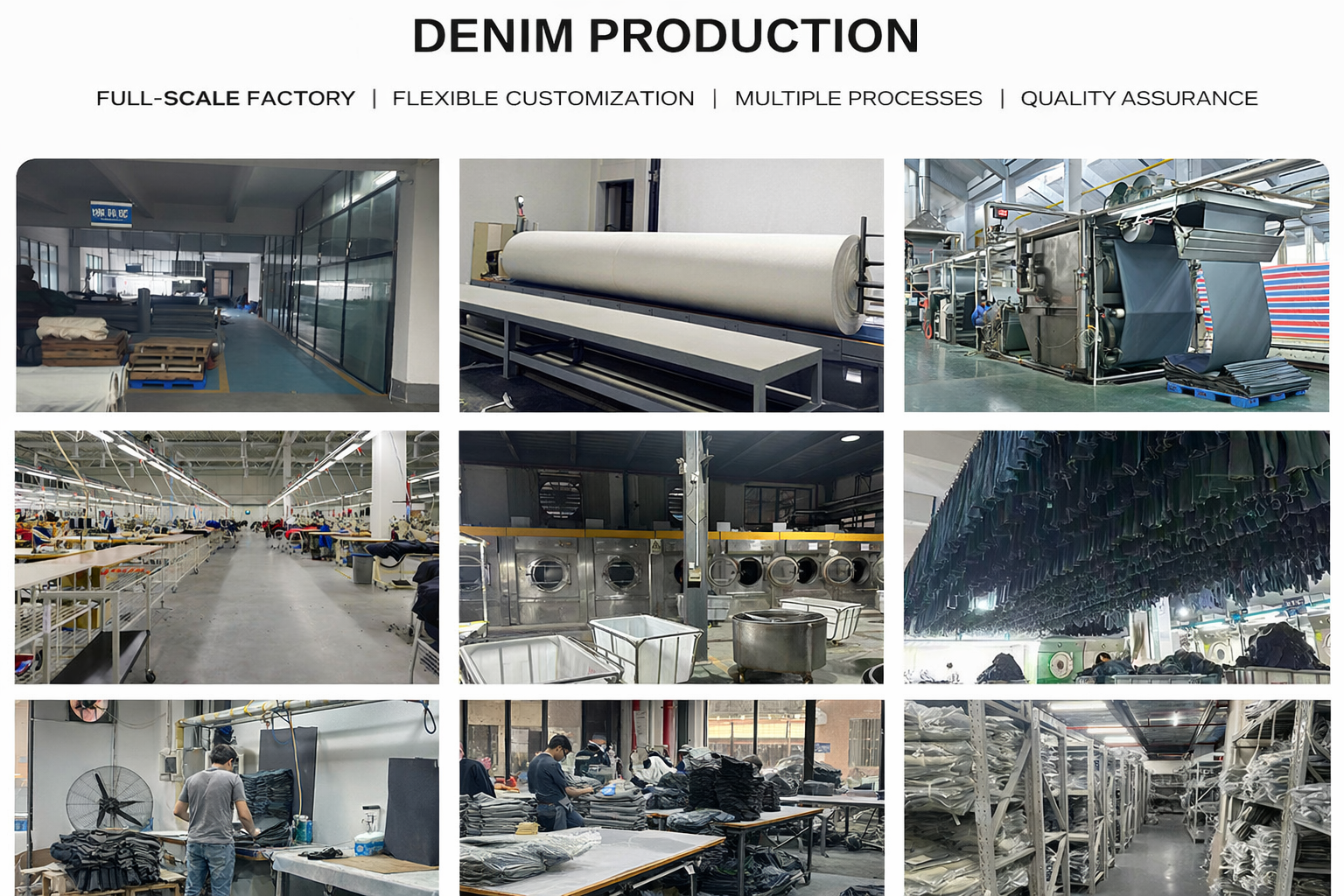
Custom denim manufacturing begins once product requirements are defined and relevant materials, fit, construction, and finishing specifications have been confirmed. Translating a approved design into consistent bulk production requires a thorough understanding of how denim behaves across every stage of processing.
Manufacturing involves much more than standard cutting and sewing. For denim garments, raw fabric behavior, pattern geometry, seam construction, wet washing, thermal drying, and final finished measurements are closely interconnected. A physical parameter established during sewing can alter significantly once the garment undergoes industrial washing and finishing.
Xinen Garment supports fashion labels, streetwear brands, and established apparel lines through the manufacturing process—from production preparation and technical verification through cutting, construction, washing, finishing, and final quality inspection.
What Custom Denim Manufacturing Involves
In practical apparel production, custom denim manufacturing encompasses the complete operational sequence required to move from approved product specifications to packed bulk orders. While exact production steps vary depending on the specific garment design, fabric weight, and required wash effects, the overall manufacturing scope includes:
Approved Product Specifications
       │
       ▼
Fabric & Material Confirmation
       │
       ▼
Pattern & Technical Preparation
       │
       ▼
Cutting & Component Grouping
       │
       ▼
Garment Assembly & Sewing
       │
       ▼
Washing & Wet Processing
       │
       ▼
Finishing & Hardware Attachment
       │
       ▼
Measurement & Visual Inspection
       │
       ▼
Final Quality Control & Packing
Each stage influences the next. For example, the tension applied during sewing affects how seams pull or pucker during washing, which in turn impacts the garment’s final measurements and overall silhouette. Manufacturing management requires controlling these interdependent steps to maintain consistency across the entire production run.
From Approved Denim Specifications to Production
A successful transition from development to bulk production depends on starting with verified inputs. Manufacturing execution begins by consolidating and reviewing all approved development assets provided by the brand or established during development:
- Approved Tech Pack: Detailed style documentation outlining construction methods, seam types, thread specifications, stitch density, and hardware placement.
- Approved Measurement Chart: Definitive target dimensions across all size grading points for both raw (pre-wash) and finished (post-wash) states.
- Approved Production Pattern: Verified digital pattern files adjusted for the specific fabric’s expected shrinkage and torque during washing.
- Approved Fabric Reference: Confirmed mill roll samples establishing baseline weight, shade, composition, and stretch characteristics.
- Approved Trim & Hardware Suite: Confirmed buttons, rivets, zippers, pocket linings, leather patches, and brand labels.
- Approved Wash Sample / Reference: A physical reference garment establishing the benchmark for color, fading intensity, hand feel, and localized distressing.
Distinctly separating development from manufacturing ensures that bulk production relies on documented parameters rather than assumptions. Once specifications are locked, factory teams use these approved benchmarks as strict reference standards throughout production.
Fabric and Material Preparation
Fabric and trim preparation establishes the foundation for physical production. In denim manufacturing, raw fabric selected during development must be correctly identified, inspected, and controlled prior to lay planning and cutting.
Fabric Inspection and Shade Sorting
Before laying out fabric, raw denim rolls are inspected for physical defects, weaving irregularities, and width consistency. Because indigo dyeing inherently exhibits lot-to-lot shade variation, fabric rolls are categorized by shade groups. Grouping similar shade lots together ensures that components cut for a single garment match in tone.
Fabric Characteristics & Washing Behavior
Denim fabrics behave differently based on their construction:
- Rigid vs. Stretch Denim: 100% cotton rigid denim behaves differently under seam tension and wash shrinkage compared to stretch denim containing elastane or synthetic blends.
- Fabric Weight (GSM / oz): Heavyweight denims (14 oz and above) require different machine tension, needle sizes, and thread types than midweight (10–13 oz) or lightweight (under 10 oz) denims.
- Shrinkage & Torque Testing: Test panels from each fabric lot undergo sample washing to verify dimensional changes in length and width, as well as skewing (leg twist).
The fabric selected during development must be carefully verified against these physical properties before cutting begins. For deeper information on raw textile evaluation, refer to our overview of denim fabric selection.
Pattern and Technical Preparation for Production
Moving an approved pattern into bulk production requires technical adaptation. Production patterns are not simply static outlines of the finished garment; they must account for the mechanical stresses of sewing and the dimensional shifts that occur during industrial washing.
Key technical preparation steps include:
- Shrinkage Allowance Integration: Pattern pieces are scaled according to the specific fabric lot’s tested shrinkage values. Length and width allowances are applied independently.
- Seam Allowance Verification: Seam widths are checked against specified machine folders and sewing operations (e.g., flat-felled inseams, overlocked outseams).
- Size Grading: Extending the approved base pattern across the entire size run while maintaining consistent fit proportions, pocket locations, and rise ratios.
- Marker Making & Yield Optimization: Digital layout markers are generated to optimize fabric utilization while respecting grainlines and directional nap.
Clear technical planning ensures the production floor works from precise templates. Learn more about our technical workflows under pattern and technical development.
Cutting and Garment Construction
Physical production begins in the cutting room, where fabric is laid flat in multi-layer spreads and precision-cut into individual garment panels.
Spreading and Cutting
Fabric rolls are allowed to relax prior to spreading to release roll tension. Spreads are aligned carefully along the selvedge. Cutting is performed using automated cutter tables or straight-knife cutters depending on style volume and panel complexity.
Bundling and Identification
Once cut, panels are bundled by size, shade group, and cut lot. Numbering or ticketing individual cut panels prevents mixed-shade components from being sewn together into a single garment.
Assembly and Sewing Operations
Denim construction relies on heavy-duty joinery designed to withstand intense industrial wash cycles. Typical operational sequences include:
- Front Pocket Assembly: Sewing scoop pockets, coin pocket placement, bartacking stress points, and attaching pocket bags.
- Fly & Zipper Construction: Constructing sub-assemblies for button flies or zipper closures, including inner placket reinforcing.
- Rear Construction: Joining back yokes to back panels using chainstitch flat-felled seams, followed by rear patch pocket attachment.
- Inseam and Outseam Joinery: Sewing structural leg seams using specialized lap-seam or twin-needle machines.
- Waistband Attachment: Attaching waistbands with continuous chainstitch operations to ensure structural integrity under tension.
- Belt Loops & Bartacks: Securing belt loops and reinforcing all high-stress areas (pocket corners, fly base, crotch junction) with heavy bartacking.
Construction details vary based on style specifications. Heavyweight workwear jeans require different stitch settings, thread weights, and needle types than lightweight fashion skirts or constructed denim jackets.
Sewing and Construction Control in Denim
Controlling assembly quality on the sewing line is critical to ensuring structural stability and consistent final fit. Minor deviations during stitching can cause major structural or visual flaws after industrial washing.
Operational checkpoints during assembly include:
- Seam Alignment: Ensuring yoke seams, waistband joins, and cross-crotch junctions align precisely across panel intersections.
- Pocket Symmetry: Verifying left-to-right balance in back pocket placement, angle, and distance from center seams.
- Stitch Density and Tension: Maintaining uniform stitches per inch (SPI) and correct thread tension to avoid seam pucker or structural seam popping during washing.
- Hardware & Reinforcement Placement: Ensuring tack buttons, rivets, and bartacks are placed at exact coordinate points without damaging adjacent fabric yarns.
- Hem Execution: Executing clean bottom hems (such as lockstitch or traditional chainstitch hems) with uniform bite and seam overlap.
Maintaining balance between visual execution and structural strength prevents seam failure during subsequent wet processing.
Washing and Finishing in Denim Manufacturing
Washing is a defining stage of denim production. Unlike standard garment dyeing or laundering, industrial denim washing alters both the appearance and the physical structure of the cotton garment.
Raw Sewn Garment
       │
       ▼
Desizing & Enzyme Washing (Color Removal / Softening)
       │
       ▼
Localized Processing (Abrasion / Scraping / Distressing)
       │
       ▼
Rinsing & Neutralization
       │
       ▼
Extraction & Tumble Drying
       │
       ▼
Dimensional Stabilized Finished Garment
Key Wash Operations
- Desizing & Softening: Removing starch sizing agents applied during fabric weaving to release natural fiber softness.
- Abrasion & Color Reduction: Utilizing enzymes, stone washing, or mechanical agitation to reduce indigo depth and highlight fabric texture.
- Manual / Localized Effects: Applying localized hand-scraping, whisker grinding, or destruction details according to approved reference samples.
- Neutralization & Rinsing: Clearing chemical residues and loose indigo dyes to achieve color fastness and clean highlights.
Impact on Final Garment
Washing is not merely decorative; it directly influences:
- Dimensional Changes: Fabric contracts or expands during thermal drying, establishing final garment measurements.
- Hand Feel: Fiber stiffness gives way to softer drape depending on process duration and softening agents.
- Seam Puckering: Fabric shrinkage around high-density stitching creates characteristic highlight ridges (“roping” at hems and seams).
Because washing alters physical size and texture, wash conditions are calibrated against approved reference standards. Explore related capabilities on our washing and finishing service page.
Why Denim Manufacturing Is Different From Basic Garment Production
Denim production differs significantly from basic knits or lightweight woven apparel due to the complex interaction between construction materials and wet processing.
| Manufacturing Aspect | Basic Garment Production (T-Shirts, Chinos) | Custom Denim Manufacturing |
| Fabric State | Fabric is generally pre-shrunk or flat-dyed prior to cutting. | Fabric is often cut in a raw state; final character is achieved post-sewing. |
| Pattern Development | Patterns match target final garment dimensions directly. | Patterns must incorporate complex shrinkage/skew calculations for wash contraction. |
| Dimensional Stability | Measurements remain relatively stable after assembly. | Measurements shift substantially during wet washing and tumble drying. |
| Component Interaction | Sewing thread, lining, and main fabric behave identically. | Pocketing, thread stretch, zipper tape, and main denim shrink at different rates. |
| Visual Finishing | Finishing involves basic pressing, folding, and packing. | Finishing requires multi-stage wash chemistry, abrasion, and thermal curing. |
In basic garment production, a pattern that is correct before sewing yields a correct finished product. In denim manufacturing, a pattern must be designed with the specific wash process in mind. Achieving target specifications requires managing fabric performance, seam construction, and wash reaction simultaneously.
Quality Control During Denim Manufacturing
To maintain consistency across bulk production, quality control checks are implemented throughout the manufacturing flow rather than relying solely on end-of-line inspections.
1. Fabric and Material Checks
- Verifying roll shade grouping and batch continuity.
- Checking incoming hardware, zippers, pocket lining, and main labels against approved trims.
- Conducting pre-cut fabric flaw inspection.
2. Cutting and Assembly Checks
- Monitoring cut component dimensions against digital production markers.
- Checking stitch density, thread color match, seam tension, and structural bartacking on active sewing lines.
- Inspecting hardware attachment strength (button pull tests and rivet setting).
3. Measurement Checks
- Checking raw sewn garments prior to wash to ensure baseline construction consistency.
- Measuring post-wash garments across all key spec points (waist, hip, thigh, rise, inseam, leg opening).
- Comparing finished dimensions against approved measurement tolerance tables.
4. Washing and Finishing Checks
- Comparing wash shade, cast, and abrasion levels against approved wash master samples.
- Checking hand feel, pocket bag cleanliness, and odor removal.
- Verifying localized distressing details for accurate placement and intensity.
5. Final Inspection & Packing
- Conducting comprehensive visual checks for loose threads, missing hardware, or fabric blemishes.
- Verifying main brand labels, care/content tags, size stickers, and hangtags.
- Checking folding, polybagging, and master carton packing specifications.
Detailed verification procedures are detailed under our overall quality control standards.
Maintaining Consistency From Sample to Bulk Production
Transitioning from an approved prototype sample to a bulk order of thousands of units requires disciplined operational control. Variations in yarn lots, wash ambient temperatures, or manual abrasion steps can introduce deviations if not properly managed.
To safeguard consistency, bulk production relies on standard reference points:
- Production Golden Sample: The physical sample approved during development serves as the master benchmark for assembly and aesthetics.
- Wash Master Range: Establishing acceptable high/low shade bands to manage natural indigo wash variations within commercially acceptable limits.
- Controlled Tolerances: Applying clear measurement tolerances across size runs to accommodate natural fabric behavior while maintaining fit integrity.
- Standard Operating Procedures: Documenting exact sewing folder specs, wash times, chemical loads, and drying parameters for factory operators.
Rather than expecting zero natural variation in indigo-dyed textiles, professional manufacturing focuses on maintaining controlled, repeatable outcomes within agreed specifications. Review our process guide on moving from sampling to bulk production.
Bulk Production for Custom Denim Brands
When a style moves into bulk manufacturing, production planning aligns material supply, machine capacity, and wash house schedules.
Specification Sign-off ➔ Fabric Lay & Cut ➔ Line Sewing ➔ Wash Operations ➔ Finishing & Trim ➔ Final QC ➔ Packing
- Material Confirmation: Locking fabric rolls, pocketing, threads, zippers, and custom hardware lots.
- Line Setup: Adjusting sewing machine attachments, folder guides, needle gauges, and thread tension for the specific denim weight.
- Scheduled Cutting & Sewing: Executing component cutting and assembly under line-supervisor monitoring.
- Batch Washing: Washing assembled units in calibrated batch sizes to ensure uniform wash effect across the production order.
- Trimming & Hardware Attachment: Installing tack buttons, rivets, leather patches, and brand labels post-wash.
- Pressing & Measurement Audit: Pressing garments to shape and auditing final dimensions.
- Packaging: Applying hangtags, polybagging units, and packing master cartons for shipment.
What Can Affect Denim Production Results?
Despite precise technical preparation, several physical variables can influence denim manufacturing results:
- Fabric Lot Differences: Subsurface variation in cotton fiber absorption, yarn twist, or dye bath saturation between fabric production runs.
- Elastane Dynamics: In stretch denim, variations in elastane recovery can cause slight fluctuations in post-wash recovery and finished dimensions.
- Wash Load Sizes: Overloading or underloading wash machinery alters mechanical friction, affecting abrasion speed and shade depth.
- Ambient Thermal Conditions: Moisture levels during tumble drying affect total fabric relaxation and length shrinkage.
- Manual Operations: Hand-sanding, whiskering, or destruction applied by hand naturally exhibits slight unit-to-unit variation.
- Late Specification Changes: Altering measurements, trims, or wash requirements after pattern grading or fabric cutting introduces risk of inconsistency.
Transparent manufacturing management involves identifying these variables early and using clear reference controls to minimize unnecessary shifts.
Repeat Production and Long-Term Denim Styles
For established fashion brands, core denim styles often remain in continuous or seasonal repeat production. Managing repeat orders requires distinct controls from initial production runs.
When reordering a style, production teams verify:
- Current Fabric Batch Specifications: Verifying if raw fabric is sourced from the same mill lot or requires updated shrinkage testing.
- Approved Reference History: Auditing the previous bulk production run rather than relying solely on early development samples.
- Pattern Maintenance: Ensuring digital pattern files incorporate any fit adjustments approved during previous production cycles.
- Trim & Label Updates: Verifying updated care label info, seasonal brand updates, or revised wash code tags.
Clearly documenting style evolution across seasons ensures long-term fit and visual continuity for brand customers.
What Xinen Garment Supports During Denim Manufacturing
Xinen Garment provides comprehensive technical execution and manufacturing support for custom denim lines:
- Production Preparation: Reviewing tech packs, checking pattern allowances, and establishing production parameters.
- Material Management: Sourcing, inspecting, and shade-sorting raw denim fabrics and custom trims.
- Technical Sewing Construction: Executing assembly across specialized denim sewing lines with controlled stitch parameters.
- Wash & Finish Coordination: Managing wet wash processing, localized hand-finishing, and thermal drying to match approved wash targets.
- Inline & Final Inspection: Performing continuous quality control across cutting, sewing, post-wash measurements, and final packing.
- Logistics Preparation: Packaging finished garments according to retail or warehouse distribution specifications.
We focus on clear communication, technical adherence, and practical quality management throughout the manufacturing run.
Custom Denim Manufacturing for Different Product Types
Manufacturing techniques are adapted to suit specific garment categories, silhouettes, and structural demands:
Jeans (5-Pocket & Fashion Cuts)
Production focuses on waistband structural integrity, crotch cross-seam strength, precise rise dimensions, pocket placement symmetry, and leg inseam twisting control.
Denim Jackets
Assembly emphasizes multi-panel alignment, chest pocket construction, collar shaping, sleeve button plackets, waistband tab placement, and uniform wash wear across seams and flat panels.
Denim Shorts
Execution concentrates on waist-to-hip proportions, leg opening hem execution, inseam balance, rise measurements, and edge-fraying or clean-hem finishing stability.
Denim Skirts
Production highlights waist and hip curve shaping, fly or button-front closure alignment, rear slit reinforcement, center seam symmetry, and hem levelness post-wash.
When Is a Denim Product Ready for Bulk Manufacturing?
A denim product is ready for bulk production when all critical specification variables have been defined, tested, and formally approved:
[✓] Raw fabric composition, weight, and lot shrinkage confirmed
[✓] Production patterns graded across all required sizes
[✓] Pre-wash and post-wash measurement spec charts approved
[✓] Sewing construction details, threads, and seam types documented
[✓] Wash recipe and visual shade range (high/low bands) locked
[✓] All trims, zippers, buttons, rivets, and labels physically approved
[✓] Production sample signed off by brand product team
Starting bulk production before these points are resolved increases the risk of measurement discrepancies or visual shade mismatch.
Custom Denim Manufacturing Process
The sequence for bulk custom denim manufacturing follows an organized technical flow:
- Review Approved Product Specifications: Finalize tech packs, bill of materials, and signed reference samples.
- Fabric & Trim Preparation: Inspect incoming raw fabric, perform shade grouping, and conduct shrinkage testing.
- Pattern Grading & Lay Planning: Scale digital patterns for wash shrinkage, grade sizes, and create cut markers.
- Cutting & Component Bundling: Cut fabric layers, apply size/shade tickets, and bundle components.
- Garment Assembly: Sew sub-assemblies and main structural seams on specialized machinery.
- Industrial Washing & Finishing: Execute wash recipes, manual abrasion, extraction, and tumble drying.
- Hardware & Trim Application: Install tack buttons, rivets, brand labels, and leather back patches.
- Measurement & Quality Inspection: Inspect garments for visual defects, construction accuracy, and spec compliance.
- Final Packing & Dispatch: Press, fold, tag, polybag, and carton-pack garments for shipment.
For a detailed breakdown of production workflows, visit our comprehensive denim manufacturing process overview.
Frequently Asked Questions
What is custom denim manufacturing?
Custom denim manufacturing is the process of taking approved brand specifications—including custom fits, fabric selections, construction details, hardware, and wash effects—and producing them in bulk quantities while maintaining quality and measurement consistency.
What information does a denim manufacturer need before bulk production?
Before starting bulk manufacturing, a factory needs an approved tech pack, graded measurement charts, verified fabric specifications, approved hardware/trims, digital production pattern files, and an approved physical sample for wash and fit reference.
Can you manufacture jeans directly from a tech pack?
Yes. A complete tech pack provides the construction foundation. However, prior to bulk cutting, the raw fabric must be tested for shrinkage and torque so the production pattern can be adjusted specifically for that fabric’s wash reaction.
What is checked during denim production quality control?
QC checks occur across multiple stages: incoming fabric flaw and shade inspection, cut-panel accuracy, inline sewing construction, post-wash measurement audits, wash shade comparison against reference samples, hardware pull-strength testing, and final pre-packing inspection.
How does washing affect denim manufacturing?
Industrial washing removes starch, alters fabric hand feel, creates visual fading, and causes fabric contraction (shrinkage). Because washing changes physical dimensions, patterns must be pre-adjusted to ensure the garment hits target measurements post-wash.
How do you maintain consistency between samples and bulk production?
Consistency is maintained by using verified fabric lots, documenting standard sewing parameters, following calibrated wash recipes, utilizing shade-band ranges, and comparing bulk output against an approved production reference sample.
Can you manufacture different denim fits and garment styles?
Yes. Custom denim manufacturing applies across various silhouettes—including skinny, straight, relaxed, wide-leg, and cargo jeans—as well as denim jackets, shorts, skirts, and overshirts.
What should be approved before bulk denim production begins?
Before cutting bulk fabric, brands should approve the fit sample, graded spec sheet, main fabric lot, wash master sample, thread colors, brand labels, zipper type, and metallic hardware.
Have a Custom Denim Product Ready for Production?
If your product specifications, fit requirements, fabric selections, and finishing targets are already defined, send your tech packs or sample details to our team. We will review your technical requirements and outline the manufacturing execution for your denim project.


