

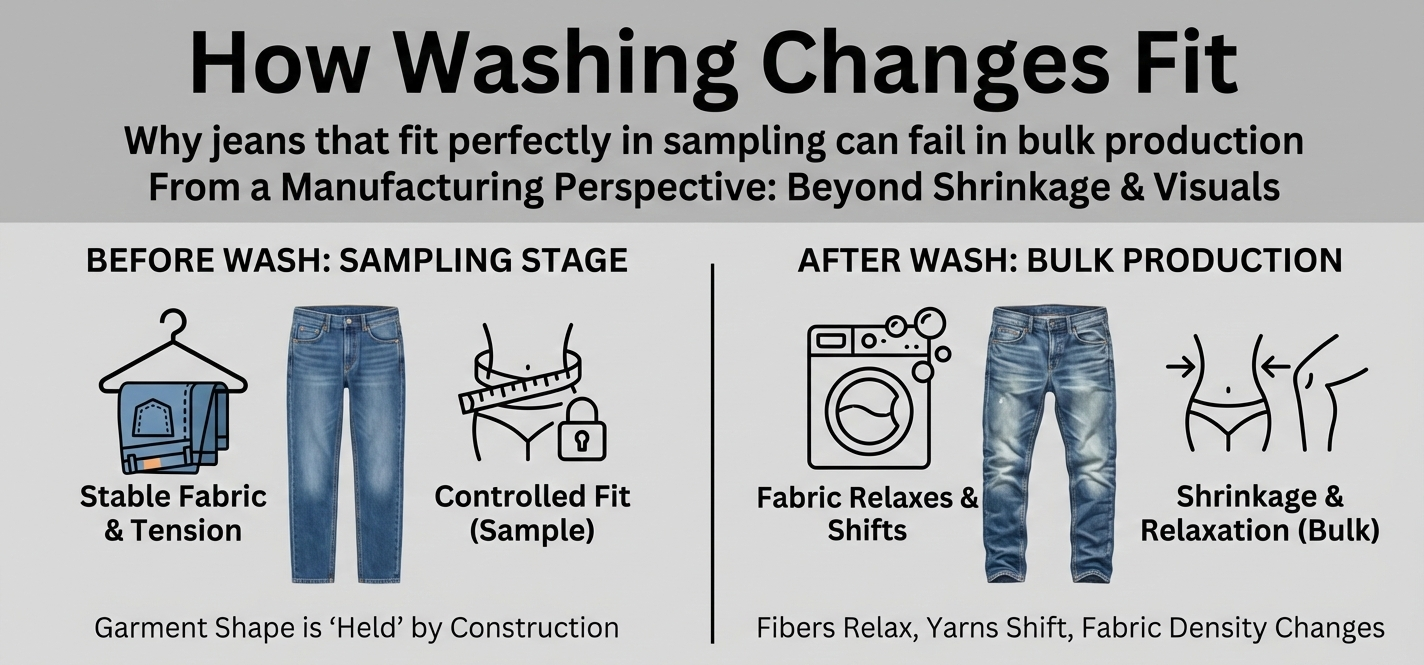
Why jeans that fit perfectly in sampling can fail in bulk production
Many denim brands believe fit is decided at the pattern stage.
In reality, fit is only finalized after washing.
A pair of jeans that fits well before washing may behave very differently once it goes through real wash programs.
This gap between expectation and reality is one of the most common reasons for bulk complaints, returns, and reworks.
Understanding how washing changes fit is not optional for brands — it is part of fit development itself.
Why fit before washing is never the final fit
In denim manufacturing, the garment you try on during sampling is often not the garment your customer will wear.
Before washing:
- Fabric tension is high
- Yarns are stable
- Garment shape is “held” by construction
After washing:
- Fibers relax
- Yarns shift
- Fabric density changes
This is why factories never judge fit only on pre-wash samples.
Shrinkage: the most visible but not the only change
Shrinkage is the first thing brands think about, but it is only part of the picture.
After washing, denim may:
- Shorten in length
- Tighten in width
- Lose or gain shape in specific areas
Shrinkage is not always uniform.
Leg opening, thigh, knee, and waist often behave differently.
If shrinkage is not built into the pattern, the final fit will drift.
Fabric relaxation and shape movement
Even sanforized denim relaxes during washing.
This relaxation can cause:
- Waist to loosen
- Hip to drop
- Leg shape to open or twist slightly
These changes are subtle but noticeable when multiplied across sizes.
From a factory view, relaxation is one of the main reasons sampling fit and bulk fit do not match.
How washing affects rigid (non-stretch) denim fit
Non-stretch denim relies fully on structure.
During washing:
- Cotton fibers swell
- Fabric tightens initially
- Shape sets after drying
If handled correctly, rigid denim becomes more predictable after washing.
However, heavy or aggressive washes can:
- Over-soften fabric
- Reduce structure
- Change silhouette balance
This is why vintage washes often require pattern adjustments.
How washing affects stretch denim fit
Stretch denim reacts very differently.
In washing:
- Elastane is sensitive to heat
- Recovery can be damaged
- Fabric may stretch permanently
Common results include:
- Waist that grows after wear
- Baggy knees
- Sagging seat
These issues are often blamed on pattern, but the real cause is wash damage to recovery.
Factories pay close attention to wash temperature and time when handling stretch denim.
Wash intensity and fit stability
Wash programs vary widely in intensity.
Light wash:
- Minor size change
- High fit retention
- Good for clean looks
Medium wash:
- Controlled shrinkage
- Moderate relaxation
- Balanced risk
Heavy or vintage wash:
- Major fabric change
- Higher fit variation
- Requires pattern compensation
The stronger the wash, the less the original pattern controls the result.
Mechanical action and garment distortion
Washing is not just chemical and water — it is also physical movement.
Inside the machine:
- Garments twist
- Seams take stress
- Panels shift
Areas most affected:
- Inner thigh seams
- Knee area
- Waistband
If construction or stitching is weak, washing will expose it.
How drying changes fit further
Fit does not stop changing when washing ends.
Drying stage can:
- Lock shrinkage
- Increase fabric stiffness
- Set garment shape
Over-drying can:
- Increase shrinkage
- Damage stretch recovery
- Cause uneven sizing
Factories often control drying more tightly than washing itself.
Why sampling wash and bulk wash must match
One of the biggest mistakes brands make is approving fit on a sample washed differently from bulk.
Small differences matter:
- Temperature
- Machine size
- Wash duration
- Load weight
If bulk wash conditions change, fit will change too.
This is why factories insist on wash-approved samples, not just fit-approved samples.
Grading consistency and wash impact
Wash effects multiply across sizes.
A 1 cm change in one size can turn into:
- 2–3 cm deviation across grading
- Visible imbalance between sizes
This is especially risky for:
- Plus size ranges
- Tight fits
- Stretch denim
Wash behavior must be considered during grading, not after.
Why washing causes most post-launch complaints
From factory feedback, many customer complaints trace back to washing effects:
- “Fits well at first, then changes”
- “Different sizes fit differently”
- “Same style feels inconsistent”
These are rarely sewing issues.
They are wash + fabric + fit interaction problems.
How experienced factories manage wash-related fit risk
Factories reduce risk by:
- Testing fabric shrinkage before pattern finalization
- Adjusting patterns for specific wash programs
- Running pilot wash tests before bulk
- Monitoring measurement after washing, not before
Fit control always happens after washing, never only before.
How brands should think about washing and fit together
Fit, fabric, and washing should be decided as one system.
Key questions brands should ask:
- Will this wash damage fabric recovery?
- Can this pattern tolerate relaxation?
- How much variation can our customer accept?
- Is consistency or visual effect more important?
Ignoring these questions leads to correction after production — the most expensive stage.
How this page fits into your washing strategy
This topic connects directly with:
- Denim washing methods explained
- Stretch denim washing risks
- Vintage wash vs clean wash
Together, they form a complete view of how washing affects the final product — not just how it looks.
Final factory perspective
Washing does not decorate fit.
It defines it.
Brands that treat washing as part of fit development gain:
- Better consistency
- Lower returns
- Fewer production surprises
Those who treat washing as an afterthought usually learn the lesson later — at a higher cost.


