

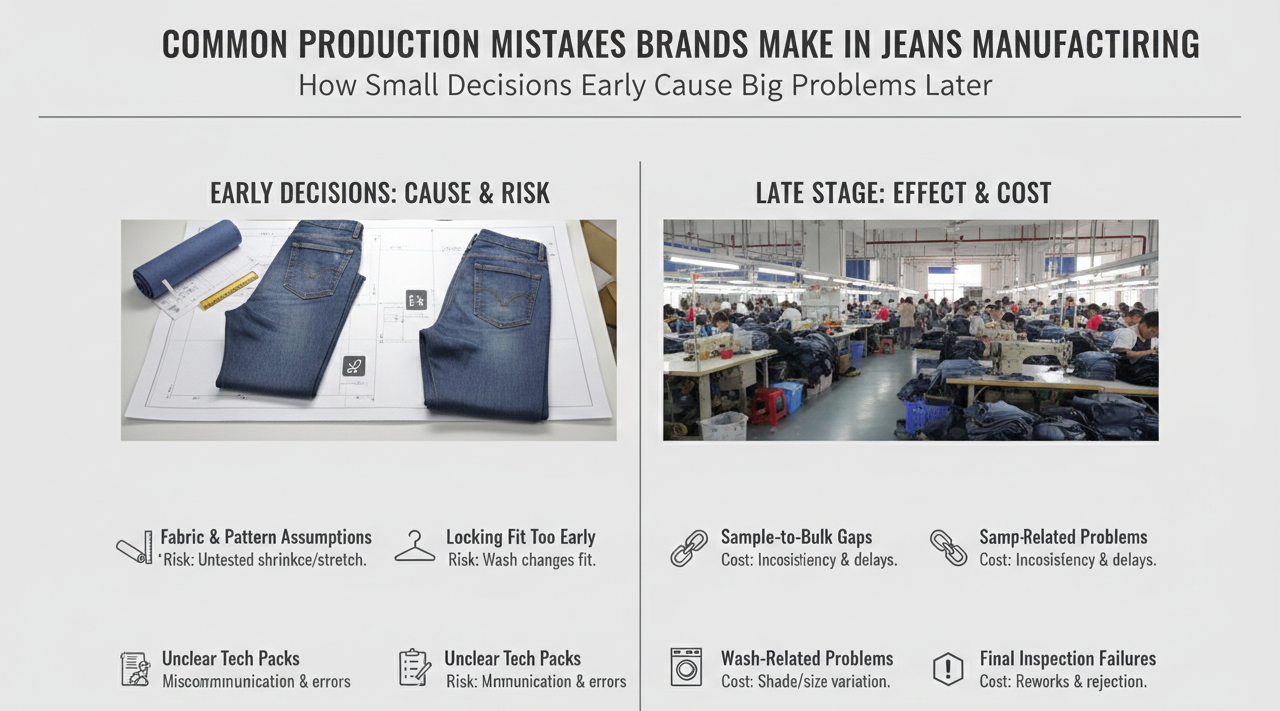
Common Production Mistakes Brands Make in Jeans Manufacturing
In jeans manufacturing, most production problems do not come from one single mistake.
They usually come from small decisions made early, combined with unclear communication later.
From a factory point of view, many brands—especially new or fast-growing ones—run into the same issues again and again. These are not “beginner mistakes.” Some are made by experienced teams who are under time pressure or working with several suppliers at once.
Below are the most common production mistakes we see in denim manufacturing, why they happen, and how brands can reduce the risk before bulk production starts.
Why do production problems still happen even after samples are approved?
Sample approval is often treated as the finish line. In reality, it is only a checkpoint.
A sample shows that a product can be made. It does not guarantee that it will be made the same way at scale. Bulk production involves different cutting layouts, longer sewing lines, washing batches, and tighter timelines.
When brands assume “approved sample = safe bulk,” problems often appear later, when changes are expensive and slow to fix.
Mistake 1: Treating samples and bulk production as the same process
This is one of the most common misunderstandings.
Samples are usually made with:
- One experienced operator
- Controlled fabric selection
- Small washing batches
- More manual attention
Bulk production is different:
- Multiple operators
- Fabric from different rolls
- Larger washing loads
- Production speed pressure
When a brand does not ask how a sample will be reproduced in bulk, small differences add up. Fit tolerance changes, wash effects shift, and consistency becomes hard to control.
How to reduce the risk:
During sampling, ask which steps will change in bulk and which will stay the same. A factory that can explain this clearly usually has better production control.
Mistake 2: Locking the fit too early
Many brands rush to lock fit because timelines are tight. But locking a fit before testing it with the actual fabric and wash plan creates problems later.
Denim reacts strongly to:
- Fabric weight
- Stretch content
- Washing method
- Drying temperature
A fit that looks correct in raw or lightly washed fabric may shift after final washing. If fit is locked too early, the only way to correct issues later is by adjusting washing or accepting compromises.
How to reduce the risk:
Fit approval should be aligned with final fabric and washing direction, not just pattern measurements.
Mistake 3: Using unclear or incomplete tech packs
A tech pack is not just a drawing. It is a production instruction.
Common issues we see:
- Missing tolerance standards
- No wash reference images
- Unclear stitching specs
- Inconsistent measurement charts
When information is missing, factories fill gaps with assumptions. Different teams may interpret the same design differently, especially when production moves fast.
How to reduce the risk:
Focus less on making tech packs “pretty” and more on making them complete. Clear notes often matter more than detailed sketches.
Mistake 4: Ignoring fabric batch differences
Denim fabric is not perfectly uniform across all rolls.
Even with the same fabric code, there can be differences in:
- Shrinkage
- Stretch recovery
- Color depth
- Surface texture
If brands do not allow fabric testing or fail to approve fabric before cutting, issues may appear only after washing or finishing.
How to reduce the risk:
Confirm fabric testing results before bulk cutting, especially for stretch or lightweight denim.
Mistake 5: Assuming washing will “fix” fit problems
Washing can improve appearance, but it cannot fix structural fit issues.
Some brands try to adjust:
- Rise
- Leg opening
- Hip balance
through washing changes alone.
This often leads to unstable results. Washing affects fabric behavior, not pattern logic.
How to reduce the risk:
Use pattern correction to solve fit problems first. Use washing to refine look, not structure.
Mistake 6: Not controlling stretch denim recovery
Stretch denim is sensitive to heat, tension, and time.
Without proper control, stretch jeans may:
- Feel tighter after wash
- Lose recovery after wear
- Change size between batches
Brands sometimes focus only on stretch percentage and ignore recovery behavior.
How to reduce the risk:
Ask how stretch recovery is tested and controlled during washing and drying, not just fabric selection.
Mistake 7: Skipping in-line inspection during production
Final inspection happens too late to prevent many problems.
If issues like:
- Stitch tension
- Measurement drift
- Panel mismatch
are only found at the end, fixing them becomes costly.
In-line inspection helps catch problems while production is still flexible.
How to reduce the risk:
Confirm whether in-line checks are done and what points are inspected during sewing and washing.
Mistake 8: Changing details too late in the process
Late-stage changes are common and understandable. But even small changes can affect the whole production flow.
Examples include:
- Changing pocket placement
- Adjusting hem width
- Modifying wash tone
When these changes happen after cutting or washing has started, results may become inconsistent.
How to reduce the risk:
Before approving bulk, confirm that all visual and construction details are final.
Mistake 9: Relying only on final inspection reports
Inspection reports show what happened, not why it happened.
When brands rely only on pass/fail reports, they miss the chance to improve the process itself. Long-term quality improvement comes from understanding root causes, not just checking results.
How to reduce the risk:
Ask for feedback during production, not only at the end.
Mistake 10: Choosing a factory based only on sample quality
Good samples do not always mean stable bulk production.
Some factories are excellent at making samples but less experienced in managing consistency across large orders. Others may have strong production systems but slower sample development.
How to reduce the risk:
Evaluate how a factory manages production flow, quality control, and communication—not just sample appearance.
Why most production mistakes are communication issues, not skill issues
In many cases, factories know how to make jeans. Problems arise when expectations are not aligned.
Clear communication about:
- Risk points
- Tolerance limits
- Non-negotiable details
often prevents more issues than adding extra inspections later.
What brands should focus on before bulk production starts
Instead of trying to control everything, brands should focus on:
- Fit logic
- Fabric behavior
- Wash impact
- Process clarity
These areas create the foundation for stable production.
Final thoughts from a factory perspective
Most production mistakes are not caused by carelessness. They are caused by assumptions.
When brands and factories take time to align early—before cutting and washing—the entire process becomes smoother, more predictable, and easier to scale.
Good denim production is not about avoiding mistakes completely.
It is about knowing where mistakes are most likely to happen and managing them before they grow.


