

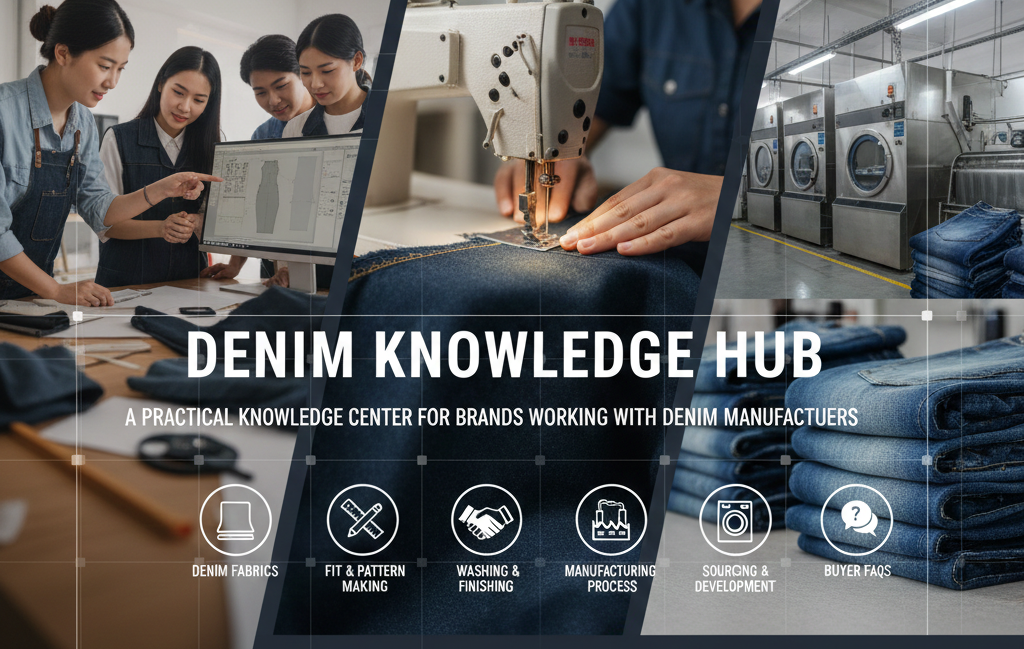
Denim Knowledge Hub
This is a reference library for brands and buyers working with denim manufacturers. The guides here cover fabric selection, fit development, wash methods, production processes, and sourcing decisions — written from a factory perspective, based on what we see affect product quality and production outcomes in real orders.
Use the sections below to find what is relevant to where you are in your project.
Denim Fabrics
Understanding fabric before you specify it saves significant time during development. Fabric weight, stretch level, and construction type all affect how a garment fits, how it washes, and how it holds up over time. These guides cover the decisions that matter most at the sourcing stage.
Stretch vs Non-Stretch Denim When stretch makes sense, when it creates problems, and how elastane percentage affects fit, recovery, and wash behavior.
Denim Weights Explained What fabric weight means in practice — how 10oz, 12oz, and 14oz denim behave differently in production, washing, and wear.
Raw Denim vs Washed Denim The difference between raw and pre-washed denim from a manufacturing and product development perspective.
Selvedge vs Non-Selvedge Denim What selvedge construction means, why it matters for certain product positions, and where it has real limitations in production.
Fit & Pattern Making
Fit problems in bulk production almost always start at the pattern stage — not at the sewing stage. These guides explain how denim fit works technically, what changes with different fabric types, and what common fit issues look like before they show up in your returns.
Common Fit Issues in Jeans The most frequent fit problems we see in production: crotch sag, waistband gap, leg twist, and thigh pull — what causes them and how they are fixed at the pattern level.
How Stretch Denim Affects Fit Why stretch denim requires different pattern logic than rigid denim, and what happens when brands use the same spec for both.
Plus Size Denim Pattern Logic How pattern grading for plus sizes differs from standard grading, and why proportional adjustments matter more than linear scaling.
Men’s vs Women’s Fit Differences The structural differences between men’s and women’s denim patterns and why they cannot be adapted from each other without significant rework.
→ See all Fit & Pattern Making guides
Washing & Finishing
Washing is where denim gets its final look and hand feel — and where the most production variation occurs. These guides explain how different wash treatments work, what risks each one carries, and how washing affects fit and fabric stability.
Denim Washing Methods Explained A practical overview of the main wash treatments used in denim production: rinse, enzyme, stone, vintage, ozone, and distressed effects — what each achieves and what each requires.
Stretch Denim Washing Risks How aggressive washing damages elastane, what treatments are safe for stretch denim, and how to specify wash intensity without shortening the garment’s lifespan.
Vintage Wash vs Clean Wash The production and cost differences between clean minimal washes and layered vintage effects, and how to specify the right level of contrast and distressing.
How Washing Changes Fit Why a garment that fits correctly before washing can come out wrong after — and how shrinkage, relaxation, and fabric behavior are managed during pattern development.
→ See all Washing & Finishing guides
Manufacturing Process
These guides explain what happens between placing an order and receiving finished goods — the development stages, production checkpoints, and the decisions that most affect whether the final product matches what was approved in sampling.
Custom Jeans Manufacturing Process A step-by-step walkthrough of how a custom denim order moves from tech pack to finished garment, with the key decisions and checkpoints at each stage.
Sampling to Bulk Production What proto samples, fit samples, and pre-production samples each do, why they are not interchangeable, and what to look for at each stage before approving bulk production.
Quality Control in Denim Production How QC works in a denim factory — what is checked, when it is checked, and what the difference is between in-line inspection and final inspection.
Common Production Mistakes Brands Make The decisions that consistently create problems in production: approving samples without testing wash, skipping the pre-production sample, under-specifying branding details, and others.
→ See all Manufacturing Process guides
Sourcing & Development
Guides for buyers who are evaluating manufacturers, planning their first denim program, or trying to understand how factory relationships work in practice.
How to Choose a Denim Manufacturer What to look for when evaluating a denim factory — beyond price and MOQ — and what questions reveal whether a factory understands denim specifically or is a general apparel supplier.
MOQ & Development Planning How minimum order quantities are set, what drives them up or down, and how to plan a first denim program around realistic MOQ and development timelines.
Working with a Custom Denim Factory How the working relationship between a brand and a denim factory typically operates — communication, approval processes, what to send, and how to avoid the most common friction points.
→ See all Sourcing & Development guides
Blog
Current articles on denim trends, manufacturing insights, and production guides for brands building or expanding their denim programs.
Recent topics:
- How fabric weight changes wide leg jeans pattern engineering
- Is the baggy trend over — mapping the transition to structured loose
- Why do wide leg jeans twist — pattern engineering mistakes
- How to produce 2026 summer distressed denim cost-effectively
- Plus size jeans manufacturing: fit engineering and return reduction
Buyer FAQs
Answers to the questions we receive most often from brands, importers, and first-time denim buyers — covering MOQ, pricing, timelines, sampling, customization, and quality standards.
Looking for something specific?
If you have a question that is not covered in the guides above, you can contact our team directly. We respond to technical questions on fabric, fit, wash, and production — not just sales inquiries.


