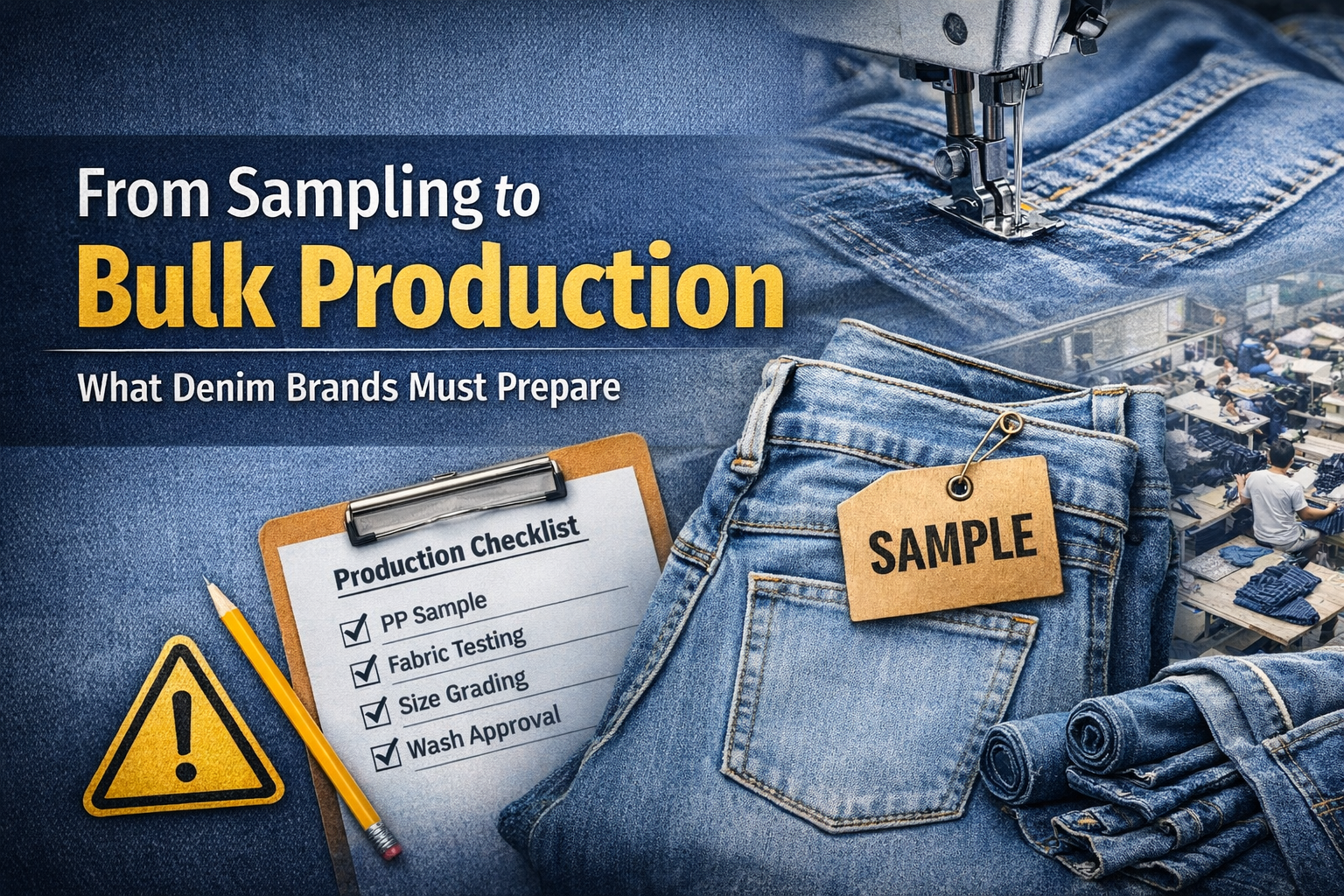
For many new denim brands, sampling feels exciting.
You see your design come to life, the fit looks good, and the wash feels right.
Bulk production feels very different.
This is usually where problems start — not because the factory changes, but because bulk production follows a different set of rules. Fabric behaves differently, fit tolerance becomes real, and small decisions made during sampling suddenly affect hundreds or thousands of pieces.
Before moving from sample approval to bulk production, brands need more than a “good sample.” They need preparation.
This article walks through what experienced denim factories expect brands to prepare before bulk production, and why skipping these steps often leads to delays, cost increases, or fit issues after delivery.
What changes when denim moves from sampling to bulk production?
Sampling is controlled and limited.
Bulk production is repetitive and scaled.
During sampling:
- Fabric often comes from limited yardage
- Sewing is handled by senior operators
- Washing is closely monitored
- Fit tolerance is flexible
During bulk:
- Fabric comes in full dye lots
- Multiple operators are involved
- Washing is done in large batches
- Tolerances must be fixed and repeatable
This shift means that decisions made casually during sampling become locked in during bulk. Factories do not “adjust freely” once production starts.
Is approving a sample enough to start bulk production?
In reality, no.
A sample shows what is possible, not what is stable.
Factories often see brands approve samples based on:
- Look and feel
- Comfort during first wear
- Visual fit on one model
But bulk production requires clarity on:
- Measurement tolerance
- Fabric variation allowance
- Wash shrinkage range
- Size grading consistency
Without these clarified, the approved sample becomes a reference — not a guarantee.
How should brands confirm fabric readiness before bulk?
Fabric issues are one of the most common causes of bulk problems.
Before bulk production, brands should confirm:
- Fabric composition and stretch %
- Fabric weight after wash
- Shrinkage and recovery results
- Dye lot consistency
Factories usually test fabric again before cutting bulk, even if the same fabric was used in sampling. This is because elastane tension, weaving density, and dye processes can vary between lots.
A common mistake: assuming “same fabric name” means same performance.
It does not.
Why does grading matter more than the sample size?
Most samples are made in one size.
Bulk production involves many.
Grading determines how measurements change across sizes. A pattern that looks good in one size can fail badly when scaled.
Factories often see issues such as:
- Waist increases too fast
- Rise not adjusted properly
- Thigh and knee ratios ignored
- Plus sizes simply enlarged, not re-engineered
Before bulk, brands should review:
- Grading rules
- Measurement jumps
- Fit intent by size group
This step is especially critical for women’s and plus-size denim.
How much tolerance should brands allow in bulk production?
No garment factory produces every piece at zero deviation.
What matters is controlled tolerance.
Before bulk production, brands should define:
- Acceptable measurement tolerance (e.g. ±1 cm)
- Wash shrinkage allowance
- Stretch recovery range
Factories need this clarity to manage quality control fairly. Without agreed tolerances, disputes often happen after delivery — even when production is technically correct.
Why does washing need to be locked before bulk?
Wash is not just appearance.
It affects size, stretch, and durability.
Changes between sample wash and bulk wash often cause:
- Unexpected shrinkage
- Loss of stretch recovery
- Shade inconsistency
- Texture changes
Before bulk, brands should finalize:
- Wash recipe
- Enzyme strength
- Temperature limits
- Drying method
Factories cannot “slightly adjust” wash in bulk without affecting the whole order.
Should brands prepare a pre-production (PP) sample?
Yes — especially for new factories.
A PP sample uses:
- Bulk fabric
- Bulk trims
- Bulk wash method
- Bulk measurements
This sample acts as a final checkpoint before full production. It often reveals issues that were invisible in earlier samples.
Skipping PP samples may save time, but it increases risk.
How do MOQ and production planning affect bulk success?
MOQ is not just about quantity.
It affects:
- Fabric sourcing options
- Dye lot control
- Cost stability
- Production scheduling
When brands push MOQ too low, factories may face:
- Limited fabric choices
- Mixed dye lots
- Higher defect risk
- Longer lead times
Clear MOQ planning helps factories allocate the right resources from the start.
What should brands prepare internally before bulk starts?
Factories often notice that delays come not from production, but from decision-making.
Before bulk, brands should prepare:
- Final tech pack
- Measurement chart
- Label and trim approvals
- Packing requirements
- Shipping method confirmation
When these are not ready, production pauses — even if the factory is ready to work.
How can brands reduce risk when working with a new denim factory?
Trust is built through structure, not promises.
Smart brands:
- Ask how fabric is tested
- Review QC checkpoints
- Confirm wash control steps
- Understand sampling vs bulk differences
Factories that explain risks clearly are often more reliable than those who promise “no problem.”
What problems usually appear after bulk if preparation is weak?
From factory experience, common post-bulk complaints include:
- Size inconsistency
- Unexpected shrinkage
- Stretch losing shape
- Wash shade differences
In most cases, these issues trace back to:
- Unclear tolerances
- Fabric assumptions
- Rushed approvals
- Missing PP confirmation
How should brands decide they are ready for bulk production?
A simple rule used in factories:
If a decision feels “flexible,” it is not ready for bulk.
Brands are usually ready when:
- Fabric behavior is tested and confirmed
- Fit works across sizes
- Wash is repeatable
- Expectations are written, not assumed
Bulk production rewards preparation, not speed.
Final thoughts from the factory floor
Sampling shows potential.
Bulk production tests systems.
Brands that prepare properly before bulk tend to:
- Receive more consistent goods
- Experience fewer delays
- Build longer factory relationships
- Reduce return and complaint rates
For denim, success is rarely about one good sample — it’s about whether the process behind it can repeat at scale.