

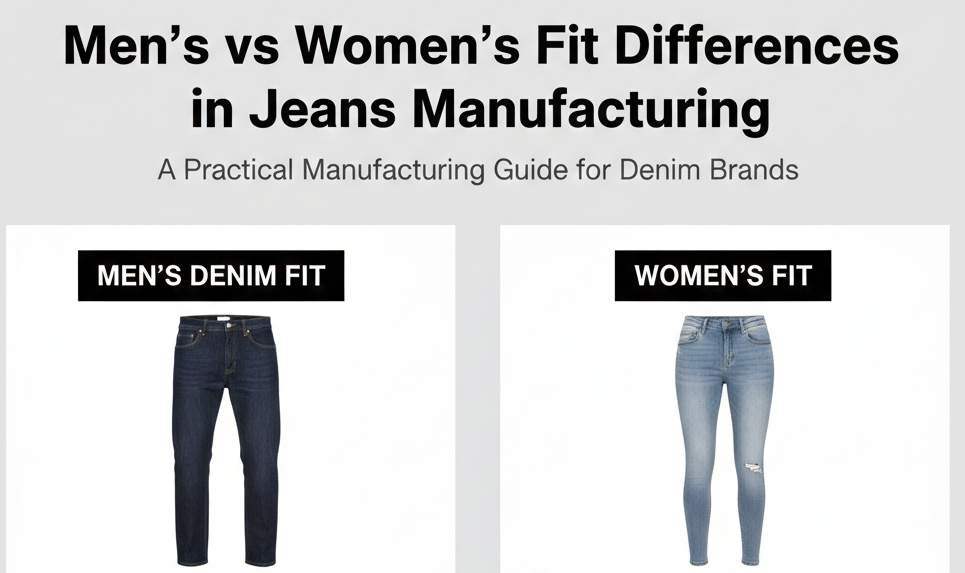
How Patterns, Proportions, and Manufacturing Logic Really Differ
When brands develop jeans for men and women, the difference is often described in simple terms:
men’s jeans are straighter, women’s jeans are more shaped.
In real manufacturing, that description is far from enough.
From a factory point of view, men’s and women’s jeans are built on different body assumptions, different pattern balance, and different risk points in bulk production. Treating them as variations of the same base pattern is one of the most common reasons fit problems appear after sampling.
This Guide breaks down how men’s and women’s jeans fit actually differs — not in styling language, but in pattern logic and production behavior.
Why can’t men’s and women’s jeans share the same pattern logic?
Because the bodies they are built for do not behave the same way.
In production, a pattern is not just a shape. It is a set of assumptions about how a body carries weight, moves, and changes when sitting, walking, or bending.
Men’s and women’s bodies differ in:
- Hip-to-waist ratio
- Pelvic angle
- Thigh volume distribution
- Center of gravity
- Movement stress points
If these differences are ignored at the pattern stage, no amount of washing or fabric choice will fully fix the fit.
How do waist and hip proportions change the entire pattern balance?
This is one of the biggest structural differences.
Men’s jeans: lower waist-to-hip contrast
Most men’s bodies have a relatively small difference between waist and hip circumference. As a result:
- Waist shaping is minimal
- Side seams are straighter
- Back rise curvature is moderate
- Seat allowance is more evenly distributed
Men’s patterns rely more on overall balance than aggressive shaping.
Women’s jeans: higher waist-to-hip contrast
Women’s bodies typically show a much larger difference between waist and hip measurements. This directly affects pattern logic:
- Waist must be shaped without collapsing the hip
- Back rise requires more curvature
- Side seams must absorb shape change
- Hip depth must allow movement without pulling the waist down
In manufacturing, this means women’s patterns are less forgiving. Small grading errors show up faster, especially in higher waist styles.
Why is the back rise so critical in women’s jeans?
From a factory perspective, the back rise is where most women’s fit problems originate.
Common complaints like:
- Gaping at the back waist
- Pulling across the seat
- Tightness when sitting
are usually back-rise balance issues, not fabric problems.
Women’s patterns require:
- More controlled back rise length
- Correct angle at the waist seam
- Balanced distribution between front and back panels
Over-correcting the back rise often leads to excess fabric at the waist. Under-correcting leads to discomfort and return issues.
Men’s jeans rarely require this level of adjustment.
How do thigh and leg shapes influence pattern structure?
Men’s jeans: forward and even volume
Men’s thigh volume is typically distributed more evenly and positioned slightly forward.
Pattern implications include:
- Straighter inseams
- Less aggressive shaping through the thigh
- More tolerance for rigid fabrics
This is why men’s jeans often work well in non-stretch or low-stretch denim.
Women’s jeans: curved and side-distributed volume
Women’s thigh volume often sits more toward the side and back of the leg.
Pattern implications:
- More curved inseams
- Careful outseam shaping
- Higher risk of drag lines if not balanced
In production, this makes women’s slim and straight fits more sensitive to fabric behavior.
How does fabric stretch affect men’s and women’s fit differently?
Stretch is often used as a shortcut to solve fit problems, but its effect is not the same for men and women.
In men’s jeans
- Stretch improves comfort
- Fit changes are moderate
- Recovery issues are less noticeable
Many men’s fits remain stable with low stretch (1–2%).
In women’s jeans
- Stretch directly impacts shaping
- Poor recovery causes waist gaping
- Fabric behavior affects size consistency
For women’s jeans, recovery matters more than stretch percentage. A fabric that stretches easily but does not recover will exaggerate pattern weaknesses.
This is especially true in high-waist and slim fits.
Why grading rules differ between men’s and women’s jeans?
Grading is not just scaling measurements.
Men’s grading logic
- More linear size progression
- Smaller changes between sizes
- Easier size consistency in bulk
This allows men’s jeans to scale with fewer revisions.
Women’s grading logic
- Non-linear size changes
- Hip and waist grow at different rates
- Rise length must adjust by size
Many fit issues in women’s jeans come from using simplified grading rules designed for men’s patterns.
What are the most common fit issues by category?
Common men’s fit issues
- Tightness at the front rise when sitting
- Excess fabric at the back thigh
- Waist slipping without belt
These are usually balance or rise issues, not fabric faults.
Common women’s fit issues
- Back waist gaping
- Thigh tightness with loose waist
- Pull lines across the seat
Most of these start at the pattern stage and are amplified in bulk production.
Why do men’s jeans perform more consistently in bulk production?
From a factory standpoint, men’s jeans are more predictable.
Reasons include:
- Simpler pattern balance
- Lower shaping pressure
- Less reliance on stretch recovery
This is why men’s programs often see fewer fit-related returns.
Why do women’s jeans require more sampling and testing?
Women’s jeans combine multiple high-risk factors:
- Complex shaping
- Stretch dependency
- Tighter tolerance for comfort
Factories often recommend:
- Extra fit revisions
- Wear testing after washing
- Fabric recovery testing before bulk
Skipping these steps often leads to size inconsistency after production.
How should brands approach fit development differently for men and women?
A practical factory-level approach looks like this:
For men’s jeans
- Focus on balance and rise
- Use fabric to fine-tune comfort
- Keep grading simple and consistent
For women’s jeans
- Prioritize pattern accuracy first
- Validate fit after washing
- Treat stretch as a support, not a solution
Developing men’s and women’s jeans as separate systems — not variations of one pattern — reduces risk in production.
Where does plus size fit amplify these differences?
Plus size development magnifies existing differences.
- Men’s plus size often scales more smoothly
- Women’s plus size requires structural pattern changes
This is why plus size women’s jeans cannot be built by simply extending core sizes.
(See: Plus Size Denim Pattern Logic for deeper coverage.)
What factories look for before approving bulk production
Before approving bulk, factories usually verify:
- Fit stability after wash
- Waist recovery behavior
- Grading consistency across sizes
For women’s jeans, this step is critical. For men’s jeans, it is still important, but usually faster.
Final manufacturing perspective
Men’s and women’s jeans are not different because of fashion trends.
They are different because bodies behave differently, and patterns must respond to that behavior.
In manufacturing, fit problems rarely come from sewing. They come from patterns that do not match real body movement.
Brands that understand this early spend less time fixing issues later — and see fewer surprises after bulk delivery.


