

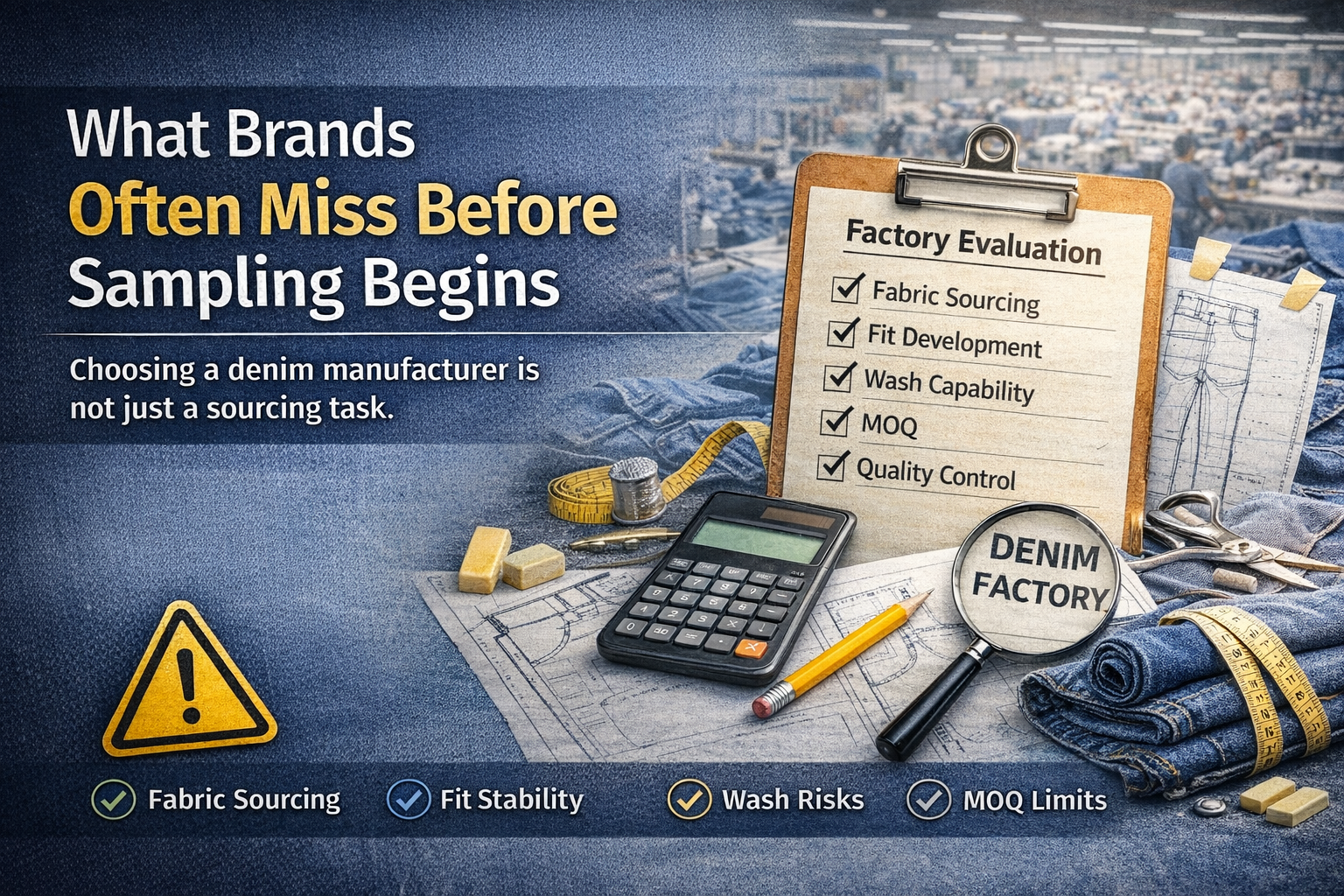
What Brands Often Miss Before Sampling Begins
Choosing a denim manufacturer is not just a sourcing task.
It is a development decision that affects fit stability, cost control, delivery risk, and how much room your brand has to grow.
Many brands focus on price, photos, or factory size at the beginning. Those factors matter, but they are rarely the reason a denim project succeeds or fails. In real production, problems usually come from misalignment — between design intent and factory capability, between sampling logic and bulk reality, or between what was promised and what can be repeated at scale.
This page walks through how denim manufacturers actually differ, what brands should evaluate before committing to sampling, and how to reduce risk when working with a factory for the first time.
What does a “denim manufacturer” actually mean?
Not all factories that make jeans operate in the same way.
In practice, “denim manufacturer” can mean very different things:
- A CMT factory that only cuts and sews, using fabrics and washes you supply
- A full-package factory that handles fabric sourcing, washing, and trims
- A wash-focused factory strong in finishing but weaker in pattern control
- A volume-driven factory optimized for large orders, not development
- A development-oriented factory used to small runs and repeated revisions
Many issues start when brands assume all denim factories can do everything equally well.
Before evaluating a factory, it helps to be clear about what you actually need at this stage:
development support, production capacity, wash capability, or cost efficiency.
Why do many brands choose the wrong denim factory at the start?
From a factory point of view, early mistakes usually fall into a few patterns.
Some brands choose based on:
- The lowest quote
- The fastest sample promise
- The most polished website
- Photos of premium-looking products
Those signals are easy to compare, but they do not show how the factory handles real production variables.
Problems tend to appear later, such as:
- Samples that look good but cannot be repeated in bulk
- Fit changes after washing that were not discussed upfront
- Fabric substitutions made quietly to meet cost targets
- Long delays once development becomes complex
By the time these issues surface, brands have often already invested time and money.
What should you evaluate before starting sampling?
Sampling is not a test of sewing skill alone. It is a test of communication, process control, and decision logic.
Before sending a tech pack, it helps to understand how the factory works in the following areas.
How does the factory handle denim fabric sourcing?
Fabric is the foundation of denim production.
Key questions to clarify:
- Does the factory source denim directly from mills, or through traders?
- Can they explain differences between fabric batches, not just weight and stretch?
- Do they test shrinkage, skew, and recovery before sampling?
- Are fabric substitutions discussed or decided internally?
Factories that rely heavily on spot-market fabrics may offer lower prices, but consistency can be harder to control in bulk.
A good sign is when a factory asks detailed questions about:
wash intensity, target hand feel, fit tolerance, and expected wear behavior.
How strong is the factory’s pattern and fit development capability?
Fit problems are rarely caused by sewing errors. They usually come from pattern logic and grading decisions.
You may want to understand:
- Does the factory have in-house pattern makers?
- Do they adjust patterns based on fabric type and wash method?
- Can they explain how fit will change after washing?
- How do they handle size grading for different markets?
Factories that only follow provided patterns may not flag issues early.
Factories that participate in fit discussions tend to prevent problems before bulk production.
How does the factory approach washing and finishing?
Washing is where many denim projects change the most.
Important points to clarify:
- Is washing done in-house or outsourced?
- Does the factory control enzyme, temperature, and time consistently?
- Can they explain how different washes affect fit and durability?
- Do they test wash results before approving samples?
A factory experienced in washing will usually talk more about risk than about effects.
That is often a good sign.
How are samples developed — and how many rounds are realistic?
Sampling timelines are often underestimated.
Instead of asking “How fast can you sample?”, it is more useful to ask:
- How many revisions are typical for this type of product?
- What changes are considered normal between rounds?
- How are sample changes documented?
- What happens if fabric or wash needs to change mid-development?
Factories used to development work will describe a process.
Factories focused only on speed may promise quick samples, but struggle with revisions.
How transparent is communication during development?
Communication style matters more than language fluency.
Signs of healthy communication:
- The factory explains why something may not work
- Risks are shared early, not after problems appear
- Cost changes are linked to specific decisions
- Limitations are stated clearly
If every request is answered with “no problem” at the beginning, that can be a warning sign.
How does MOQ really work in denim production?
MOQ is not a single number.
In denim, MOQs are influenced by:
- Fabric mill requirements
- Dye lot control
- Washing batch size
- Trim customization
A factory that explains MOQ in detail usually has more control over the supply chain.
If MOQ is presented as a fixed, simple rule, it may be hiding flexibility — or hiding risk.
What role does quality control play before bulk production?
Quality control should not start after production.
It should be built into:
- Fabric inspection before cutting
- Measurement checks after washing
- Fit approval standards
- Bulk pre-production samples
Ask how the factory prevents issues, not just how they fix them.
How does the factory scale from sampling to bulk?
Many brands experience a gap between sample quality and bulk reality.
Useful questions include:
- Will bulk use the same fabric source as samples?
- Are wash parameters locked after approval?
- How is size consistency monitored during production?
- What tolerances are considered acceptable?
Factories with stable bulk systems usually talk about controls, not just capacity.
What are common warning signs when choosing a denim manufacturer?
From experience, some signals deserve attention:
- Vague answers about fabric sourcing
- Reluctance to discuss wash risks
- No clear sampling workflow
- Large price swings without explanation
- Overconfidence without data
None of these alone mean a factory is unsuitable, but together they increase risk.
How should new or growing brands approach factory selection?
For early-stage brands, the goal is not perfection. It is learning without excessive loss.
Helpful approaches include:
- Starting with simpler washes and fabrics
- Developing one core fit before expanding styles
- Accepting slightly higher costs for better control
- Choosing factories experienced with small to mid-size runs
Factories that understand development phases tend to be better long-term partners.
Is the “best” denim manufacturer the same for every brand?
No.
A factory that is ideal for:
- Heritage raw denim
- High-volume basics
- Fashion-driven washed styles
- Plus-size or stretch-focused products
may not be ideal for another category.
The right manufacturer is the one whose strengths match your product and growth stage.
How do experienced brands reduce sourcing risk over time?
Brands that scale successfully usually:
- Build long-term relationships with fewer factories
- Document development decisions carefully
- Lock core fabrics and fits early
- Review bulk results after every season
Factory selection is not a one-time decision. It evolves as the brand grows.
Final thoughts from a manufacturing perspective
Choosing a denim manufacturer is less about finding the “best” factory, and more about finding the right fit between product, process, and expectations.
When brands and factories understand each other’s limits, production becomes more stable, costs become more predictable, and development becomes faster over time.
Good denim products are rarely the result of one good sample.
They come from systems that can repeat decisions consistently.


