Quality control in bulk jeans production is not a single inspection step.
It is a system that starts long before sewing begins and continues until garments are packed for shipment.
Many brands assume quality issues appear at the end of production.
From a factory perspective, most quality problems originate earlier — during fabric selection, sampling decisions, and wash planning.
This article explains how quality control actually works in bulk jeans production, how factories manage risk at each stage, and what brands should realistically expect.
What does “quality control” mean in bulk jeans production?
In denim manufacturing, quality control is not only about checking finished garments.
It includes:
- Preventing defects before they happen
- Monitoring consistency during production
- Verifying that bulk results match approved samples
Factories treat QC as a process discipline, not a final inspection task.
Good QC systems focus more on risk prevention than defect detection.
Why is quality control more critical in bulk production than sampling?
Sampling proves whether a style can be made correctly.
Bulk production tests whether it can be made consistently.
Key differences between sampling and bulk include:
- Larger fabric batches
- Multiple sewing operators
- Longer wash runs
- Higher cumulative tolerance risk
A sample may pass perfectly, while bulk production exposes small variations that add up over hundreds or thousands of pieces.
This is why QC standards must be stricter in bulk than in sampling.
How is fabric inspected before bulk cutting starts?
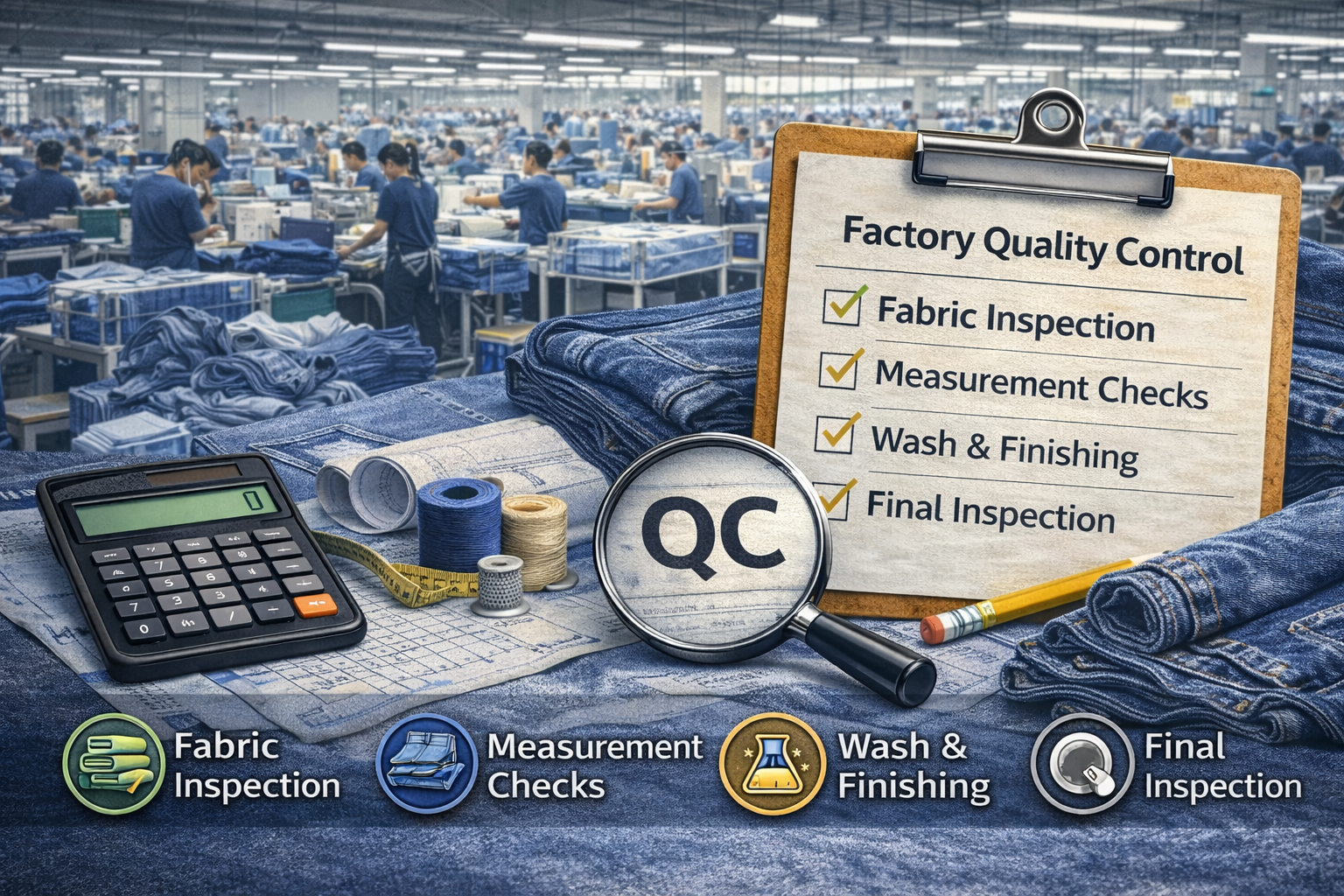
Fabric inspection is the first major QC checkpoint.
Factories typically check:
- Fabric defects (holes, slubs, oil stains)
- Shade consistency between rolls
- Stretch and recovery behavior
- Fabric width and weight stability
Even approved fabrics can vary between lots.
Uncontrolled fabric variation is one of the most common causes of bulk quality issues.
Fabric inspection helps factories decide:
- Whether fabric is safe to cut
- How to spread rolls during cutting
- Whether special adjustments are needed
Skipping or rushing this step increases downstream risk significantly.
How do factories control measurement accuracy during sewing?
Measurement control during sewing focuses on process checks, not only final results.
Common methods include:
- First-piece approval at each sewing line
- In-line measurement sampling
- Critical point checks (waist, hip, rise, inseam)
Factories understand that denim measurements can shift due to:
- Sewing tension differences
- Operator handling
- Fabric relaxation
By checking early and frequently, factories prevent small deviations from becoming bulk-wide problems.
How is washing quality controlled in bulk jeans production?
Washing is one of the highest-risk stages in denim manufacturing.
Quality control during washing includes:
- Wash recipe control (time, temperature, chemicals)
- Load size consistency
- Shade and appearance comparison to approved wash standards
- Post-wash measurement verification
Stretch denim requires extra monitoring because elastane can be damaged by:
- Excessive heat
- Overwashing
- Aggressive abrasion
Factories often run pilot washes before full bulk washing to confirm stability.
How do factories ensure wash consistency across large quantities?
Consistency is more important than perfection in bulk washing.
Factories manage this by:
- Locking wash standards after approval
- Using reference garments for comparison
- Limiting batch size variation
- Scheduling similar washes together
Even small changes in wash conditions can alter color, hand feel, or fit.
Strong QC focuses on keeping results within acceptable tolerance, not chasing unrealistic uniformity.
What quality checks are done after washing?
After washing, factories typically perform:
- Appearance checks (color, damage, symmetry)
- Measurement re-checks
- Stretch recovery evaluation (if applicable)
- Defect sorting
This stage confirms whether washing has altered fit or appearance beyond acceptable limits.
Garments that fail this stage are usually repaired, downgraded, or removed before final inspection.
What happens during final inspection before shipment?
Final inspection is the last QC gate, not the main one.
It usually includes:
- Measurement sampling
- Visual inspection
- Labeling and packaging checks
- Carton verification
Final inspection catches remaining issues, but it cannot fix systemic problems caused earlier.
Factories with strong upstream QC rely less on final inspection to “save” production.
What are the most common quality issues in bulk jeans production?
From factory experience, common bulk issues include:
- Measurement drift between sizes
- Wash shade inconsistency
- Stretch recovery problems
- Fabric defects missed during cutting
- Sample-to-bulk differences
Most of these issues are predictable, not accidental.
They usually result from:
- Rushed development
- Late fabric changes
- Unclear wash standards
- Inconsistent feedback
How can brands support better quality control during bulk production?
Factories perform best when brands:
- Approve samples with wash testing completed
- Lock fabric and wash decisions before bulk
- Define clear measurement tolerances
- Communicate changes early, not mid-production
Quality control works best as a shared responsibility, not a factory-only task.
Brands that understand QC logic see fewer surprises and more consistent results.
Why strong quality control is a system, not a checklist
Bulk jeans production is complex by nature.
Quality control succeeds when:
- Risks are identified early
- Standards are clearly defined
- Processes are stable
- Communication is structured
The goal of QC is not perfection, but predictability.
Factories that build stable QC systems help brands scale production with fewer corrections, lower cost, and better long-term results.