

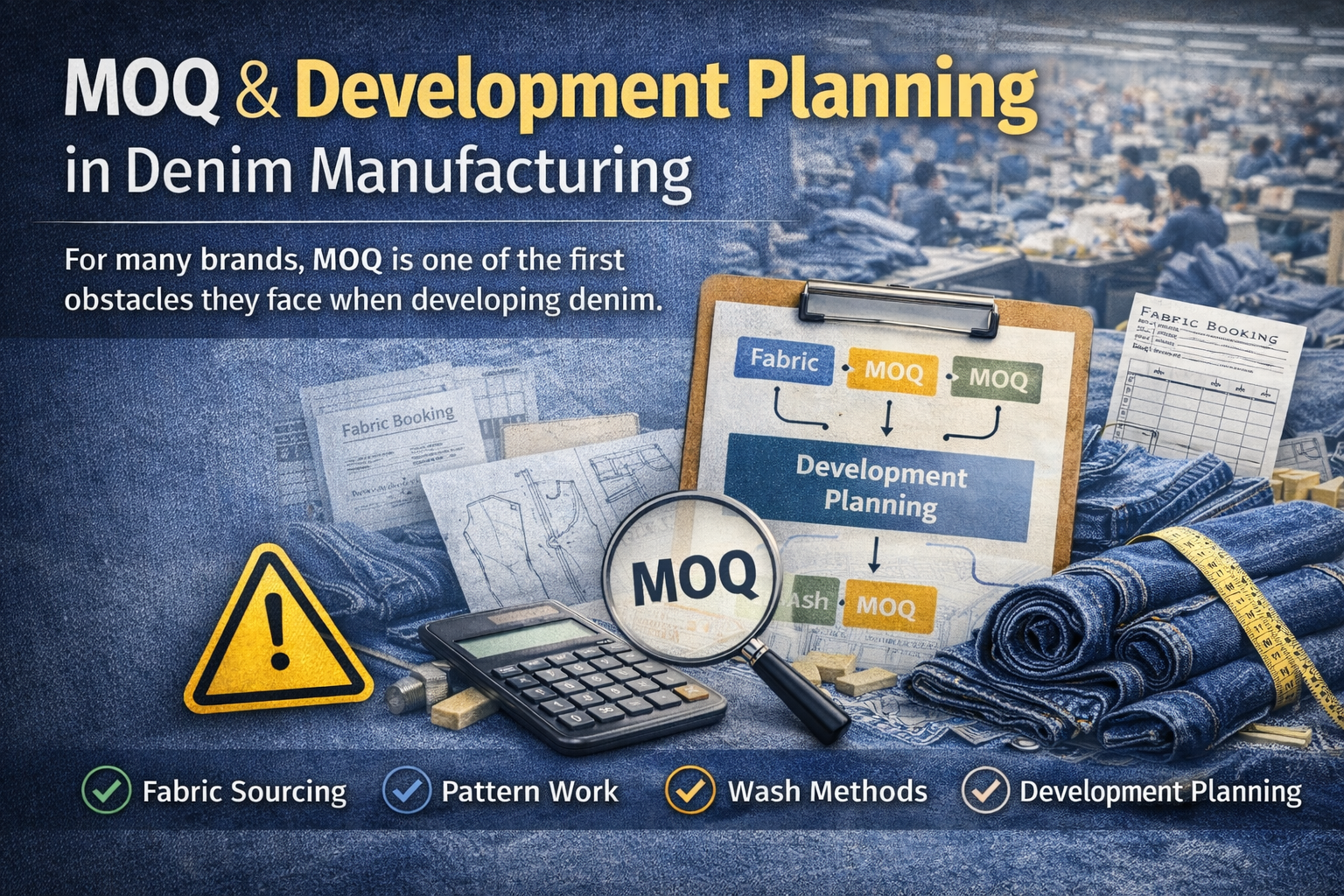
For many brands, MOQ is one of the first obstacles they face when developing denim.
But in real production, MOQ is not just a number. It is the result of fabric sourcing, pattern work, washing methods, and how development is planned from the start.
From a factory point of view, most MOQ problems do not come from the factory being “rigid.”
They come from unclear development planning.
This page explains how MOQ works in denim manufacturing, how it connects to development decisions, and how brands can plan realistically — especially at the early stage.
Why Does Denim Have MOQ in the First Place?
MOQ exists because denim production is a system, not a single process.
A pair of jeans usually involves:
- Fabric weaving or booking
- Indigo dyeing
- Washing and finishing
- Pattern development and grading
- Cutting and sewing
- Quality inspection
Each step has minimum requirements to stay stable and repeatable.
When order volume drops below a certain point, cost and risk increase for both sides.
From a factory’s perspective, MOQ is mainly driven by fabric and washing, not sewing.
Is MOQ the Same for All Denim Products?
No. MOQ changes based on what you are making.
For example:
- Basic 5-pocket jeans with standard wash
→ Lower MOQ possible - Custom fabric, special wash, or heavy distressing
→ Higher MOQ required - Stretch denim with strict recovery control
→ MOQ often increases due to fabric batch control - Raw or non-stretch denim with no wash
→ More flexibility in MOQ
MOQ is not fixed by brand size.
It is fixed by technical complexity.
How Fabric Choice Affects MOQ More Than Brands Expect
Fabric is usually the biggest MOQ driver.
Standard stock fabric
If the factory already works with a certain fabric weight and composition, MOQ can be lower because:
- No custom weaving
- No dye lot risk
- Faster sampling
Custom fabric development
If you request:
- Custom weight
- Custom stretch ratio
- Custom yarn blend
- Special hand feel
MOQ increases because:
- Fabric mills require minimum yardage
- Dyeing must be done in full lots
- Fabric testing must be repeated
This is why two jeans that look similar can have very different MOQs.
Development Stage vs Bulk Stage: Different MOQ Logic
A common misunderstanding is assuming sampling MOQ = bulk MOQ.
During development:
- Small yardage may be accepted
- Fabric may be substituted
- Wash tests are limited
During bulk production:
- Fabric must be consistent
- Dye lots must match
- Wash results must repeat
Factories plan MOQ based on bulk stability, not sample flexibility.
If development decisions ignore bulk reality, MOQ issues appear later — usually at the worst time.
How Wash Programs Change MOQ Requirements
Washing is another major factor.
Simple wash programs
Examples:
- Rinse wash
- Clean enzyme wash
- Light softener wash
These allow:
- Lower MOQ
- Easier production planning
- More flexibility for small brands
Complex wash programs
Examples:
- Heavy stone wash
- Vintage abrasion
- Multiple-step finishes
- Hand distressing
These require:
- Test runs
- Wash consistency control
- Higher rejection tolerance
As a result, MOQ often increases to absorb production risk.
Why Low MOQ Often Increases Total Cost
Many brands focus only on unit price.
Factories focus on total development cost.
With very low MOQ:
- Fabric cost per unit rises
- Sampling cost spreads over fewer pieces
- QC cost stays the same
- Rejection risk is higher
This is why a “low MOQ” order sometimes ends up costing more overall.
In some cases, slightly increasing MOQ can reduce cost and risk at the same time.
Development Planning: The Real Key to Managing MOQ
Good development planning reduces MOQ pressure more than negotiation.
Effective planning includes:
- Finalizing fabric direction early
- Limiting wash options in first season
- Avoiding unnecessary trims or constructions
- Using proven patterns before experimenting
Factories can work with smaller MOQs when development variables are controlled.
Unclear development always pushes MOQ up.
Common MOQ Mistakes Brands Make
From factory experience, these mistakes appear often:
- Changing fabric after sampling approval
- Using the same MOQ expectation for different styles
- Mixing multiple wash effects in one small order
- Underestimating fabric lead time
- Treating MOQ as negotiable, not technical
Most MOQ conflicts are preventable with early planning.
Can Startups and Small Brands Still Work with Denim Factories?
Yes — but expectations must be realistic.
Factories usually suggest:
- Starting with fewer styles
- Sharing fabric across multiple SKUs
- Using standard washes in the first run
- Planning seasonally, not style-by-style
Small brands succeed when they plan development like a system, not as isolated samples.
How MOQ Planning Connects to Factory Selection
MOQ is not independent from choosing a manufacturer.
Different factories specialize in:
- Large-scale basics
- Small-batch development
- Stretch denim
- Heavy wash programs
Choosing the right denim manufacturer often solves MOQ issues before they appear.
This is why MOQ planning should always be discussed together with factory capability.
A Practical Way to Think About MOQ
Instead of asking:
“What is your MOQ?”
Better questions are:
- What fabric options allow lower MOQ?
- Which wash programs are stable at small volume?
- Can styles share fabric or trims?
- How does development choice affect bulk risk?
Factories respond better to planning questions than price pressure.
Final Thoughts on MOQ & Development Planning
MOQ is not a barrier.
It is a signal.
It shows:
- How complex the product is
- How stable the production plan is
- How ready a style is for bulk
Brands that treat MOQ as part of development planning move faster, make fewer mistakes, and build stronger factory relationships.


