

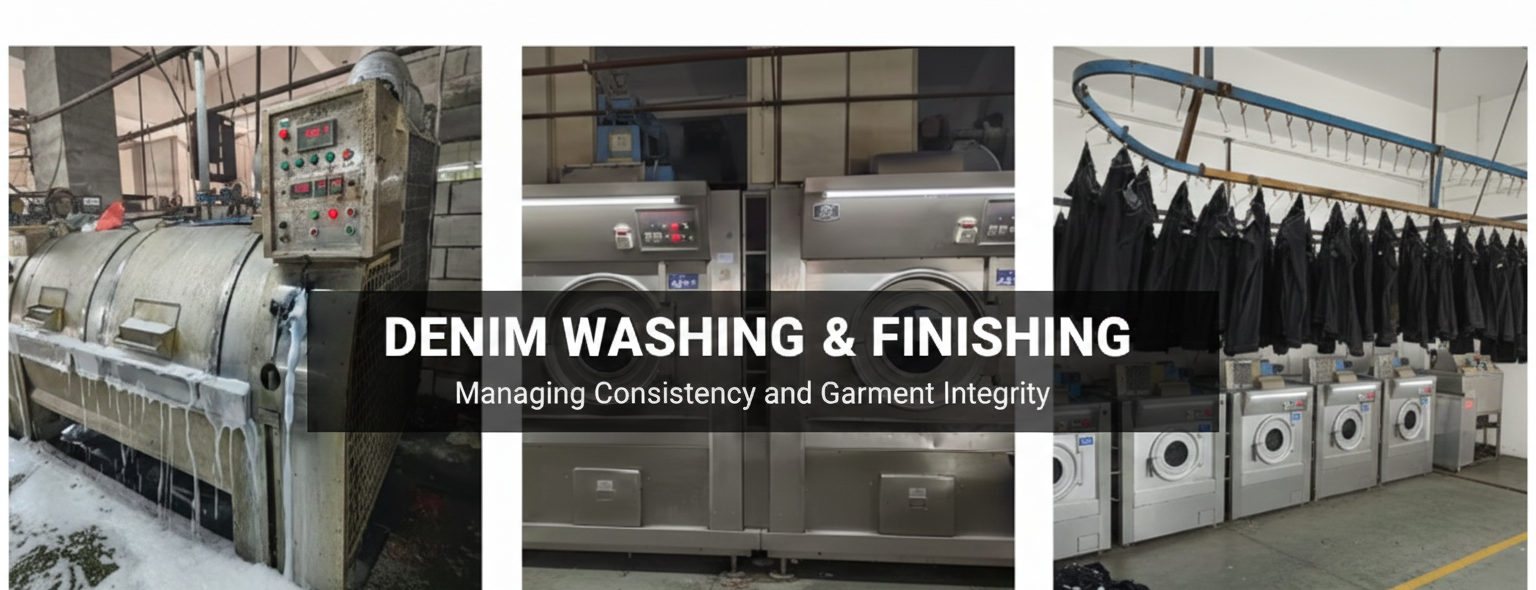
In custom denim production, achieving the right wash is rarely a matter of picking a standard name from a laundry menu. A visual target—whether defined by a vintage reference garment, a physical swatch, or a moodboard photo—must be translated into a controlled, repeatable process on a specific fabric and garment construction.
Denim wash development is the structured process of testing, refining, and approving a wash finish during product development. At Xinen Garment, we work alongside designers, product developers, and sourcing teams to bridge the gap between visual intent and bulk production. We evaluate how the chosen fabric, dye type, pattern geometry, and seam construction react to mechanical and chemical processing, making adjustments until the sample achieves the desired color depth, contrast, hand feel, and finished dimensions.
Reference images and garments provide a clear direction, but replicating a finish requires balancing multiple physical variables. We work with brands to establish realistic parameters, refine wash formulas, and lock in an approved production reference before moving to bulk manufacturing.
What Is Denim Wash Development?
There is a distinct functional difference between washing a finished garment and developing a denim wash.
Garment washing simply applies a standardized laundry cycle to a finished item. In contrast, denim wash development is an iterative technical phase within product development. It involves establishing, evaluating, and fine-tuning the chemical, thermal, and mechanical steps required to achieve a defined visual and tactile target on a specific garment.
During wash development, we test and adjust parameters to control:
- Color and shade: Target indigo level, cast (greenish, reddish, or neutral), and overall brightness.
- Contrast and highlights: The degree of separation between high points (seams, pockets, fly) and base fabric areas.
- Surface character: Graininess, slub expression, abrasion levels, and wash-down consistency.
- Hand feel and drape: Fabric softness, weight reduction, and surface texture achieved through enzyme treatments or softeners.
- Dimensional results: How shrinkage, movement, and fabric relaxation affect the finished measurements.
The primary objective is not merely to make denim lighter or softer, but to align the aesthetic execution with the structural performance of the garment.
Starting With a Wash Reference
When launching a custom denim project, brands communicate their wash intent through various reference materials:
- Physical reference garments: The most effective reference for evaluating target color, localized abrasion patterns, seam contrast, and fabric hand feel simultaneously.
- Previous approved samples: Useful for maintaining continuity across seasons or updating an existing style.
- Fabric swatches: Helpful for establishing base shade targets or surface texture expectations.
- Photos and moodboards: Excellent for establishing overall aesthetic direction, though digital images do not capture fabric weight, tactile softness, or true color depth.
- Technical specifications: Written documentation outlining desired fading levels, contrast expectations, or specific distressing details.
When working from photos or digital artwork, we use the images to establish direction while managing technical expectations. Photographs are subject to lighting, camera settings, and screen calibration. Physical development allows us to turn digital references into tangible fabric results.
Rather than promising an absolute visual replica of a photograph, our development team focuses on developing toward the reference, matching the intended direction, and establishing a physical sample for client sign-off.
Fabric and Wash Development Are Connected
A washing process does not produce identical results across different denim fabrics. The base fabric dictates how the garment responds to mechanical abrasion, chemical agents, and heat.
Fabric Characteristics + Garment Construction + Washing Process = Finished Denim Product
Key fabric variables that directly influence wash development include:
- Fiber composition: 100% cotton reacts differently to enzymes, bleaching, and abrasion than cotton blends containing polyester, rayon, or elastane.
- Fabric weight (Oz): Heavyweight denims (13 oz and above) withstand aggressive mechanical washing and develop pronounced high-low contrast, whereas lightweight denims (8–10 oz) require gentler processing to maintain structural integrity.
- Yarn structure and slub character: Ring-spun yarns expose different levels of character under abrasion compared to open-end yarns.
- Dye type and shade depth: Pure indigo, sulfur-bottomed indigo, or overdyed denims wash down at different rates and reveal distinct undertones during oxidation and reduction cycles.
- Stretch content: Elastane and composite stretch yarns require controlled thermal and chemical exposure during washing to prevent fiber degradation.
Developing a heavy stone wash on a lightweight stretch denim using a recipe designed for 14 oz rigid denim can cause seam damage, loss of elasticity, or excessive fabric distortion. Evaluating fabric characteristics prior to establishing the wash process is essential.
To learn more about selecting the right base material for your project, explore our guide on [denim fabric selection].
How Wash Development Connects With Denim Fit
Washing changes the physical dimensions and structural drape of a denim garment. As indigo is stripped and cotton fibers relax, shrink, or expand under heat and agitation, the finished measurements of the garment shift.
Unwashed Garment (PFD / Raw) ---> Washing & Drying ---> Finished Measurements & Fit
Washing can alter:
- Inseam and outseam length: Vertical shrinkage occurs as warp yarns contract during wet processing and drying.
- Waistband and hip width: Weft contraction alters horizontal dimensions, particularly on rigid fabrics.
- Rise and leg opening: Seam puckering and fabric movement can pull panels, shifting how the garment sits on the body.
- Drape and silhouette: Removing yarn sizing softens the fabric, causing the garment to hang closer to the body compared to its raw state.
Because dimensional shifts depend heavily on the specific combination of fabric weave, construction, and wash intensity, fixed shrinkage rates cannot be assumed. A fit profile approved on a raw or lightly rinsed prototype will fit differently once subjected to an intense vintage wash.
Pattern adjustments must account for the specific wash process. Our team integrates wash testing with [denim fit and pattern development] to ensure that garment patterns are scaled correctly before cutting bulk production.
Common Denim Wash Effects We Develop
We work with a wide range of wash directions, tailoring each formulation to the brand’s visual targets and target fabric quality:
- Clean washed denim: Subtle rinse, garment, or light enzyme washes designed to remove sizing, stabilize shrinkage, and soften hand feel while retaining a rich, uniform indigo shade.
- Dark indigo wash: Controlled wash cycles that achieve minor high-low seam contrast while maintaining a deep indigo base color.
- Medium blue wash: Intermediate enzyme or stone washing that reduces base color depth, exposing yarn character and seam highlights.
- Vintage wash: Multi-step processing combining abrasion, fading, and subtle tinting or topping to replicate natural aging and wear.
- Faded and stone-washed finishes: Utilization of neutral pumice stone or synthetic media alongside enzymes to abrade raised areas of the garment naturally.
- Distressed and abraded denim: Controlled manual or mechanical wear applied to pockets, hems, and seams to simulate long-term use.
- Localized effects: Precision placement of whiskering, thigh scraping, knee highlights, and seat fading aligned with the garment’s pattern lines.
Each effect is selected based on how it interacts with the garment’s construction, ensuring structural durability is maintained.
Developing Vintage and Worn Denim Effects
Achieving an authentic vintage or worn look requires a balance of manual artistry and process control. Rather than applying random abrasion, localized finishing must align with natural body movement and garment ergonomics.
Key manual and localized effects include:
- Whiskering (Moustache lines): Crease patterns developed across the front lap/hip area where jeans naturally fold when sitting.
- Thigh and knee wear: Subtle vertical highlights that elongate the leg line and simulate true wear patterns.
- Pocket edge and hem grinding: Targeted rim abrasion along pocket scoops, coin pockets, back pockets, and bottom hems.
- Tacking and 3D creasing: Resin application and heat setting to freeze dimensional folds into the fabric prior to washing.
- Destruction and repair: Hand-slashing, hole grinding, and internal patching details for distressed denim styles.
Because manual processes like hand scraping and grinding rely on operator execution, minor natural variations occur between individual garments. This inherent variance gives vintage denim its authentic character. During wash development, we establish master standards and boundaries for abrasion intensity to maintain consistency across bulk production.
Wash Development for Stretch Denim
Stretch denim—whether comfort stretch (1–2% elastane) or high-stretch performance blends—requires distinct handling during wash development compared to 100% cotton rigid denim.
Critical considerations for stretch denim include:
- Thermal management: High drying temperatures can degrade synthetic elastomeric cores, leading to lost recovery, bagging at the knees, or wavy zipper plackets.
- Chemical exposure: Harsh oxidative bleaches and strong chemical agents can weaken stretch fibers if exposure times and pH levels are not monitored.
- Mechanical tension: Heavy stonewashing cycles can over-agitate stretch yarns, causing elastane breakage (“snap-back”) that appears as small white elastic filaments on the fabric surface.
- Dimensional recovery: Stretch fabrics often shrink more in the width during wet processing but can stretch back out during wear.
During development, wash recipes for stretch denim are formulated to protect fiber elasticity while achieving the target visual fade, balancing aesthetic requirements with long-term garment recovery.
Wash Development for Rigid and Heavyweight Denim
Rigid denim (100% cotton) and heavyweight fabrics (14 oz to 18+ oz) present different development considerations. While highly durable, these materials require sufficient processing time to soften the hand feel and reveal yarn slub character.
Development considerations for rigid and heavyweight denim:
- Pucker and high-low expression: Dense weaves allow for pronounced contrast along felled seams, belt loops, and pocket borders when abraded.
- Crack marks and fold lines: Rigid denim is prone to unwanted processing lines (“marbling” or “crack marks”) if washed in overloaded machines or with insufficient liquor ratios during early rinse stages.
- Hand feel modification: Heavy fabrics require tailored enzyme baths or softeners to break down stiff yarn sizing without weakening seam construction.
- Weight retention: Heavy washing strips indigo weight and fiber mass. A 14 oz raw fabric may weigh noticeably less after an intense bleach or stone wash cycle.
Heavier denim does not automatically require more aggressive washing. The process is calibrated to release the character of the weave while preserving garment weight and structural integrity.
From First Wash Sample to Approved Wash
Transitioning from a design reference to a bulk-ready production finish follows a structured, step-by-step sampling procedure.
1. Reference Review & Material Evaluation
   ↓
2. Initial Wash Sample Creation
   ↓
3. Review: Shade, Contrast, Hand Feel & Fit
   ↓
4. Technical Recipe Adjustment
   ↓
5. Secondary Sample / Wash Swatch (If Required)
   ↓
6. Master Wash Approval & Recipe Lockdown
The Sampling Sequence:
- Reference review: We analyze the client’s reference garment, tech pack, or moodboard targets alongside the chosen fabric.
- Garment construction: Prototype garments are sewn using the specified thread, hardware, and seam construction required for the style.
- Initial wash trial: The first wash sample is processed using a base recipe calculated for the fabric weight and composition.
- Evaluation: The sample is inspected for base shade, abrasion contrast, whisker placement, seam integrity, and hand feel.
- Dimensional check: Post-wash measurements are taken and compared against pre-wash pattern specifications.
- Formula refinement: Wash times, chemistry ratios, stone media, or laser parameters are adjusted based on evaluation findings.
- Approval sample confirmation: A final wash sample is presented for client sign-off alongside post-wash measurement sheets.
The number of sampling iterations depends on the complexity of the finish and the clarity of the initial target. A simple rinse wash may be finalized in one round, whereas a heavily distressed vintage style may require two or three refinements to perfect localized abrasion placement and final shade depth.
For complete details on our broader prototyping workflow, view our guide on [denim sampling and fit approval].
What We Review During Wash Approval
When evaluating a wash sample for production sign-off, both visual aesthetics and technical parameters are systematically inspected:
| Review Category | Visual & Technical Checkpoints |
| Color & Shade | Overall base color depth, cast/tone (reddish, greenish, or bright blue), and color uniformity across body panels. |
| Contrast & Abrasion | Separation between abraded high points and darker low points; natural progression of fading. |
| Localized Effects | Placement, width, and intensity of whiskering, thigh scraping, knee highlights, and edge grinding relative to seam lines. |
| Tactile Quality | Fabric softness, flexibility, weight, drape, and absence of chemical odor or surface harshness. |
| Dimensional Stability | Compliance with target size specifications; checking for torque/leg twist, seam puckering, or neck/waistband distortion. |
| Structural Integrity | Seam strength, pocket corner security, thread condition, and metal hardware finish post-washing. |
Establishing clear priorities during review ensures that visual targets are met without compromising fabric strength or fit.
How Wash Development Affects Bulk Production
An approved wash sample serves as the master production standard. Once signed off, the sample and its technical wash record dictate the parameters for bulk manufacturing.
To maintain consistency during bulk production, we document and control:
- Approved master sample: Used as the physical bench standard for shade matching and hand-feel comparison during production inline checks.
- Standardized wash recipes: Machine load weights, liquor-to-fabric ratios, chemical dosages, bath temperatures, and cycle times are fixed.
- Effect placement templates: Physical stencils or digital laser files are created based on the approved sample to standardize whisker and highlight locations across all sizes.
- Shade band limits: Establishing acceptable upper and lower shade variations (lighter/darker limits) to account for natural dye lot variations inherent in indigo textiles.
Because denim washing involves wet chemistry and manual artistry, absolute identicality across thousands of units is impossible. Establishing clear master samples and shade bands ensures that bulk production remains within controlled, commercially accepted tolerances.
Learn more about our end-to-end manufacturing capabilities under [custom denim manufacturing].
Manual Effects vs. Technology-Assisted Techniques
Modern denim finishing balances traditional craftsmanship with controlled machinery. Depending on design intent and order volumes, we utilize both manual methods and technology-assisted processes during wash development:
+-------------------------------------------------------------------+
|                        FINISHING APPROACHES                       |
+---------------------------------+---------------------------------+
| Manual Finishing                | Technology-Assisted             |
| • Hand scraping                 | • Laser abrasion                |
| • Pocket edge grinding          | • Ozone fading                  |
| • Hand-applied distressing      | • Automated resin spraying      |
|                                 |                                 |
| Best for: Organic, unique,      | Best for: Precise repeatability,|
| vintage-style character         | sharp detail, reduced water use |
+---------------------------------+---------------------------------+
- Manual finishing: Techniques like hand-scraping with sandpaper, hand-grinding edges, and manual resin creasing deliver organic, highly customized vintage characteristics. However, they naturally incorporate minor variations between operators and garments.
- Technology-assisted finishing: Laser processing allows digital whisker and distress patterns to be burnt onto the garment surface with high repeatability. Ozone processing uses gas oxidation to bleach indigo shade without heavy chemical use or high water consumption.
During the development phase, we advise brands on the ideal combination of manual artistry and technological precision based on their target aesthetic, budget, and production scale.
What Information Should a Brand Provide?
To streamline the wash development process, brands should provide a clear project brief prior to initial sampling:
Wash Development Checklist:
- [ ] Base fabric specs: Fabric weight (oz), composition (100% cotton vs. stretch blend), and weave preference.
- [ ] Visual reference: Physical reference garment, swatch, high-resolution wash photo, or detailed moodboard.
- [ ] Wash direction: Desired shade depth (raw, dark, medium, light, bleach), undertone cast, and contrast level.
- [ ] Distressing specs: Details on whiskering, hand scraping, knee holes, hem wear, or repair details.
- [ ] Garment tech pack: Flat sketches, construction notes, and target finished measurements.
- [ ] Target fit profile: Slim, relaxed, straight, or oversized fit expectations post-wash.
Brands do not need to provide precise chemical formulas or laundry recipes. Your primary role is to define the visual target, hand feel, and fit expectations; our role as the manufacturer is to engineer the process that delivers that target reliably.
Wash Development Before Bulk Production
Before authorization is given to proceed with bulk production cutting and washing, several key development elements must be locked down:
- Final fabric lot approval: Bulk fabric must be tested against the approved wash recipe, as different dye lots can react differently to the same wash cycle.
- Signed master wash sample: Physical sample approved for shade, hand feel, and detail placement.
- Post-wash measurement confirmation: Approved fit verified on garments that have undergone the exact bulk wash cycle.
- Shade tolerance bands: Agreement on minor acceptable shade limits for production inspection.
Changing base fabrics or making major alterations to wash intensity after sample sign-off voids prior test results. Any significant material or visual modification requires a quick wash swatch re-validation to safeguard bulk consistency.
How Wash Development Fits Into the Full Denim Development Process
Wash development does not occur in isolation. It functions as an interconnected stage within our broader denim manufacturing ecosystem:
Product Concept
       │
       ▼
Fabric Selection ────────────► (Influences wash speed & shade response)
       │
       ▼
Fit & Pattern Development ───► (Pattern dimensions scale based on wash shrinkage)
       │
       ▼
Prototyping & Sampling
       │
       ▼
Wash Development ────────────► (Establishes shade, contrast, hand feel & finish)
       │
       ▼
Fit & Wash Final Approval
       │
       ▼
Production Preparation
       │
       ▼
Custom Denim Manufacturing
By connecting fabric sourcing, pattern making, wash testing, and bulk production under one technical roof, we eliminate guesswork and ensure your design intent is executed accurately from first prototype to final delivery.
To explore real-world examples of completed client developments, visit our portfolio of [denim development projects]. For technical background on denim care and processing, check out our resource section on [denim washing and finishing knowledge].
Frequently Asked Questions About Denim Wash Development
What is denim wash development?
Denim wash development is the technical process of creating, testing, and refining a specific wash recipe and finishing sequence for a custom denim garment. It aligns color depth, contrast, softness, localized distressing, and shrinkage rates with a brand’s target reference before bulk production begins.
Can you develop a custom jeans wash from a reference sample?
Yes. Physical reference garments are the most reliable starting point for wash development. We analyze the reference’s color depth, abrasion patterns, and hand feel, then formulate a wash process on your chosen fabric to match that direction.
Can a wash be developed from photos only?
Yes, wash development can begin from photographs or moodboards. However, because lighting and digital displays distort true color depth and cannot convey fabric hand feel, photo references are used for aesthetic direction. A physical sample is then produced for client evaluation and approval.
How does denim fabric affect washing?
Fabric composition, weight, weave structure, and dye depth dictate how denim reacts to washing. A heavy 100% cotton rigid denim will yield different contrast and shade changes than a lightweight stretch denim subjected to the exact same wash process.
Does washing change the fit of jeans?
Yes. Wet processing, agitation, and thermal drying cause cotton fibers to contract or relax, altering the garment’s length, width, and drape. Pattern dimensions must be developed to account for the specific shrinkage profile of the intended wash.
How many wash samples are normally needed?
Most standard washes are finalized within one to two sampling rounds. Complex vintage finishes involving multi-stage distressing, resin treatments, or precise localized fading may require additional refinements to lock in master approval standards.
Can you develop vintage or distressed denim washes?
Yes. We develop a full range of vintage effects, including localized hand-scraping, whiskering, pocket-edge grinding, tacking, resin setting, and controlled destruction details aligned with natural wear patterns.
Can stretch denim be washed without changing its intended fit?
Yes, provided the wash process is correctly calibrated. Stretch denim requires controlled processing temperatures and gentle mechanical action to preserve elastane recovery and prevent permanent fabric distortion or bagging.
How is a denim wash approved before bulk production?
Wash approval occurs when the client inspects and signs off on a physical wash sample. This sample is reviewed for shade accuracy, contrast, localized detail placement, hand feel, and post-wash finished measurements, becoming the master production standard.
Can the same wash be reproduced for repeat orders?
Yes. Once a wash is approved, the exact chemical recipe, machine settings, process times, and effect stencils are archived. Repeat production runs utilize these technical records alongside physical shade bands to maintain consistency across lots.
What should I send before starting a denim wash development project?
You should provide your design flats/tech pack, target fabric specifications, a physical sample or photo reference of the desired wash, and notes on specific distressing or fit expectations.
Discuss Your Denim Wash Development
If you have a wash reference, moodboard, existing garment sample, or a specific denim finish in mind, share your project details with our team. We will review your fabric selection, garment construction, and target aesthetic to outline a clear development path before starting sample creation.


