Starting a denim brand is an emotional journey. You have a vision of the perfect fit, the perfect wash, and the perfect logo. But when you move from the design studio to the factory floor, that emotion can often lead to bad financial decisions.
At Xinen Garment, we receive hundreds of inquiries every month. We see a clear pattern. The brands that succeed are not always the ones with the best designs; they are the ones who understand where to spend money and where to save it.
Manufacturing custom jeans is not like printing t-shirts. It involves chemistry (washing), engineering (pattern making), and heavy machinery. If you don’t understand the process, you will burn through your budget before you even sell your first pair.
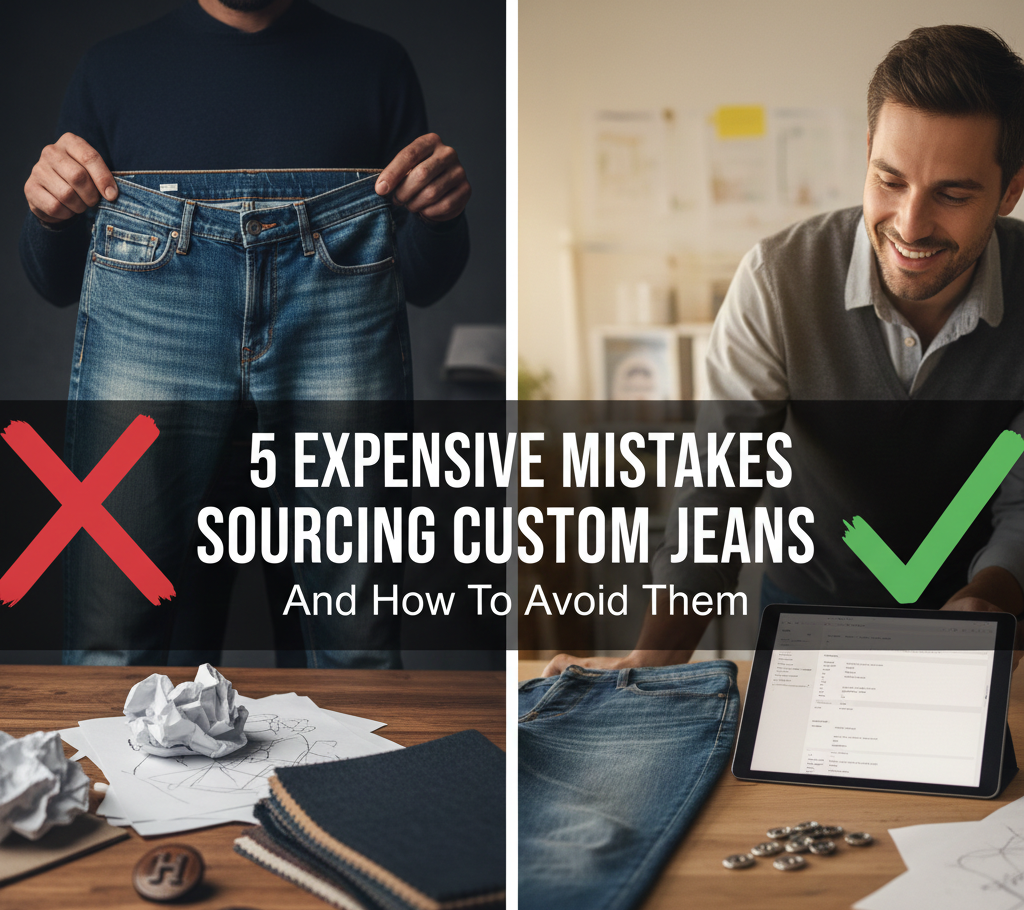
We have compiled the five most common—and most expensive—mistakes we see new brands make. We are sharing this so you can avoid them, save your capital, and get a better product.
Mistake #1: Why is choosing denim fabric based only on photos or “weight” a financial disaster?
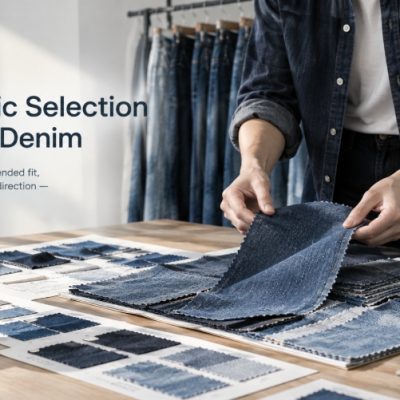
The first mistake happens before the sewing machine even starts. Many new designers search online for “14oz denim” or look at photos of fabric textures and say, “I want that one.”
This is dangerous because denim is a three-dimensional product. A photo cannot show you the “Hand Feel” (stiffness vs. softness) or the “Recovery” (how well the denim snaps back after being stretched).
The Cost:
If you choose a fabric that is too stiff for a skinny fit, or too loose for a structured fit, the jeans will be unwearable. You will pay for sample development, shipping, and maybe even a bulk deposit, only to realize the final product feels like cardboard or pajamas. You have to scrap everything and start over. That is thousands of dollars wasted.
The Reality of Shrinkage:
Denim is cotton. It shrinks. A “Rigid” (100% cotton) fabric might shrink 3% in width but 10% in length. A “Stretch” fabric might shrink 15% in width. If you force a factory to use a fabric they don’t recommend just because it “looks cool” in a photo, the pattern calculation will be wrong.
How to Avoid It:
- Trust the Factory’s Library: Instead of sending us a photo of a fabric weave, send us a Reference Sample. Send us a pair of jeans from a brand like Levi’s or Zara that has the exact feel you want.
- Ask for Swatches First: We can mail you a book of fabric swatches (Fabric Hangers). Touch them. Stretch them. Wash them at home. Only approve the fabric when you have held it in your hands.
- Listen to the “Oz” Advice: If you are making a summer collection, do not insist on 14oz denim just because it sounds “premium.” It will be too hot and customers will return it. Let us suggest a 10oz or 11oz alternative.
Mistake #2: Can a factory make the perfect sample from just a sketch or a Pinterest image?
The short answer is: No.
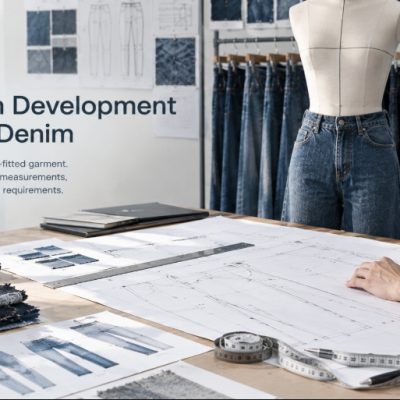
This is the most common reason for delays and extra sampling fees. A sketch is artistic; a Tech Pack is scientific. Factories cannot sew “vibes” or “cool aesthetics.” We need millimeters and centimeters.
The Cost:
If you send a sketch that says “make it baggy,” our pattern maker has to guess what “baggy” means to you. We make the first sample. You receive it and say, “It’s too big.” We make a second sample. You say, “Now the pockets are too low.”
Each sample costs 2x to 3x the production price plus express shipping fees ($50-$100 per shipment). If you need 4 rounds of sampling because your instructions were vague, you have spent $600+ just on one prototype.
The Solution: The Tech Pack
A Tech Pack is the blueprint. It bridges the gap between your brain and our machines.
Here is a comparison of how instructions affect clarity:
| Feature | Expensive Instruction (Vague) | Money-Saving Instruction (Specific) |
| Fit | “Make it look like these vintage 90s jeans.” | “High rise. Inseam 30 inches. Leg opening 16 inches. See attached measurement chart.” |
| Wash | “I want a cool vintage blue wash.” | “Mid-blue stone wash. Localized hand-sanding on thighs. No whiskers. Reference Pantone 19-4029 TCX.” |
| Thread | “Gold stitching.” | “Tobacco Gold thread. Tex 60 for seams, Tex 40 for hem. Contrast buttonhole in Red.” |
| Hardware | “Silver buttons.” | “17mm Tack Button, Matte Silver finish, Zinc Alloy. Plain face (no logo).” |
How to Avoid It:
If you don’t know how to make a Tech Pack, hire a freelancer to do it, or ask us if we have a standard template. Spending $100 on a good Tech Pack saves you $500 in failed samples.
Mistake #3: How does over-complicating the wash destroy your profit margins?
Denim washing is an industrial art. It involves tumbling jeans in giant drums with stones, enzymes, or ozone gas. It also involves manual labor—workers scraping the jeans by hand to create “whiskers” or using Dremel tools to create rips.
The Cost:
New brands often want “everything” on their first design: heavy stone wash, bleach spots, knee rips, paint splatters, and 3D whiskers.
Every single process you add increases the CMT (Cut, Make, Trim) cost.
- Basic Rinse Wash: $1.00 – $1.50 per unit (approximate added cost).
- Heavy Vintage Wash + Hand Destruction: $4.00 – $7.00 per unit (approximate added cost).
If you are producing 300 jeans, an extra $5.00 per unit means your total bill just went up by $1,500. Furthermore, complex washes have a higher “defect rate.” If you ask for heavy rips, 5% of the jeans might tear completely during the wash and have to be thrown away. You pay for that waste.
The “Consistency” Trap:
Complex washes are hard to replicate. If you order 300 pairs, the first 50 might look different from the last 50 because the manual sanding pressure varies from worker to worker. This leads to customer complaints.
How to Avoid It:
- Keep it Simple for Launch: Focus on a great fit and a clean, high-quality wash (like a deep indigo rinse or a standard enzyme wash). These are cheaper to produce and look very premium if the fabric is good.
- Add Complexity Later: Once you have sales and cash flow, you can experiment with expensive, heavy-destruction washes in future collections.
Mistake #4: Should you invest in custom-engraved buttons for your first 150 pairs?
Branding is important. You want your logo on everything. We understand that. But custom hardware (metal buttons, rivets, zippers) is the biggest “Cash Flow Trap” for startups.
The Cost:
Metal hardware is made using molds. To put your logo on a button, the hardware factory has to cut a steel mold.
- Mold Fee: $100 – $200 per design (Button cap, rivet burr, rivet face).
- Hardware MOQ: Hardware factories usually won’t turn on the machine for less than 5,000 or 10,000 buttons.
If you are only ordering 150 pairs of jeans, you only need 150 buttons. But you have to pay for 5,000 buttons plus the mold fee. You will have 4,850 buttons sitting in a box in our warehouse for years. That is “dead money.”
The Solution: “Soft” Branding
For your first few collections, branding should come from items that are cheap to produce in low volumes.
- Leather/Paper Patch: The patch on the back waistband is the most visible branding. We can emboss or print your logo here with very low minimums.
- Woven Labels: The tag inside the waist or on the pocket. These are cheap and easy to customize.
- Hangtags: A high-quality cardboard hangtag makes the product look expensive.
How to Avoid It:
Use our “Open Mold” Hardware. Xinen Garment has a stock of high-quality, unbranded buttons (plain silver, antique copper, gunmetal, stars, laurels). They look professional and clean. Use these for your first collection. Save the custom engraved buttons for when you are ordering 2,000 pairs at a time.
Mistake #5: Why does copying a competitor’s size chart often lead to high return rates?
This is specifically important for e-commerce and Amazon FBA sellers. A common mistake is finding a popular brand (like Levi’s or Gap), copying their size chart from their website, and telling the factory: “Make it these measurements.”
The Cost:
A size chart on a website is a guide for the body, not the garment.
Furthermore, fabrics behave differently.
- Brand A uses a 12oz Rigid Denim (0% stretch). Their Size 32 waist measures 33 inches to allow for breathing room.
- You choose a 10oz High-Stretch Denim (2% Spandex). If we make your Size 32 waist 33 inches, it will stretch to 35 inches and fall off the customer.
If you get the sizing wrong, your Return Rate on Amazon could hit 30% or 40%. You pay for shipping both ways, and Amazon penalizes your listing. This can bankrupt a new brand in months.
The Solution: The Pattern & Shrinkage Test
You must rely on the factory’s pattern maker to adjust the measurements based on the specific fabric you chose.
- The Shrinkage Test: Before we cut bulk fabric, we wash a sample of the fabric to see exactly how much it shrinks. We then adjust the pattern.
- The Size Set: Before bulk production, we can make a “Size Set” (e.g., one pair of Size 28, 30, 32, 34). You try them on different people to ensure the “grading” (the jump between sizes) is correct.
How to Avoid It:
Don’t dictate the exact centimeter measurements if you aren’t a professional pattern maker. Instead, give us the “Target Fit” (e.g., “I want this to fit a body with a 32-inch waist”) and let our technical team calculate the garment measurements based on the fabric’s elasticity.
Conclusion: Your Factory is Your Profit Partner
If you look at these five mistakes—Fabric, Tech Packs, Wash, Hardware, and Sizing—they all share one common theme: Making assumptions.
New brands assume that manufacturing is just “ordering.” In reality, it is a collaboration. When you try to control every single variable without technical knowledge, you usually end up increasing costs.
At Xinen Garment, we want you to grow. Why? Because if you sell out your first 300 pairs, you will come back and order 1,000 pairs. That is how we both make money.
So, how do you avoid these expensive mistakes?
- Ask for fabric recommendations, not just photos.
- Invest time in a clear Tech Pack.
- Keep the first wash clean and simple.
- Use generic hardware and brand with labels/patches.
- Trust our pattern makers to adjust sizing for the specific fabric.
Are you ready to start your custom denim project the smart way? We are ready to guide you through the process, from the first swatch to the final delivery.