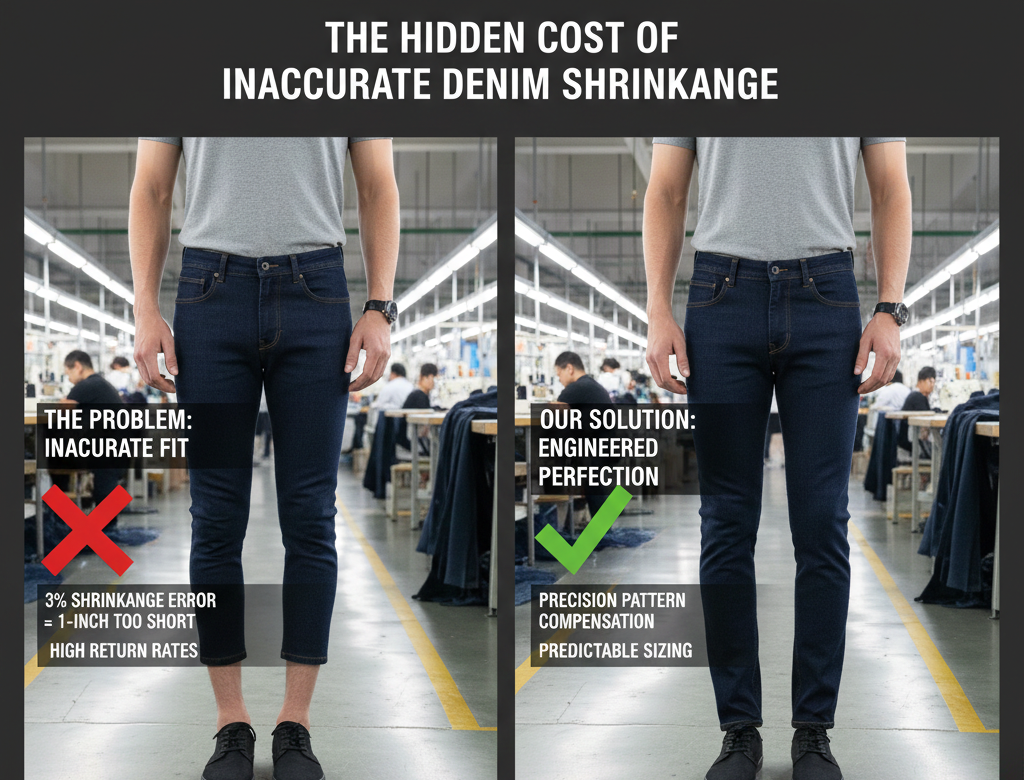
Imagine unboxing your new production run. The denim looks beautiful. The wash is perfect. The stitching is clean. But when your fit model tries on a size 32, the hem hits above the ankle, and the waistband feels tight.
You measure the inseam. It is 2.5cm (1 inch) shorter than the tech pack.
The factory tells you: “Oh, the shrinkage was a bit higher than expected.”
In the world of custom denim manufacturing, this is the silent killer of profitability. A “small” variance in shrinkage calculation—even just 3%—is the difference between a 5-star review and a customer return.
At Xinen Garment, we believe that shrinkage isn’t something that happens to you; it is a variable that must be engineered. Here is the technical reality of why denim shrinks, how it ruins fit if ignored, and the rigorous protocols we use to control it.
What Does a “3% Variance” Actually Look Like?
When we talk about percentages in a factory setting, they can sound abstract. A 3% error doesn’t sound like a disaster. But let’s apply that math to a standard pair of men’s jeans.
The Math of Failure:
- Target Inseam: 32 inches (81.2 cm)
- The Error: An unexpected 3% shrinkage variance.
- ** The Result:** The jeans shrink an extra 0.96 inches (2.4 cm).
Suddenly, your 32-inch inseam is a 31-inch inseam. You are no longer selling the size you promised on the label.
But the problem goes deeper than just length. Denim shrinks in both the warp (length/vertical) and the weft (width/horizontal).
If your width shrinkage is off by 3%:
- The Rise Drops: The front rise shrinks, creating a “wedgie” effect or making the crotch feel restrictive.
- The Knee Moves: The intended knee point shifts upward, making the leg shape look distorted, especially on flared or tapered cuts.
- The Hip Tightens: A size 32 waist becomes a size 31, leading to complaints that your sizing runs small.
For a brand, this leads to a high return rate. Customers don’t care about fabric physics; they only know the jeans don’t fit.
Why Is Denim Shrinkage So Hard to Predict?
You might ask, “Why can’t we just use the data from the fabric mill?”
This is the most common mistake in the industry. Fabric mills provide a Shrinkage Standard sheet with every roll. It might say: Length -3%, Width -1.5%.
Many high-volume factories take these numbers, input them into the CAD software, and start cutting. This is gambling.
The mill’s data is an average. However, denim is a natural fiber product. It is alive.
- Roll-to-Roll Variance: One roll of denim might shrink 3%. The next roll from the same batch might shrink 5% because the tension on the weaving loom changed slightly during production.
- Relaxation: When denim is rolled onto a tube for shipping, it is stretched under tension. If you cut it immediately, it will “snap back” (relax) before it even hits the washing machine.
- The Wash Process: The chemical recipe matters. A stone wash with hot water shrinks fabric differently than a cold enzyme rinse. The mill doesn’t know your wash recipe, so their data is strictly theoretical.
If your manufacturer relies solely on mill data, they are not engineering your product; they are guessing.
How Does “Leg Twist” Relate to Shrinkage?
Have you ever bought a pair of vintage jeans where the side seam wraps around to the front of the shin? That is Leg Twist (or Skew).
This happens because of the direction of the twill weave (Left Hand Twill vs. Right Hand Twill). When denim shrinks, the yarns torque and untwist, pulling the fabric in a spiral.
- Standard Manufacturing: The factory ignores this. The jeans look straight on the table, but after the first wash, the seams twist.
- Engineered Manufacturing: We calculate the skew movement. We can actually adjust the pattern so that the leg is cut “crooked” intentionally. When the fabric shrinks and twists in the wash, the seam aligns perfectly straight.
This level of detail is critical for brands positioning themselves in the premium or heritage space.
How Do We Calculate Shrinkage Before Cutting? (The Xinen Protocol)
To prevent fit disasters, we use a multi-stage testing protocol. We do not cut bulk fabric until we have proven data. Here is our process for denim shrinkage calculation.
Step 1: The Relaxation Period
Before we test anything, we unroll the fabric. We let the denim “rest” on large tables for 24 to 48 hours. This allows the mechanical tension from the rolling process to release. If you skip this, your pattern pieces will change shape while you are sewing them.
Step 2: The Blanket Test (The 50×50 Method)
We cut a square of fabric measuring exactly 50cm by 50cm. We mark this square with indelible ink.
We then put this fabric square through the exact wash recipe your collection will use. Not a generic wash—your specific wash.
- If you are doing a heavy stone wash, the square gets stone washed.
- If you are doing a raw rinse, the square gets rinsed.
Step 3: The Calculation
After washing and drying, we measure the square again.
If the 50cm length is now 47cm:
- $3 \div 50 = 0.06$
- Shrinkage is 6%.
If the 50cm width is now 49cm:
- $1 \div 50 = 0.02$
- Shrinkage is 2%.
Step 4: Pattern Compensation (The Grading Logic)
Now, the engineering begins. We don’t just “add 6%” to the bottom of the pant leg.
We apply this percentage to every vertical coordinate in the CAD system.
- The knee position moves down 6%.
- The back pocket placement moves down 6%.
- The rise extends 6%.
This ensures that when the garment shrinks, every element lands exactly where the designer intended. This is pattern grading for shrinkage, and it is a specific skill set that separates high-end factories from budget operations.
Sanforized vs. Unsanforized: Do You Still Need to Test?
A common question we get from clients is: “I bought Sanforized denim. Doesn’t that mean it won’t shrink?”
Sanforization is a mechanical pre-shrinking process done at the mill. It reduces potential shrinkage, but it does not eliminate it.
- Unsanforized (Raw) Denim: Can shrink up to 10-12%. This is extremely difficult to manage and requires specialized “shrink-to-fit” pattern engineering.
- Sanforized Denim: Typically shrinks 1-3%.
However, “1-3%” is still a variance range.
If we cut a pattern assuming 1% shrinkage, but the fabric actually shrinks 3% in a hot industrial dryer, the fit will fail.
Even with Sanforized denim, we always perform the Blanket Test. We treat “pre-shrunk” as a marketing term, not an engineering guarantee.
The Role of Composition: Cotton vs. Stretch
The complexity increases when you change fiber blends.
100% Cotton Rigid Denim:
Shrinkage is generally linear. It shrinks once and settles. It is predictable if tested correctly.
Stretch Denim (Cotton + Elastane/Polyester):
This is trickier. Stretch denim has high thermal sensitivity.
In the dryer, the elastane fibers can contract significantly. More dangerously, they can lose their elasticity if the heat is too high (“heat shock”).
Sometimes, stretch denim shrinks more in the width (weft) than the length because the elastic fibers pull everything tight.
For stretch projects, we often have to adjust the circumference measurements (thigh, knee, leg opening) much more aggressively than the length measurements. A factory that treats stretch shrinkage the same as rigid shrinkage will produce jeans that are too tight in the thigh.
How Inaccurate Shrinkage Increases Your Costs
Why should a brand owner care about the technical details of a shrinkage test? Because accuracy protects your margin.
- Reduced Returns: Fit issues are the #1 reason for returns in e-commerce. Consistent sizing builds customer loyalty.
- Fabric Consumption: If a factory over-estimates shrinkage “just to be safe,” they are wasting fabric. Over thousands of units, adding an unnecessary inch to every pant leg adds up to hundreds of yards of wasted denim. You pay for that waste.
- Sample Rejection: Accurate shrinkage calculation means your First Prototype (PP Sample) is more likely to be correct. This reduces the number of sampling rounds, saving you development fees and weeks of time.
Checklist: What to Ask Your Denim Factory
If you are vetting new manufacturing partners, don’t just look at their sewing samples. Ask them about their engineering process. Here are three technical questions to ask:
1. “Do you perform a shrinkage test on every roll, or do you use the mill’s average data?”
- The Right Answer: They should test every batch (lot) of fabric. Fabric lots vary.
2. “How do you handle different shrinkage rates for the same pattern?”
- The Right Answer: They should be able to group fabric rolls by shrinkage rate (e.g., Group A is 3%, Group B is 4%) and use slightly different markers for each group. This is advanced, but necessary for large orders.
3. “Can I see your shrinkage report for my sample?”
- The Right Answer: A professional factory, like Xinen Garment, will transparency share the Blanket Test data with you. We show you the math before we cut the bulk.
Conclusion: Fit Is Not an Accident
Great fit is not magic. It is math.
When a customer puts on a pair of jeans and feels they were “made for them,” it is because the shrinkage compensation was calculated correctly. The waist sits right, the leg falls straight, and the length is precise—all because the factory anticipated exactly how the fabric would react to water and heat.
At Xinen Garment, we pride ourselves on being more than just sewers. We are engineers. We take the uncertainty out of denim production so you can focus on building your brand.
Don’t let a 3% variance compromise your collection.
Are you struggling with inconsistent sizing in your current production?
Send us your tech pack and fabric specs. Our technical team can review your current shrinkage strategy and help you achieve the consistent fit your brand deserves.