

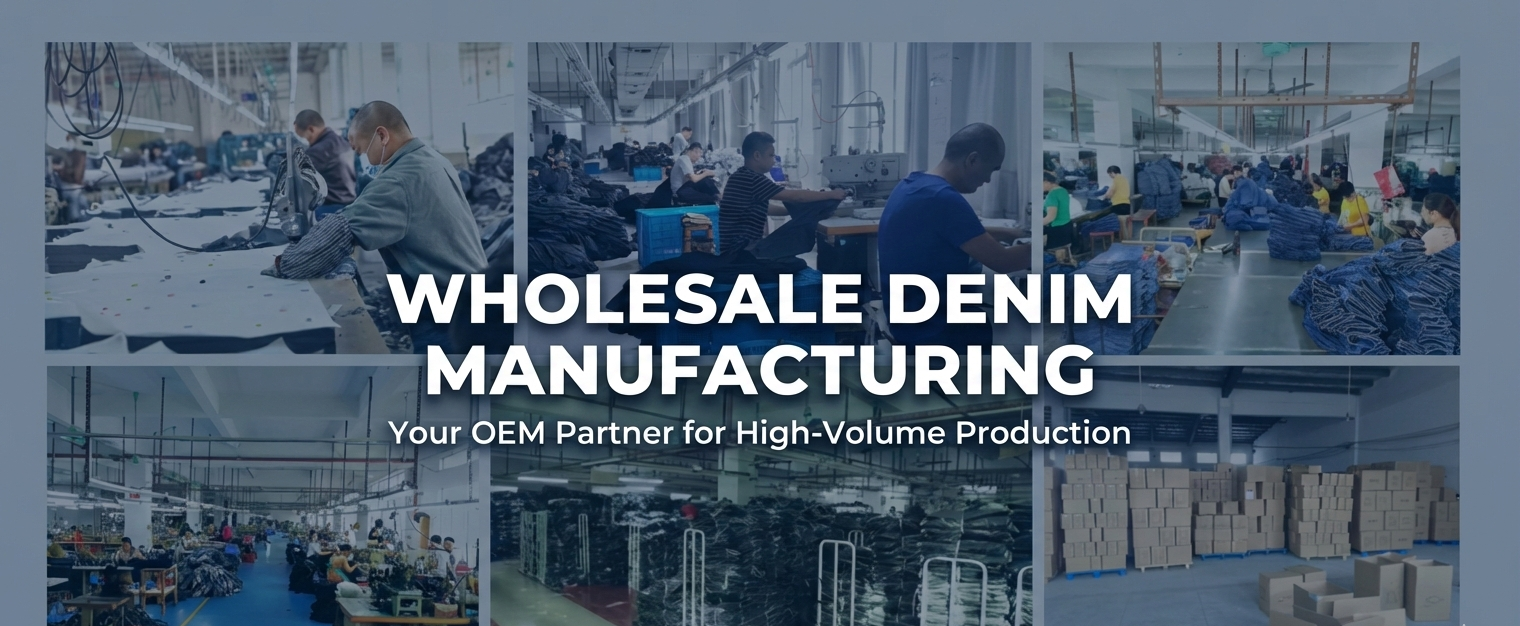
Wholesale Denim Manufacturing Capabilities
Wholesale denim production introduces consistency challenges that do not exist at smaller volumes: multiple fabric rolls from the same dye lot, wash batches running across days rather than hours, and size grading that must hold across a full run of thousands of pieces.
This page covers the specific systems we use to manage these challenges — fabric lot control, wash batch documentation, measurement tolerance standards, and QC across large runs. It also covers production capacity, pricing tiers, and how repeat orders are handled across seasons.
If you want to understand how we work with importers and wholesalers as a client type, see our [For Importers & Wholesalers] page in Who We Serve.
Production Capacity
Understanding our capacity upfront saves time on both sides.
| Capacity Metric | Detail |
|---|---|
| Monthly output | 30,000–50,000 pieces across all active styles |
| Simultaneous styles | Up to 8–12 styles in production at one time |
| Wholesale MOQ | 1,000 pieces per style per color |
| Mid-volume range | 500–999 pieces (same process, higher per-unit cost) |
| Maximum single order | 10,000+ pieces per style, discuss timeline in advance |
| Size range | XS–4XL or 26–44 waist depending on style |
| Bulk production: 1,000–3,000 pcs | 20–30 working days after PPS approval |
| Bulk production: 3,000–5,000 pcs | 30–40 working days |
| Bulk production: 5,000–10,000 pcs | 40–55 working days |
Orders above 5,000 pieces require production scheduling discussion before we confirm the timeline. We do not overcommit production capacity and give inaccurate timelines.
Fabric Lot Control
At wholesale volume, a single style may require 8–15 fabric rolls to complete the order. Variation between rolls — in color shade, weight, or weave density — is the most common source of visible inconsistency in bulk denim production.
How we manage fabric lot consistency:
Step 1: Dye lot verification before ordering When we place a fabric order for a wholesale run, we specify the dye lot and request that the mill supplies all rolls from the same lot. If the quantity requires more than one lot, we request swatches from each lot and compare them before confirming the order.
Step 2: Roll-to-roll check before cutting Before any cutting begins, our fabric team pulls a sample from each roll and checks it against the approved standard:
- Color shade under standardized lighting (D65 lightbox)
- Weight per square meter (within ±5% of spec)
- Stretch recovery if elastane fabric (within ±3% of spec)
Rolls that fall outside tolerance are flagged. We do not cut fabric that has not passed the roll-to-roll check.
Step 3: Cut planning by roll We plan the cut to minimize roll changes within a single size. Mixing rolls mid-size creates the highest risk of shade variation between pieces. Where possible, we assign specific rolls to specific sizes.
Wash Batch Management
Wash consistency across a large run is where most wholesale denim factories struggle. A 3,000-piece order may involve 30–35 wash cycles over 3–4 days. Without documentation and active monitoring, the result across the first and last batches can be visibly different.
Our wash batch documentation system:
Every wash cycle is logged with:
- Cycle start time and duration
- Water temperature
- Chemical type and quantity per kilogram of fabric
- Stone or abrasive load (if applicable)
- Machine identifier
This log is reviewed against the approved wash recipe before each cycle begins. If a variable has drifted from the recipe — water temperature running 3°C high, for example — the cycle is adjusted before loading.
Shade monitoring during the run:
After every 5th cycle, a finished garment is pulled and compared against the approved Pre-Production Sample (PPS) under standardized lighting. If the shade reading falls outside the agreed tolerance (±0.5 grey scale grade), we stop the run, identify the cause, and correct before continuing.
Batches that fall outside tolerance are not mixed with on-spec batches. They are either adjusted and rewashed or set aside for review. We do not ship a mixed-shade bulk order.
Wash types available at wholesale volume:
| Wash Type | Consistency at 1,000+ pcs | Notes |
|---|---|---|
| Rinse wash | Excellent | Most stable across large runs |
| Enzyme wash | Excellent | Consistent biological action |
| Stone wash | Good | Load and cycle control critical |
| Vintage wash | Good | More variables, requires tighter monitoring |
| Ozone finishing | Excellent | Machine-controlled, consistent |
| Laser finishing | Excellent | Digitally controlled, identical per piece |
| Hand sanding | Moderate | Manual process, sorted by grade before packing |
| Distressed effects | Good | Bar-tack placement consistent, hole size varies slightly |
| Garment tinting | Good | Batch-to-batch color logged and matched |
For styles using hand sanding, we visually grade finished pieces before packing. Pieces that fall outside the approved effect range are reworked before shipment.
Measurement Tolerance and Size Consistency
Measurement drift across a large run is a real production variable. Fabric relaxes differently after washing depending on where it came from in the roll. Sewing line variation adds a further layer of tolerance.
Our standard measurement tolerances for wholesale orders:
| Measurement Point | Tolerance |
|---|---|
| Waist (relaxed) | ±1 cm |
| Hip | ±1.5 cm |
| Front rise | ±0.5 cm |
| Back rise | ±0.5 cm |
| Thigh | ±1 cm |
| Knee | ±1 cm |
| Leg opening | ±0.5 cm |
| Inseam | ±1 cm |
These tolerances are tighter than the ±2cm standard used by many factories. We confirm tolerances in writing before bulk production begins. If your specification requires tighter tolerances on specific points, we discuss this during pre-production alignment.
How we check measurements at wholesale volume:
We measure a minimum of 10% of finished garments across all sizes after washing. For each size, we measure at least 10 pieces. Key measurement points are recorded against the approved PPS spec. If any measurement falls outside tolerance in the sample, we expand to 100% checking for that size before releasing it to packing.
Grading Consistency Across the Size Run
Size grading for wholesale orders requires testing at the extremes of the size range, not just at the mid-size.
A pattern that fits correctly at size 32 can gap at the waistband at size 40, or pull through the thigh at size 28, if the grading increments are not set correctly.
Our grading process for wholesale styles:
- We test fit at a minimum of three size points: smallest, a mid-size, and largest in the run
- Grading increments are reviewed at each size bracket separately — we do not apply a single increment across the full size range
- For extended size grading (XS–4XL or 28–44 waist), we run a dedicated fit review at the plus-size end of the range before approving the grade for bulk
For styles with proportional grading requirements — particularly plus-size fits where thigh ease, rise height, and crotch depth scale differently than standard — see our [Plus Size Denim Pattern Logic] page in Resources.
Pre-Production Sample Before Every Bulk Run
The Pre-Production Sample (PPS) is produced in the actual bulk fabric lot before any bulk cutting begins. It is the most important sample in the production process for wholesale orders.
What the PPS confirms:
- The approved fit translates correctly to the bulk fabric lot — different dye lots can behave differently
- The wash result matches the approved wash standard under bulk conditions (larger machine load, longer cycle time)
- All measurement points are within the agreed tolerance after washing
- Branding details (labels, patches, hardware) are correctly positioned and finish correctly through the wash
The PPS is signed off in writing before bulk cutting begins. We do not start bulk production without written PPS approval. This protects both sides: it means the buyer has seen and approved the exact standard that bulk production will follow.
QC Process for Wholesale Orders
Three inspection stages apply to all wholesale orders.
Stage 1 — Fabric inspection before cutting Every roll is checked before cutting. Defects, shade variation, and weight are verified. Rolls outside tolerance are not cut.
Stage 2 — In-line sewing inspection QC checks during sewing cover stitch density and tension, seam alignment, pocket placement accuracy, hardware attachment, and label and patch placement. Issues caught at this stage are corrected before garments enter the wash, avoiding the cost of rewashing or discarding finished goods.
Stage 3 — Post-wash final inspection After washing and finishing, 10% of the bulk order is measured across all sizes. Appearance is checked for wash consistency, construction defects, and branding detail quality. Any size with measurement issues in the sample is moved to 100% checking before packing.
Third-party inspection: We support SGS, Bureau Veritas, Intertek, and independent inspection agencies. We need 2–3 working days’ notice before inspection to ensure finished goods are accessible and documentation is prepared.
Repeat Orders and Seasonal Supply
For buyers placing repeat wholesale orders on the same style:
Spec retention: Pattern, fabric specification, wash recipe, and branding details are retained after the first approved production run. Repeat orders reference the same standard — no development cost applies.
Faster turnaround: Because development is complete, repeat orders move directly to PPS confirmation and then bulk. Typical repeat order timeline is 2–3 weeks shorter than a new style.
Fabric continuity: For repeat orders, we request fabric from the same mill and, where possible, the same dye lot series. If the mill has changed the fabric construction between seasons, we flag it and request a comparison swatch before committing to bulk.
Seasonal planning: For buyers with predictable seasonal demand (e.g., two main orders per year), we can discuss reserving production capacity in advance. This is particularly relevant for orders above 3,000 pieces where production scheduling affects our overall capacity allocation.
Pricing Tiers
Pricing depends on fabric weight, wash complexity, branding requirements, and style construction. The ranges below are indicative for a standard jeans style in mid-weight denim with a single standard wash.
What moves pricing within the range:
Higher end of range: heavyweight fabric (14oz+), complex multi-stage wash (vintage, heavy stone with hand sanding), extended size grading (XS–4XL), full branding with engraved hardware.
Lower end of range: mid-weight fabric (11–13oz), single standard wash (rinse or enzyme), standard size run (S–XL or 30–38 waist), basic branding (woven label, standard button).
What to Send for a Wholesale Quote
To provide an accurate quote and production timeline, the most useful information is:
- Tech pack or reference sample
- Target fabric: weight, stretch level, any specific certification requirement
- Wash direction: reference photos or PPS from a previous supplier
- Quantity per style per color
- Full size breakdown (pieces per size)
- Branding requirements
- Required delivery date or production window
- Destination country (for shipping and compliance documentation planning)
If you have an existing approved sample from another factory, send it. We will assess what we can match and flag any areas where our production process may produce a slightly different result.
FAQ
What is the wholesale MOQ?
1,000 pieces per style per color is our standard wholesale MOQ. Orders between 500–999 pieces are handled at a higher per-unit cost using the same production process. Below 500 pieces, see our Low MOQ production page.
Can we order multiple styles in one shipment?
Yes. Many wholesale buyers order 3–10 styles in one production run and consolidate into one shipment. Each style has its own MOQ and timeline. We coordinate production to align shipment dates where possible.
What measurement tolerance do you work to?
Our standard tolerance is ±1cm on most key points after washing, tighter than the ±2cm standard used by many factories. Specific tolerances are confirmed in writing before bulk production begins.
Do you support third-party inspection?
Yes. We work with SGS, Bureau Veritas, Intertek, and independent agencies. Please give us 2–3 working days’ notice before the inspection date.
Can you provide fabric and compliance documentation?
Yes. We provide fabric composition certificates, mill test reports, and where applicable, OEKO-TEX, GOTS, or GRS certification documentation. Documentation requirements should be confirmed before production begins.
How are repeat orders handled?
Repeat orders on an approved style use the retained pattern, fabric spec, and wash recipe. No development cost applies. Timeline is 2–3 weeks shorter than a new style. Pricing is confirmed before each order based on current quantity and material costs.
What if bulk production doesn’t match the approved PPS?
We measure finished garments against the PPS after washing. If results fall outside tolerance, we identify the cause and either rework the affected pieces or replace them before shipment. We do not ship goods that have not passed the post-wash measurement check.


