For apparel importers, private labels, and fashion wholesalers, selecting a denim manufacturer is a high-risk supply chain decision. Denim is not like standard knitwear; it is a rigid twill fabric that undergoes aggressive chemical and mechanical wet processing after assembly. A factory that excels at making t-shirts will often fail entirely when tasked with heavy-duty denim.
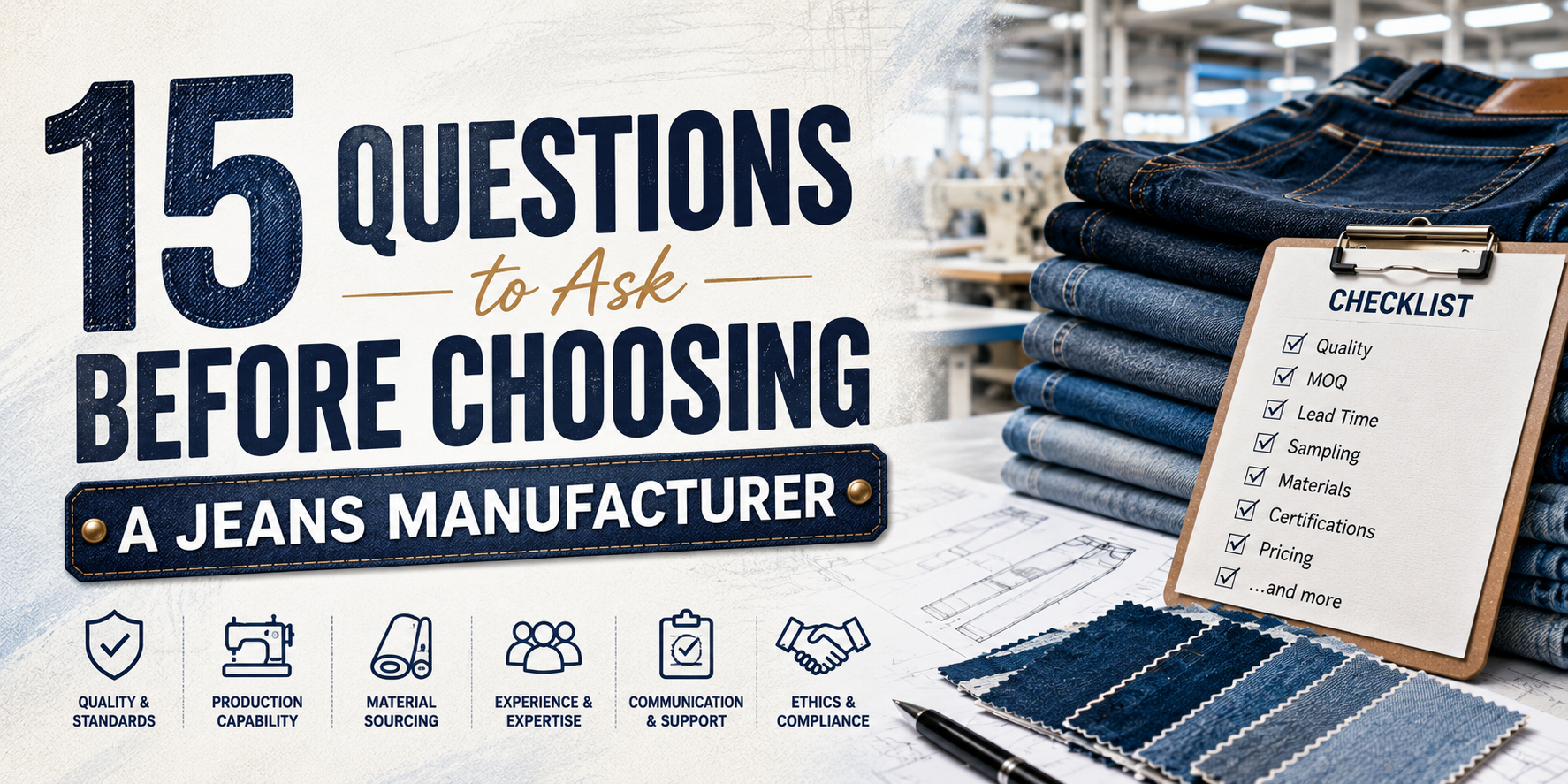
To prevent bulk quality drift, skewed seams, and unpredictable wash shrinkage, procurement teams must audit suppliers rigorously. Below is a definitive checklist of 15 technical questions you must ask a potential partner in China before finalizing a custom denim order.
How Do You Verify the Factory’s Core Manufacturing Identity?
Many suppliers listed on global B2B platforms operate as middlemen, routing orders to unverified sub-contractors. You must establish direct factory accountability first.
1. Are you a direct garment factory or a trading company? Direct factories control the schedule and quality on the floor. Trading companies add a markup and often lack deep technical knowledge of denim machinery.
2. What does your Chinese business license specify? Request their business license. The “Business Scope” should explicitly state “manufacturing,” “processing,” or “production” of garments. If it only lists “wholesale” or “import and export,” they are a trading agent.
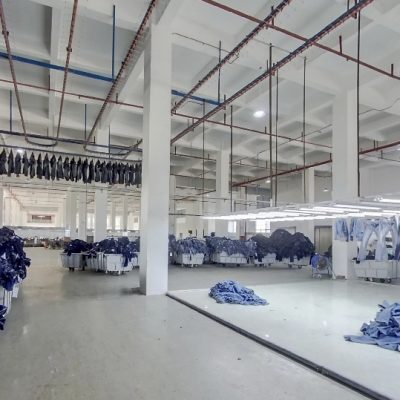
3. Do you have dedicated production lines specifically for heavy denim? Standard lightweight sewing machines cannot process 12oz to 14oz denim. The factory must own heavy-duty dual-differential feed machines to handle thick, folded seams without breaking needles.
What Are Your Technical Pattern Making and Sizing Capabilities?
Denim sizing is highly volatile due to wash shrinkage. Your manufacturer must engineer patterns mathematically, not just visually.
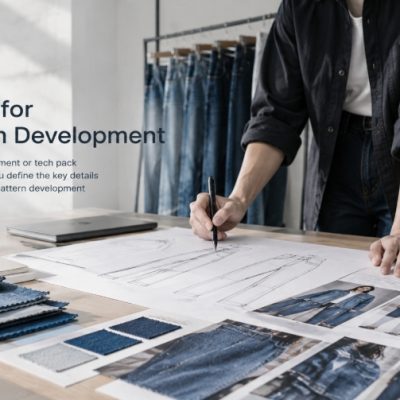
4. Do you use in-house CAD grading software? Manual cardboard patterns lead to inconsistent size runs. Reliable factories employ CAD engineers to create precise grading rules tailored to US, EU, or Asian sizing charts.
5. How do you calculate and adjust for fabric shrinkage before cutting? This is a critical question. The factory must answer that they conduct a 1×1 meter fabric swatch wash test on every incoming roll to calculate exact warp and weft shrinkage, adjusting the digital CAD markers before cutting.
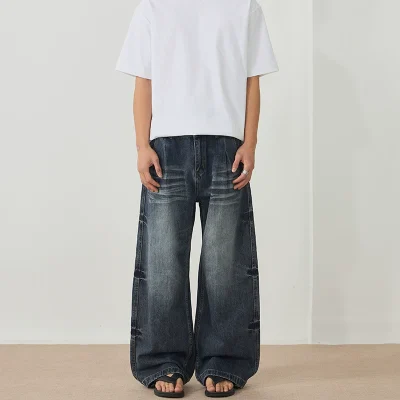
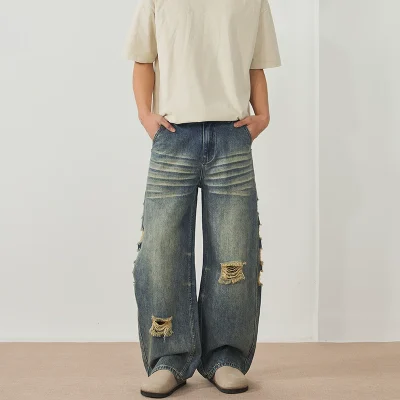
6. Can you engineer complex fits without dimensional drift? Ask if they can balance the “top block” (waist and rise) while scaling complex silhouettes like men’s wide-leg jeans, relaxed fits, or heavy cargo styles.
How Do You Manage Fabric Sourcing and Industrial Washing?
The industrial laundry phase dictates the final aesthetic and durability of the jeans.
7. How do you control shade banding and color consistency? Indigo dye shifts naturally. The factory should utilize standardized D65 light source boxes to categorize finished bulk garments into matching shade bands, ensuring no mismatched tones end up in the same retail carton.
8. What automated wash technologies do you operate? Look for factories utilizing automated laser distressing and ozone gas fading. These modern techniques eliminate the inconsistencies of manual hand-sanding and PP spray.
9. How do you prevent leg twist on finished bulk jeans? Leg twist happens when fabric is cut off-grain. The cutting room must align patterns strictly parallel to the vertical warp threads. They should also recommend pre-skewed fabrics to counter the twill weave’s rotational pull.
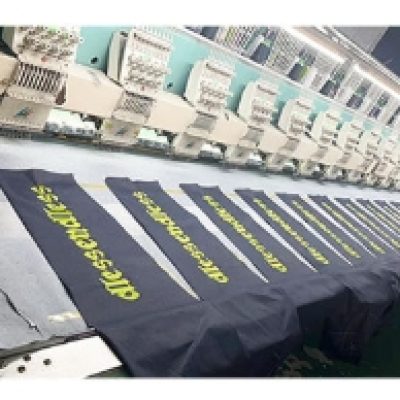
10. How do you prevent dye migration on embroidered or printed denim? If your tech pack includes graphics, the factory must apply low-cure anti-migration underbases for prints, or use high-tensile 100% polyester threads for flat-panel embroidery before the industrial wash.
What Are Your Quality Control and Assembly Standards?
The structural integrity of custom jeans relies on strict hardware and sewing floor management.
11. Do you use heavy-duty chain-stitching for critical seams? Inseams and outseams require double or triple-needle chain stitching to stretch naturally with the heavy fabric and prevent thread snaps during wear.
12. What is your standard Stitch Per Inch (SPI) count? A premium denim standard is 8 to 10 SPI. Lower-tier suppliers will drop this to 5 or 6 to speed up production, resulting in weak, cheap-looking seams.
13. What are your commercial measurement tolerances? For premium B2B custom orders, the measurement tolerance for critical points (waist, rise, inseam) should be strictly capped at +/- 0.5 inches (+/- 1.2cm).
14. Do you utilize industrial needle detectors? Because denim requires heavy needles, breakages happen. The factory must pass 100% of finished garments through a conveyor needle detector to ensure no hazardous metal fragments remain in the pockets or seams.
How Do You Handle Minimums and Logistics?
Finally, align their commercial terms with your brand’s growth trajectory and shipping strategy.
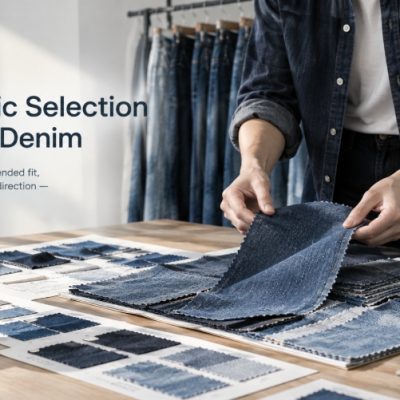
15. How do fabric choices affect your Minimum Order Quantities (MOQs)? A reliable factory will explain that custom-dyed fabrics require high mill minimums, but they can offer flexible MOQs by utilizing premium stock fabrics or aggregating fabric yardage across multiple styles in your collection.
Why Choose Xinen Garment for Your Custom Denim Production?
Executing a flawless denim collection at scale requires technical discipline. Located in China, Xinen Garment is a direct-to-B2B professional denim manufacturer specializing in serving global fashion importers, private labels, and wholesalers.
- Precision Fit Engineering: We do not guess fabric behavior. Our CAD pattern engineers integrate lot-specific shrinkage data directly into our cutting markers, guaranteeing your bulk orders match the approved pre-production sample within a strict +/- 0.5-inch commercial tolerance.
- Advanced Wash Control: From raw indigo rinses to complex vintage stone and ozone washes, we manage wet processing with digital precision to eliminate batch-to-batch shade variance.
- Transparent Supply Chain: We provide verifiable manufacturing data, welcome third-party QC inspections (such as SGS or Intertek), and manage complete export logistics (FOB, CIF, or DDP) to ensure your inventory lands securely and on schedule.
Frequently Asked Questions (FAQ)
What is the development timeline for a pre-production denim sample?
Sample development typically requires 7 to 14 days once tech packs are verified and fabrics are selected. Bulk production generally ranges from 30 to 45 days following your final sample approval.
Can we use our own custom-branded hardware?
Yes. We integrate client-provided hardware or assist in sourcing custom-molded, anti-oxidizing zinc-alloy buttons, rivets, and debossed leather waist patches directly into our automated riveting lines.
Do you offer sustainable or eco-friendly denim manufacturing?
We source various sustainable formulations, including GOTS-certified organic cotton and recycled blends. Our wash partnerships utilize low-liquor ratio dyeing and ozone processing to drastically reduce water consumption compared to traditional methods.