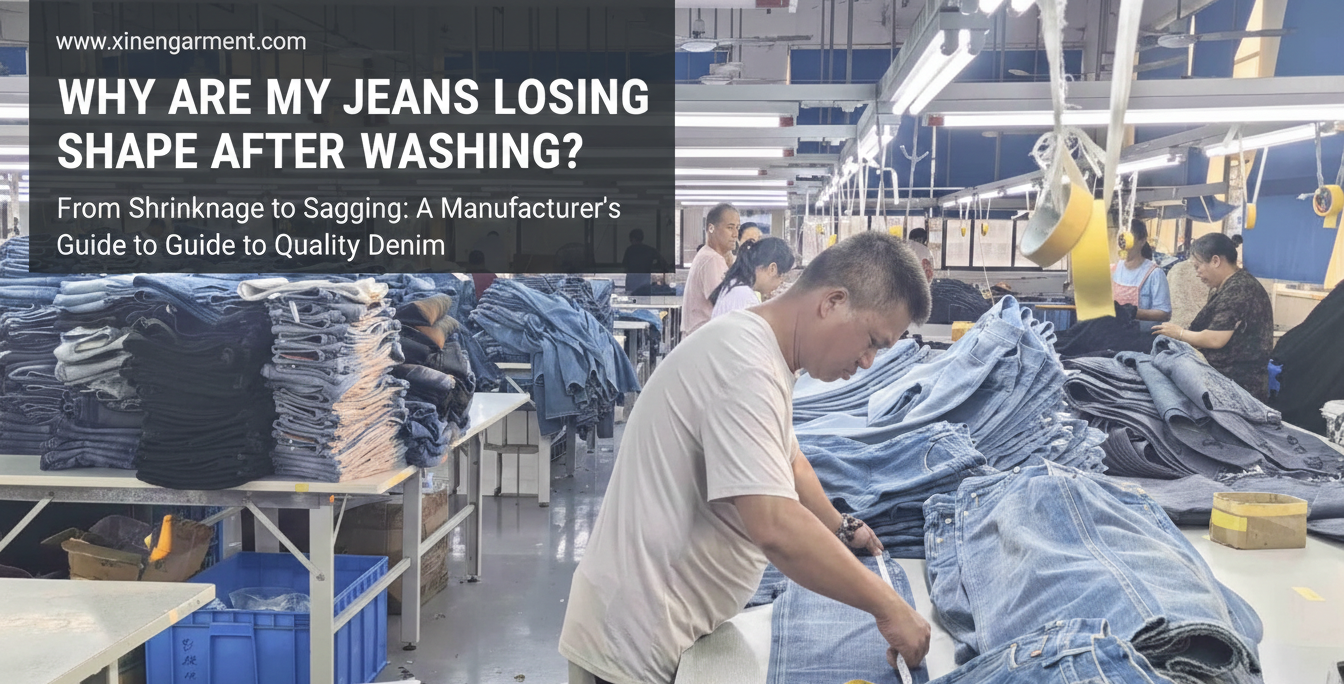
As a denim manufacturer, one of the most common complaints I hear from new brand owners is: “I bought a pair of jeans from another brand, and after two washes, the knees are baggy, the butt sags, and the side seams are twisted. How do we make sure our jeans don’t do this?”
Consumers usually blame the brand for selling a “cheap” product. Brands usually blame the factory for “bad sewing.” But the truth is entirely based on physics, fabric selection, and how the jeans were treated before they even left the sewing floor.
If you are developing a premium denim line—especially for a high-end market that expects a pair of jeans to last for years—here is the honest truth about why jeans lose their shape and how to stop it.
Are You Cooking the Elastane in Your Jeans?
Let’s start with the most common reason stretch jeans sag: heat.
If you are designing women’s jeans with 1% or 2% elastane (Spandex/Lycra) for comfort, you need to understand that elastane is basically rubber. What happens to a rubber band if you leave it in the hot sun or boil it? It melts, gets brittle, and snaps.
When a consumer washes their stretch jeans in hot water and then throws them into a hot tumble dryer, they are literally cooking the elastane fibers. Once those tiny elastic threads snap inside the denim, the fabric loses its “recovery” (the ability to bounce back). The knees stretch out when the person sits down, and because the elastane is dead, the fabric just stays baggy forever.
The Factory Fix: Put clear, strict care labels inside your jeans: Wash Cold. Hang Dry. Never Tumble Dry. Educate your customers that heat destroys stretch denim.
Did the Factory Skip the “Wash Test” Shrinkage Check?
This is a dirty little secret in fast-fashion manufacturing. Every single roll of denim shrinks differently when it hits the water.
In a professional factory, before we cut 300 pairs of jeans, we take a 1×1 meter square of your chosen fabric and wash it in our massive industrial machines. We measure it after it dries to find the exact shrinkage percentage (e.g., 4% in the length, 2% in the width). We then make your paper patterns 4% longer and 2% wider so that after the industrial wash, they shrink down to your perfect measurements.
Cheap factories skip this step to save time. They cut the fabric exactly at the target size. When the consumer washes the jeans at home for the first time, the fabric finally undergoes its natural shrinkage. The fit is instantly ruined, and the jeans feel warped.
Is the Fabric Woven Too Loosely?
Not all 12oz denim is created equal. Fast fashion brands love loosely woven denim. Why? Because it uses fewer cotton yarns per square inch (which saves money) and it feels artificially “soft” right off the shelf.
However, a loose weave has no structural integrity. When the wearer moves, the yarns simply slide apart. The fabric has no “memory.” For high-end Nordic and European markets, you should always choose a tightly woven denim. It might feel slightly stiffer on the first wear, but a dense weave locks the yarns in place, meaning the jeans will mold to the wearer’s body and hold that shape for years.
Why Do the Legs Twist After the First Wash?
Have you ever washed a pair of jeans and noticed the outside side-seam twisted all the way to the front of your kneecap? This is called “leg twist,” and it is a manufacturing failure.
Denim is a twill weave, meaning the yarns are woven diagonally. When water hits twill, the fabric naturally wants to pull and twist in the direction of that diagonal line. Premium fabric mills treat the fabric (a process called “skewing”) to counter-balance this natural twist.
If a factory buys cheap, un-skewed fabric, or if the cutting department rushes and cuts the pattern panels “off-grain” (not perfectly aligned with the fabric threads), the jeans will look fine on the hanger but will violently twist the moment they are washed.
How Can Brands Prevent This Before Production?
If you are ordering a batch of premium jeans, you must control the process before the sewing machines turn on.
- Ask for the Shrinkage Report: Make sure your factory actually tested the fabric roll they are using for your bulk order.
- Check the Stretch Recovery: If you use stretch denim, ask the factory for the fabric’s “recovery rate.” Good premium stretch denim should recover at least 90% of its shape within 30 seconds of being stretched.
- Stick to Heavy/Medium Weights: For a shape that holds, avoid anything under 10oz unless it is specifically a summer chambray. 12oz to 14oz is the sweet spot for durability and structure.
FAQ: The Reality of Denim Fit and Washing
Can 100% rigid cotton jeans lose their shape?
Yes, but in a different way than stretch jeans. 100% cotton (rigid denim) naturally “bags out” by about half a size as you wear it because the cotton fibers relax under body heat and tension. However, unlike stretch jeans where the damage is permanent, washing a 100% cotton jean will tighten the fibers right back up to their original shape.
What is the ideal stretch percentage for high-end women’s jeans?
For the Scandinavian/Minimalist market, less is more. 1% to 2% elastane mixed with 98% or 99% cotton is the absolute golden rule. This gives the wearer enough comfort to sit at a desk all day, but keeps the heavy, authentic look of vintage denim. Anything above 3% or 4% elastane starts to look and behave like a cheap yoga legging.
Should my customers freeze their jeans instead of washing them?
No. This is an internet myth that refuses to die. Freezing your jeans does not clean them; it just puts the bacteria to sleep until they warm up again. Dirt, body oils, and dead skin build up in the fabric and actually break down the cotton fibers faster, causing blowouts in the crotch. Wash your jeans inside out, in cold water, with a gentle detergent every 10 to 15 wears to protect the fabric.