If you are an independent designer in Copenhagen, you already know the harsh reality: you cannot compete with global fast-fashion giants on price.
When a massive brand orders 50,000 pairs of jeans, their cost per unit is incredibly low. If you try to play their game by ordering thousands of units just to save a few dollars per pair, you will likely end up with an empty bank account and a warehouse full of unsold stock.
In the premium Nordic market, the smart move isn’t to be “bigger”—it’s to be faster and more exclusive. By using a Low MOQ (Minimum Order Quantity) strategy—specifically the “Magic 300”—small labels are actually beating the giants. Here is how it works in the real world.
Why Does “Selling Less” Actually Make More Sense?
Big brands sell volume; you sell uniqueness. In the Danish high-end market, consumers want to wear something their friends don’t have.
By keeping your production runs to 300 pairs, you create natural scarcity. It isn’t just a “production limit”; it’s a marketing story. When a style sells out, it’s gone. This creates urgency. For a small brand, “Sold Out” is the ultimate proof of desirability. It also means you aren’t paying for a massive storage unit or desperately putting your jeans on a 70% off clearance rack at the end of the season.
How Does the Cash Flow Math Work for Small Batches?
Let’s look at the numbers without the marketing fluff.
Imagine a massive factory tells you: “We can make these jeans for $10 a pair, but you must order 3,000 pairs.” That is a *$30,000* invoice.
Now, imagine a specialized factory like Xinen tells you: “We can make these for $15 a pair, but you only need 300 pairs.” That is a *$4,500* invoice.
Yes, your cost per unit is $5 higher. But you just saved **$1,500** in upfront cash. For a startup, that cash is your oxygen. You can use it for photoshoots, influencer marketing, or developing your next silhouette instead of having it sit as “dead stock” on a shelf.
What is the Realistic Timeline from Design to Delivery?
To compete with giants, you need to be agile. However, “small batch” does not mean “instant.” High-end denim requires a technical process that cannot be rushed if you want the fit to be perfect.
Here is what a real production calendar looks like when you work with us:
| Phase | Duration | What is actually happening? |
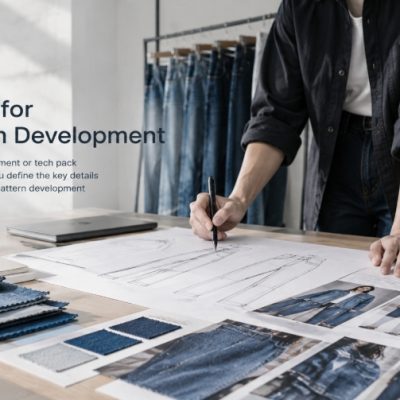
| 1. Tech Pack Review | 1 Week | We check your measurements against Danish sizing standards (longer inseams, specific waist ratios). |
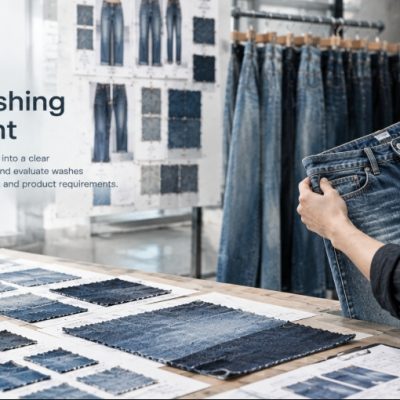
| 2. Fabric & Proto-Sample | 1-2 Weeks | We select high-quality stock fabric and sew one “Proto” to test the initial fit and shrinkage. |
| 3. Fitting & Approval | 1 Week | The sample is sent to Denmark. You test it on a fit model and we finalize any tweaks. |
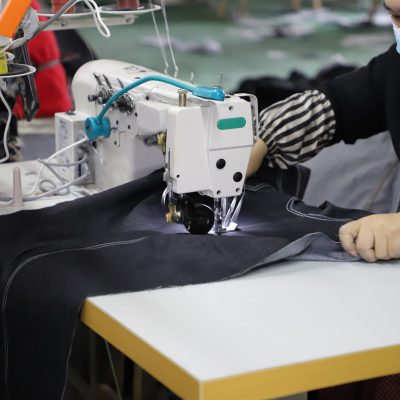
| 4. Bulk Production | 3-4 Weeks | This includes precision cutting, sewing, and the industrial wash cycle which gives the jeans their soul. |
| 5. Global Logistics | 1-2 Weeks | Air shipping (7-10 days) for quick launches, or Sea freight (5 weeks) to save on costs. |
Can a Small Run Really Match the Quality of a Big Brand?
The short answer is yes—if you hit the 300-piece mark.
As we’ve discussed before, 300 pairs is the “Magic Number” because it perfectly fills an industrial washing drum. It allows us to use the same heavy-duty machines that the big brands use, ensuring your fades and whiskering look authentic and expensive. You aren’t sacrificing quality; you are simply choosing to be more focused.
The Trade-off: What Are the Limitations of Low MOQ?
I promised to be honest, so here is the catch: At 300 pieces, you have to be flexible.
- Fabric: You usually have to use “Stock Fabrics” (high-quality rolls already at the mill) rather than weaving a custom fabric from scratch.
- Hardware: Custom-engraved buttons often have high minimums. Most small Danish labels solve this by using high-end “blank” hardware or investing in a large batch of buttons once and using them across multiple seasons.