Why is 300 the “Technical Limit” for Industrial Washing?
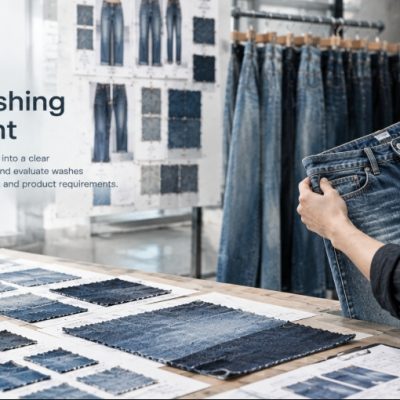
If you want that authentic, high-end look—think of those soft fades and perfect whiskering—you have to use industrial washing machines. These aren’t like the ones in your house. They are massive drums that hold 100kg to 200kg of weight.
Here is the physics of it: To get the right friction between the denim and the stones (or enzymes), the machine needs to be full. If we put only 50 pairs in a 100kg machine, the jeans just “float” around. They don’t get the abrasion they need, and the wash ends up looking cheap and flat. 300 pairs usually fill one or two industrial loads perfectly, ensuring every pair gets that premium, high-contrast finish.
How Does the Math Work for Premium Fabric Rolls?
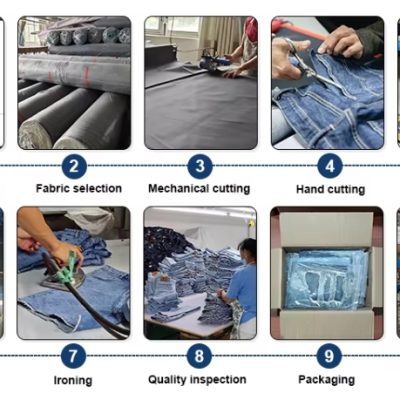
Denim fabric doesn’t come in meters; it comes in heavy rolls, usually 50 to 100 meters long.
- To make one pair of women’s jeans, you need about 1.3 to 1.5 meters of fabric.
- One roll of high-end Japanese or Italian denim might yield roughly 40 to 60 pairs.
If you order 300 pairs, we are using about 5 or 6 full rolls of fabric. This is the point where fabric mills stop charging us “small-batch surcharges.” It allows us to keep your cost per unit reasonable without forcing you to buy 1,000 meters of fabric you don’t need yet.
Can 300 Units Actually Cover Your Size Range?
In a market like Denmark, sizing is everything. You aren’t just selling “Small, Medium, Large.” You are likely selling waist sizes from 24 to 32.
If you try to do an order of 100 pairs across 10 sizes, you only have 10 pairs per size. That is a logistical nightmare. One “Sold Out” notification on a popular size like 27 or 28, and you’ve lost the sale. With 300 pairs, you can realistically stock about 30 to 40 units of your “hero sizes” and 15 to 20 of the outliers. It’s enough inventory to actually run a marketing campaign without selling out in two hours.
Does “Small Batch” Help or Hurt Your Brand Image?
In the high-end Nordic market, “over-production” is a dirty word. Customers value the fact that their jeans aren’t being mass-produced in a sweatshop by the millions.
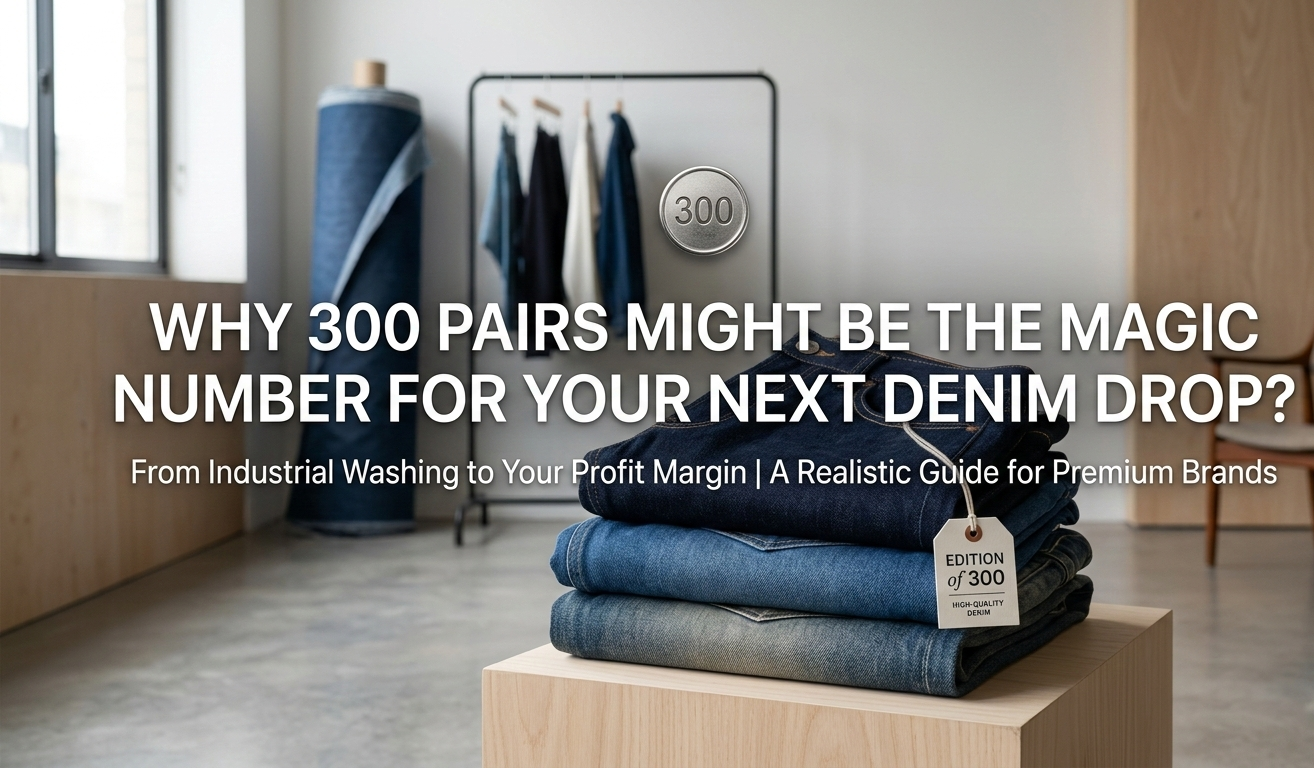
Marketing an “Edition of 300” creates a natural sense of scarcity. It tells your customer: “We didn’t make more than the world needed.” It justifies a higher price point because the product is exclusive. From a business side, it also means you aren’t paying for a massive warehouse. You can move the stock, get your cash back, and reinvest in your next 300-pair drop within a few months.
What is the “Hidden Catch” with 300-Piece Orders?
I promised to be honest, so here it is: 300 pairs will always be more expensive per unit than 3,000 pairs.
The time it takes my team to create the pattern, calibrate the sewing machines, and test the wash recipe is the same whether we make 300 or 3,000. On a 300-piece run, those “setup costs” are spread over fewer items. You are paying a premium for flexibility and lower risk. You are essentially buying insurance against the possibility of being stuck with 2,700 pairs of jeans that don’t sell.
The Bottom Line If you are a growing brand, don’t rush into 1,000-unit orders because you want a cheaper price. And don’t settle for 50-unit “sample runs” that look terrible because the wash wasn’t done in a real machine.
300 is where the chemistry of the wash, the economics of the fabric, and the reality of your bank account finally meet.
Are you planning a 2026 collection? Let’s look at your design. I can tell you exactly which stock fabrics we have that can hit that 300-pair mark without breaking your budget.