
For apparel brands, wholesalers, and private labels planning their 2026 inventory, allocating budget to the right silhouettes is a matter of margin protection. A frequent question among procurement teams is whether denim cargo pants are a passing trend or a stable category.
The market data for 2026 indicates that utility wear has transitioned from a micro-trend into a core menswear and womenswear staple. Consumers continue to demand functional, relaxed-fit garments. However, selling cargo denim successfully in 2026 requires executing the fit, pocket construction, and branding flawlessly. Here is a practical guide for brands looking to add cargo jeans to their production lines.
1. The Market Reality of Cargo Denim in 2026
Cargo jeans remain highly viable for B2B buyers because they offer higher retail profit margins compared to standard five-pocket jeans. The perceived value of the added pockets, heavy hardware, and complex wash finishes allows brands to command a premium price point.
- Shift to Relaxed Profiles: The demand for skinny or slim fits has flattened. The 2026 consumer expects wide-leg, straight, and relaxed cargo cuts that offer high mobility.
- Utility as an Everyday Aesthetic: Cargo pants are no longer restricted to workwear. With clean enzyme washes and minimal hardware, they have integrated into smart-casual and streetwear markets globally.
- Year-Round Sales Consistency: Unlike seasonal items, a well-constructed 13oz to 14oz cargo jean performs consistently across all four quarters, reducing end-of-season markdown risks for wholesale buyers.
2. Technical Preparations for New Denim Brands
If you are a new brand preparing to manufacture cargo denim, the transition from design concept to bulk production requires strict technical control. A cargo jean is structurally heavy, and small errors in the tech pack will ruin the bulk order.
Exact Measurement Standards
When submitting your tech pack to the factory, using the correct method of measuring jeans is mandatory. Because cargo pockets add weight to the side seams, incorrect measurement methods for the thigh, knee, or outseam will result in a garment that twists or restricts movement. Always measure the garment laid completely flat, taking the thigh measurement at a precise drop point below the crotch seam.
Clean Design Documentation
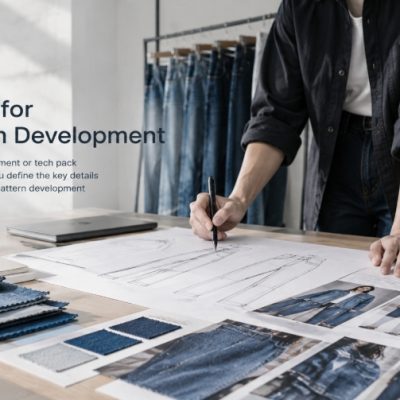
Factories operate on clear instructions. When compiling your design references for the pattern makers, merge your reference images together cleanly into a single, cohesive technical document. Relying on loose, scattered files or confusing layouts increases the risk of the factory misinterpreting the exact placement and proportions of the 3D bellows pockets.
Protecting Your Intellectual Property
To build a sustainable private label, your branding must be 100% original. A professional factory cannot and will not manufacture replicas. When sending reference photos, you must remove any existing text logos or trademarked back-pocket embroidery (such as the Levi’s arcuate). Provide your own original vector artwork for all leather patches, woven labels, and custom-molded hardware.
3. Fabric and Wash Specifications
The success of a cargo jean depends heavily on the raw material and the industrial laundry process.
- Fabric Weight: Cargo pockets require structure. Specify mid-to-heavyweight denim, strictly between 12oz and 14.5oz. Using lightweight fabrics will cause the pocket flaps to sag and tear at the stress points.
- Wash Finishes: Over-dyeing is highly requested in 2026. Applying earth tones like olive, brown, or charcoal over a standard indigo base yields a vintage, military-inspired aesthetic that appeals directly to the utility market.
4. Why Choose Xinen Garment for Cargo Denim Production
At Xinen Garment, we manage the technical complexities of manufacturing utility denim for international B2B clients, fast-fashion wholesalers, and independent labels. Operating out of our manufacturing facilities in China, including Foshan and Guangxi, we provide end-to-end OEM and ODM services.
- Precision Pattern Engineering: Our pattern makers balance the outseams and grade the cargo pockets proportionally across your entire size run, ensuring the heavy utility pockets do not distort the fit.
- Heavy-Duty Construction: Our production lines utilize automated bartack machinery to reinforce every pocket corner and flap joint, utilizing poly-core cotton thread capable of withstanding heavy industrial stone washing.
- Original Hardware Sourcing: We support your private label by molding custom, legally compliant solid brass snaps, zippers, and rivets based strictly on your original vector files.
- Direct Manufacturer Communication: By working directly with our factory team, you eliminate middleman markups and receive transparent production timelines from the pre-production sample to the final bulk shipment.
5. Frequently Asked Questions (FAQ)
Are 3D bellows pockets more expensive to produce than flat patch pockets?
Yes. 3D bellows (gusseted) pockets require folding, ironing, and complex top-stitching, which increases the cut-and-make (CM) labor time. However, they offer a more authentic tactical look that justifies a higher retail price point.
What is the minimum order quantity (MOQ) for custom over-dyed cargo jeans?
MOQs for complex washes and over-dyeing depend on the specific chemical bath requirements. Please contact our sales team with your tech pack for an exact volume and pricing assessment.
How do we stop the cargo pocket flaps from curling after washing?
We apply a layer of industrial interfacing (stabilizer) inside the pocket flaps before sewing. This ensures the flaps remain crisp and flat, even after heavy enzyme or vintage stone washing.