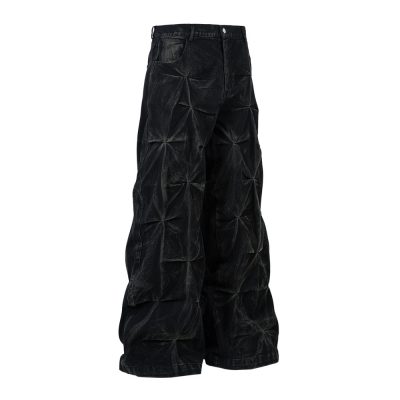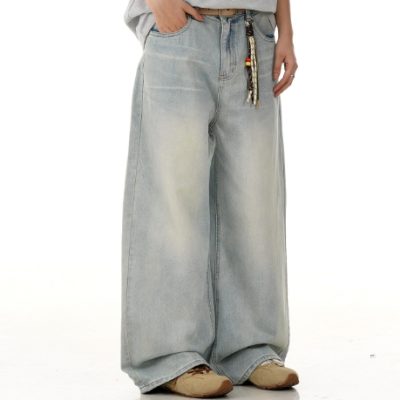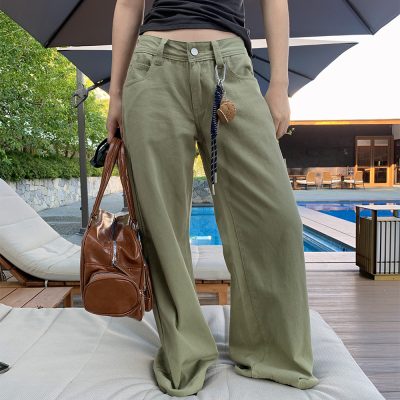
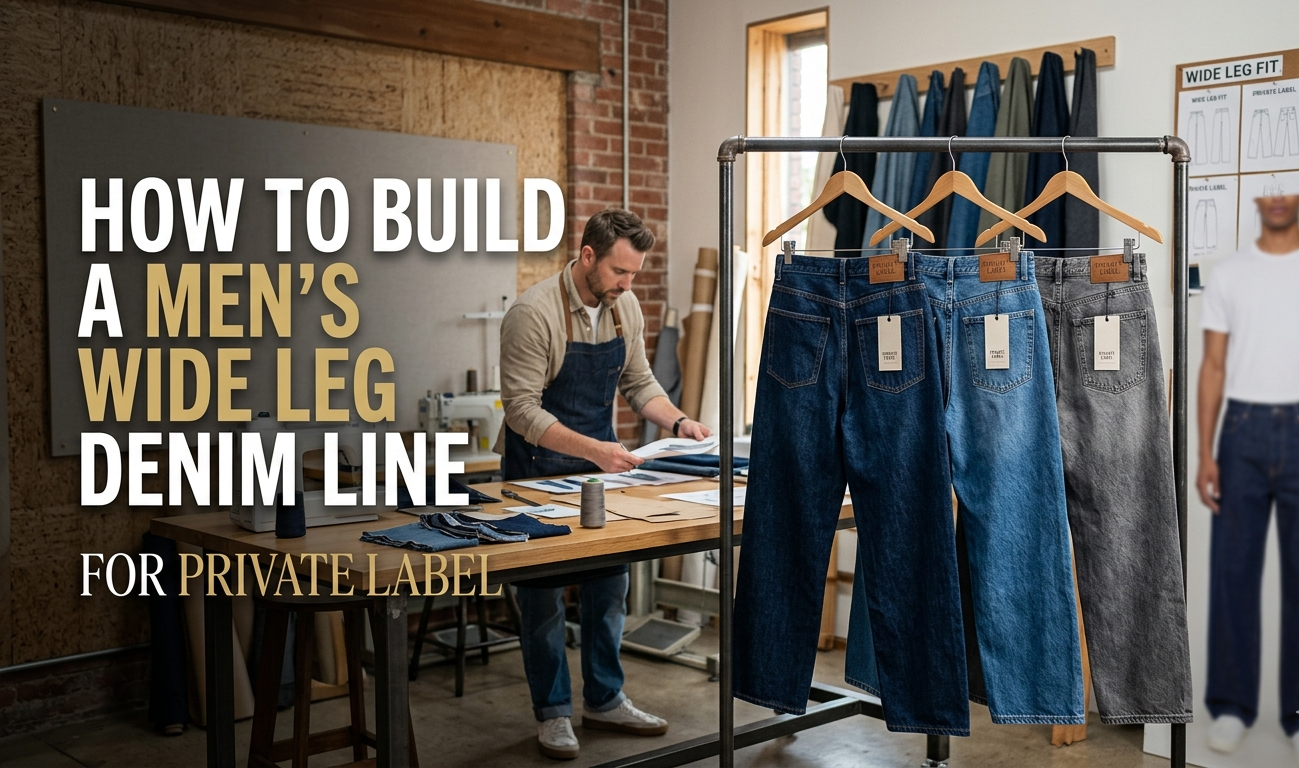
Launching a private label men’s wide-leg denim line requires shifting focus from purely aesthetic designs to industrial manufacturing parameters. For clothing importers, wholesalers, and fashion brands, wide-leg fits represent a high-margin opportunity, but they carry a higher level of pattern and fabric risk than standard straight or slim cuts.
Because wide-leg jeans utilize larger fabric panels that hang completely away from the body, any error in fabric selection, CAD sizing grading, or wash shrinkage calculation becomes highly visible on the retail shelf. This production guide breaks down the essential technical steps required to build a consistent, commercially viable wide-leg denim collection.
How Do You Select the Right Fabric Weight for a Premium Wide Silhouette?
The drape of a wide-leg jean is entirely dependent on the structural integrity of the textile. Lightweight fabrics collapse under their own weight, causing the wide silhouette to look baggy, wrinkled, and cheap.
- The Baseline Weight: For a premium, structured drape that falls cleanly from the hip to the shoe hem, private labels should specify a mid-to-heavyweight denim, ideally between 12oz and 14oz.
- Fiber Composition Realities: 100% cotton rigid denim remains the factory standard for authentic wide-leg collections. If your brand demographic requires comfort or stretch, limit elastane content to 1% to 2% max. Higher stretch percentages cause the wide leg panels to lose their geometric shape after a few hours of wear, leading to knee-bagging and pocket deformation.
What Pattern Grading Parameters Prevent Fit Drift Across Sizes?
A common failure point in scaled denim production is uniform grading, where a factory simply scales up every dimension of the pattern proportionally to create larger sizes. This creates an unwearable garment in the waist and seat.
- Isolating the Top Block: The technical secret to a clean wide-leg fit is a structured top block. The waist circumference, rise, and upper hip measurement must remain relatively tailored to anchor the garment securely on the pelvis.
- The Widening Pivot Point: The true widening angle of the CAD pattern should initiate smoothly below the lower crotch line or at the mid-thigh.
- Proportional Hem Control: Leg opening circumferences must be carefully graded alongside inseam lengths. For commercial private labels, a target leg opening of 19 to 22 inches balances modern volume with practical wearability, ensuring the hem does not drag on the ground.
Which Wash and Fading Techniques Mitigate Bulk Production Risks?
Because wide-leg jeans present a broad, flat canvas of fabric, any inconsistency in the industrial laundry stage is immediately apparent to the consumer.
- Pre-Clipped Shrinkage Adjustments: Heavy industrial washes (such as vintage stone washes or intensive enzyme washes) shrink denim unevenly along the warp and weft. Your manufacturing partner must execute a 1×1 meter fabric swatch test for every incoming denim lot, calculating exact shrinkage rates to adjust the CAD cutting markers prior to bulk fabric slicing.
- Transitioning to Low-Impact Fading: To ensure uniform color consistency across thousands of units, modern brands utilize automated laser distressing for whiskers and scraping, followed by ozone gas fading. This eliminates the human error associated with manual hand-sanding and chemical spray variations between wash batches.
How Can Custom Trims and Seam Construction Elevate the Line?
When a brand strips away heavy, overt branding in favor of a minimalist, modern wide-leg aesthetic, the construction details become the primary indicators of luxury quality.
- Lapped Seams with Chain-Stitching: Due to the increased weight of 13oz-14oz wide-leg panels, standard lockstitching along the inseam and outseam is prone to failure. Specify double-needle or triple-needle chain stitching to ensure flexible, high-tensile seam strength.
- Stitch Density (SPI): Maintain a strict manufacturing standard of 8 to 10 Stitches Per Inch. Lower SPI counts look cheap and degrade quickly under wash stress.
- Matte Industrial Hardware: Replace standard shiny rivets and buttons with custom-branded, oxidized, or matte-finished shank buttons. This subtle contrast against deep indigo or washed-black denim reinforces your private label’s premium market positioning.
Why Choose Xinen Garment for Private Label Denim Production?
Sustaining structural consistency across large-scale commercial runs requires an experienced, technically disciplined production partner. Xinen Garment operates a professional denim manufacturing facility in Foshan, specializing in translating high-end B2B tech packs into flawless bulk shipments.
- Advanced CAD Grading Capabilities: Our technical打版 (pattern engineering) team constructs custom sizing rules tailored specifically to your target demographic (US, EU, or Asian size charts), ensuring an exact fit in the top block across your full size run.
- In-House Wash Replication & Testing: We mitigate scaling risks by running rigorous pre-production fabric lot tests. We adjust our bulk cutting parameters to account for wash shrinkage, keeping your final bulk shipments strictly within approved size chart tolerances.
- Direct Factory B2B Support: We partner exclusively with clothing importers, wholesalers, and private labels. By managing the supply chain from raw fabric procurement to final multi-point quality inspections and shade banding, we deliver retail-ready inventory on schedule.
Frequently Asked Questions (FAQ)
What is the minimum order quantity (MOQ) for a custom private label wide-leg jean?
Our production MOQs are structured to meet the dye-lot requirements of premium textile mills. Please submit your tech packs and projected collection volumes to our team, and we will provide a scalable, competitive manufacturing quotation.
Can Xinen Garment source sustainable fabrics for our line?
Yes. We source a variety of sustainable denim formulations, including GOTS-certified organic cotton, recycled cotton blends, and Tencel-blend denim. We ensure these eco-fabrics maintain the necessary weave density to support wide-leg silhouettes.
How do you prevent leg twisting on wide-leg patterns during bulk sewing?
Leg twist occurs when fabric is cut off-grain. In our cutting room, patterns are strictly aligned parallel to the vertical warp threads of the denim roll. We also implement pre-skewed fabric processing to neutralize the natural rotational pull of the twill weave prior to assembly.
What is the development timeline for a pre-production wide-leg sample? Sample development typically takes 7 to 14 days once your tech pack and fabric choices are finalized. Bulk manufacturing requires approximately 30 to 45 days following your final approval of the pre-production sample (PPS).