For emerging apparel brands, independent private labels, and boutique wholesalers, scaling a denim collection presents a common financial hurdle: Minimum Order Quantities (MOQs). Navigating the industrial landscape of China’s denim manufacturing hub requires an understanding of how fabric mills and sewing floors operate.
Many new brands seek “low MOQ” options to test market response without overextending capital. However, because denim manufacturing relies heavily on industrial scale, sourcing flexible quantities requires a strategic approach. This guide outlines the technical realities of low MOQ production in China and how new brands can safely launch a denim line this year.
Why Is Denim Manufacturing Inherently Built for High Volumes?
To successfully negotiate lower production minimums, brands must first understand why factories prefer high-volume orders. Denim production is not a continuous single-piece process; it is highly dependent on heavy industrial infrastructure.
- Textile Mill Minimums: High-end denim mills weave and dye fabric rolls in massive industrial lots. A standard custom dye-run of premium 12oz to 14oz raw indigo denim typically requires thousands of meters of fabric. When a garment factory offers low MOQs, they cannot order custom-woven fabric from the mill.
- Industrial Laundry Logistics: Denim achieves its final aesthetic—whether a vintage stone wash, mid-blue enzyme fade, or washed black—inside large industrial laundry drums. These machines process garments in batches of 100 to 200 pairs to maintain uniform water temperature, mechanical friction, and chemical concentration. Washing a tiny batch alters the chemistry, leading to unpredictable color shifts and uneven shrinkage.
How Can Emerging Brands Successfully Source Low MOQs in China?
New labels can bypass traditional high MOQ constraints by adopting specific procurement strategies that align with factory workflows.
- Utilize Factory Stock Fabric Programs: Instead of requesting custom fabric compositions or unique dye formulations, select premium fabrics that the factory already holds in stock or can source from local wholesale markets. This allows the manufacturer to cut smaller batches without violating textile mill minimums.
- Standardize Fabric Profiles Across Fits: If your collection includes a men’s wide-leg jean, a classic straight-leg jean, and a denim jacket, use the exact same denim fabric weight and composition for all three styles. By aggregating your fabric yardage requirements, you become a more viable customer for the factory while ensuring color continuity across your product line.
- Leverage Hybrid Customization: Instead of paying for custom-molded metal buttons and rivets—which require high manufacturing minimums—use high-grade, unbranded industrial hardware. Focus your customization budget on flexible elements like embossed leather waist patches, custom pocket liners, and screen-printed internal branding, which can be produced efficiently in smaller lots.
What Technical Trade-offs Should You Expect with Smaller Fabric Runs?
While low MOQ options protect cash flow, scaling down production introduces technical variables that require strict quality management.
| Sourcing Factor | High-Volume Production | Low MOQ Production (Stock Fabrics) |
| Fabric Sourcing | Custom-dyed/woven directly from textile mills. | Sourced from factory stock or open wholesale markets. |
| Shade Consistency | High consistency across single-batch laundry lots. | Risk of minor batch-to-batch shade variance between fabric rolls. |
| Pattern Testing | Dedicated multi-stage fit samples and wear trials. | Compressed sampling cycles requiring precise initial tech packs. |
| Unit Costs (CMT) | Optimized for efficiency; lowest per-piece cost. | Higher per-piece cutting and sewing labor costs. |
Because smaller runs often pull fabric from different production rolls, checking for shade banding and executing accurate pattern adjustments is critical to preventing fit defects.
How Do Professional Factories Manage Flexible Orders Safely?
A reliable manufacturing partner does not compromise on technical execution just because an order is smaller. The factory must maintain the same strict quality control checkpoints utilized for large wholesale clients.
- Lot-Specific Shrinkage Tests: Stock fabrics from different lots react differently to industrial washing. Before cutting any panels, the factory must perform a 1×1 meter wash test to calculate exact warp and weft shrinkage, automatically adjusting the CAD cutting patterns.
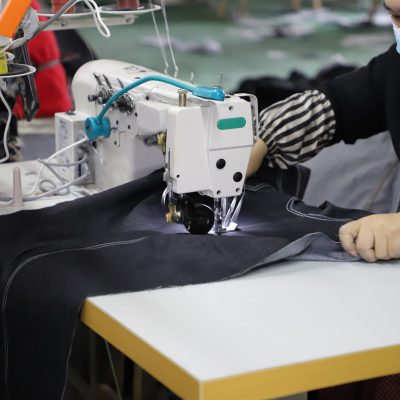
- Industrial Stitch Density: The sewing floor must utilize heavy-duty chain-stitch machinery, maintaining a standard of 8 to 10 Stitches Per Inch (SPI). Lower-tier suppliers often swap to standard lockstitching on small orders to save setup time, which leads to popped seams along the inseam and crotch under stress.
Why Choose Xinen Garment for Your Growing Denim Line?
Xinen Garment operates as a professional, direct-to-B2B denim manufacturer in Foshan, China. We build sustainable manufacturing partnerships with apparel importers, private labels, and fashion wholesalers by focusing on technical accuracy and scalable infrastructure.
- Advanced CAD Pattern Control: We eliminate fit drift. Our in-house pattern engineers construct precise CAD grading rules tailored to your regional demographic (US, EU, or Asian size charts), ensuring your waist, rise, and leg openings remain balanced across your entire size run.
- Rigorous Material Verification: We perform pre-cut shrinkage profiling and raw material inspections on every batch of fabric. Whether you are executing a structured wide-leg jean or a heavily washed vintage jacket, we ensure the final dimensions fall strictly within commercial tolerances (+/- 0.5 inches).
- A Pathway to Scale: We treat emerging brands as long-term partners. By optimizing our sewing floor lines and maintaining close relationships with certified, eco-compliant wash facilities, we help you manage initial inventory risks while providing the production capacity to scale as your wholesale volumes grow.
Frequently Asked Questions (FAQ)
Why are sample costs significantly higher than bulk production prices?
Sample development requires our senior pattern makers and master tailors to isolate a single pattern, adjust CAD markers manually, cut fabric by hand, and run separate, small-scale wash tests. The sample fee covers this intensive, individualized engineering labor.
How does Xinen Garment prevent leg twist on low MOQ orders?
Leg twist occurs when fabric panels are cut off-grain to save space on the cutting table. Regardless of order size, our cutting room technicians strictly align all CAD markers parallel to the vertical warp threads of the denim roll, eliminating the structural skewing common in low-tier manufacturing.
Can we implement complex vintage washes on smaller orders?
Yes, but the wash style dictates the production flow. Heavily distressed vintage stone washes or complex ozone fades require specific laundry drum volumes. We balance our production schedules to group identical wash recipes together, ensuring consistency for smaller private label lines.
What is the standard production timeline for a new brand’s order?
Once your tech packs are verified, sample development requires 7 to 14 days. Following your final approval of the pre-production sample (PPS) and raw material validation, bulk manufacturing typically ranges from 30 to 45 days, depending on the complexity of the wash finish.