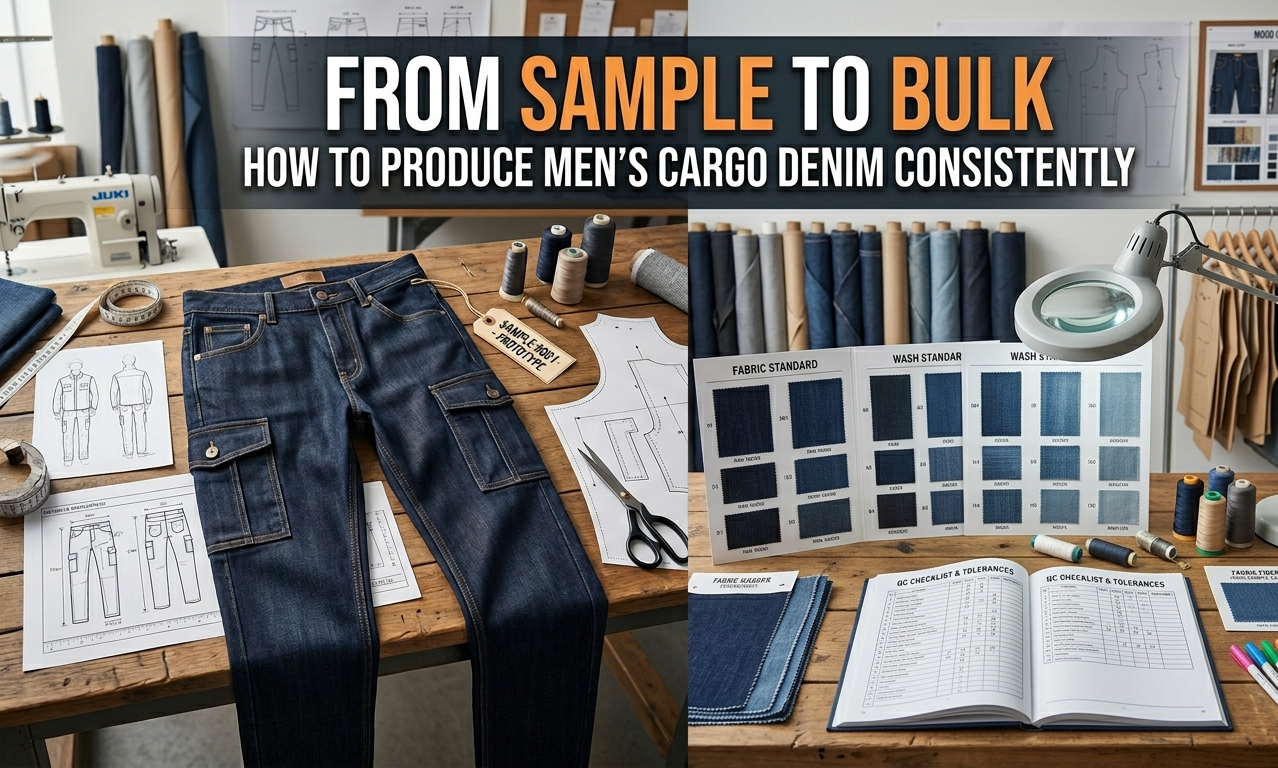
Approving a flawless pre-production sample (PPS) is a significant milestone for any emerging clothing brand. However, duplicating that exact fit, pocket layout, and wash tone across a high-volume wholesale run of 500, 1,000, or 5,000 pieces introduces major industrial variables.
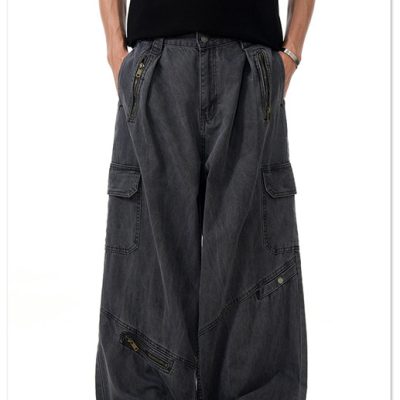
For men’s cargo denim jeans, maintaining bulk consistency is exceptionally difficult. Unlike standard five-pocket jeans, cargo styles feature multiple layers of overlapping fabrics, structural pocket flaps, and heavy metal hardware. If your manufacturing partner lacks rigorous multi-stage quality controls, your bulk shipment may arrive with twisted outseams, warped pocket flaps, or localized shading defects.
To safely scale your cargo line from sample to bulk without compromising your inventory investment, you must manage specific factory control points.
1. Calibrating Fabric Shrinkage for Multi-Layer Panels
Denim shrinks during commercial laundering processes like stone washing or enzyme rinsing. In cargo jeans manufacturing, the challenge lies in differential shrinkage.
A standard leg panel is a single layer of fabric, but a 3D bellows cargo pocket consists of multiple overlapping layers of denim and fused stabilizer fabrics (interfacing). These areas contract at completely different rates under the high temperatures of industrial washing and drying tunnels.
The Factory Solution
Before a single piece of bulk fabric is cut, the pattern room must perform an isolation wash test on a raw roll sample. If the fabric displays an 8% warp and 5% weft shrinkage profile, the digital cutting blocks for both the leg panels and the individual cargo pocket components must be graded up proportionally. This ensures that after the final bulk wash, the completed cargo pocket lies perfectly flat and the garment matches your size chart exactly.
2. Managing Proportional Pocket Grading Across Your Size Run
A template mistake made by unverified sourcing agents is utilizing a single, fixed pocket size across an entire size scale. A cargo pocket that looks perfectly proportioned on a size 32 waist sample will look tiny and misplaced on a size 40 waist, severely reducing its retail value.
The Factory Solution
Your manufacturer must apply rigorous digital grading blocks to the utility components. As the waist and inseam measurements scale upward, the height, width, and flap geometry of the cargo pockets must expand proportionally.
Furthermore, the placement markers—the exact distance from the waistline and the outseam—must be recalculated mathematically for each size pattern to ensure the visual profile remains identical across your entire inventory.
3. Standardizing Assembly Lines for Pocket and Hardware Attachment
Manual sewing variance is the primary cause of defects in wholesale apparel production. If operators sew pocket gussets or position pocket flaps based on guesswork, no two jeans in your order will look identical.
The Factory Solution
High-end denim production utilizes programmable automated sewing templates and heavy-duty sewing lines.
- Creasing Jigs: Pocket panels are fed into automated iron folding jigs to ensure every bellows pleat and flap edge has crisp, uniform dimensions before assembly.
- Automated Bartacking: The high-stress corners of cargo pockets undergo heavy mechanical strain. Automated bartack machinery must be calibrated to execute a precise stitch-per-inch (SPI) density, anchoring the pocket corners securely to prevent tearing during mass laundering.
4. Stabilizing Bulk Wash Recipes to Prevent Batch Shading
Indigo dye is an organic substance that reacts dynamically to water temperature, chemical concentrations, and friction duration. Because cargo pockets feature deep fabric folds, they easily trap loose dye particles, leading to dark, irregular stains inside the gussets—a defect known as indigo backstaining.
The Factory Solution
The laundry facility must document the exact chemical log, stone-to-garment ratio, water level, and heating profile used to approve your sample. For bulk processing, anti-backstaining agents must be mixed into the wash drums to suspend loose indigo in the water until it is fully drained.
Upon leaving the drying lines, quality inspectors must sort the completed jeans into precise shade bands to guarantee uniform color matching within every wholesale shipping carton.
Why Choose Xinen Garment for Consistent Bulk Cargo Production
At Xinen Garment, we eliminate the technical risks associated with scaling custom cargo denim lines. Operating directly as a premium manufacturer, we support clothing importers, fast-fashion wholesalers, and private labels with precise, data-driven production.
- Advanced Engineering and Shrinkage Control: We test raw fabric shrinkage properties prior to bulk cutting, modifying our automated pattern blocks to ensure your cargo elements match your approved tech pack tolerances.
- Industrial Heavy-Duty Sewing Floors: Our production floor is equipped with specialized automated folding and bartacking machinery, allowing us to replicate complex 3D bellows pockets cleanly across high-volume runs.
- Strict Quality Control Tolerances: We enforce an industrial measurement tolerance of +/- 0.5 inches on critical points. Any garment falling outside these parameters or showing shading variations is rejected internally before final packaging.
- Transparent Manufacturer Operations: By working directly with our factory teams in China (including Foshan and Guangxi), you remove trading company middleman markups, establishing clear volume pricing structures and direct accountability.
5. Frequently Asked Questions (FAQ)
What measurement tolerance limits should we specify for mass production?
For professional men’s cargo denim, you should enforce a strict structural tolerance of +/- 0.5 inches for the waist, hip, thigh, and leg opening. Any variance wider than this can distort the intended straight or relaxed fit profile.
How do you prevent the 3D cargo pockets from twisting the side seams during mass production?
Our technical pattern rooms balance the cutting dimensions of the front and back leg panels to offset the downward and forward pull of heavy cargo pockets, keeping your outseams perfectly vertical through repeated wash cycles.
How should we submit design adjustments if we need to modify our initial cargo sample?
To ensure absolute clarity on the production floor, please gather all structural notes, pocket measurements, and hardware placement charts, and merge them cleanly into a single technical design document. Fragmented files or loose images increase the risk of misinterpretation during sewing line setups.