Let’s be real: anyone can pay a few cents to have a fancy leather patch or a colorful woven label sewn onto a pair of jeans. In the world of premium denim manufacturing, a logo is the easiest thing to fake.
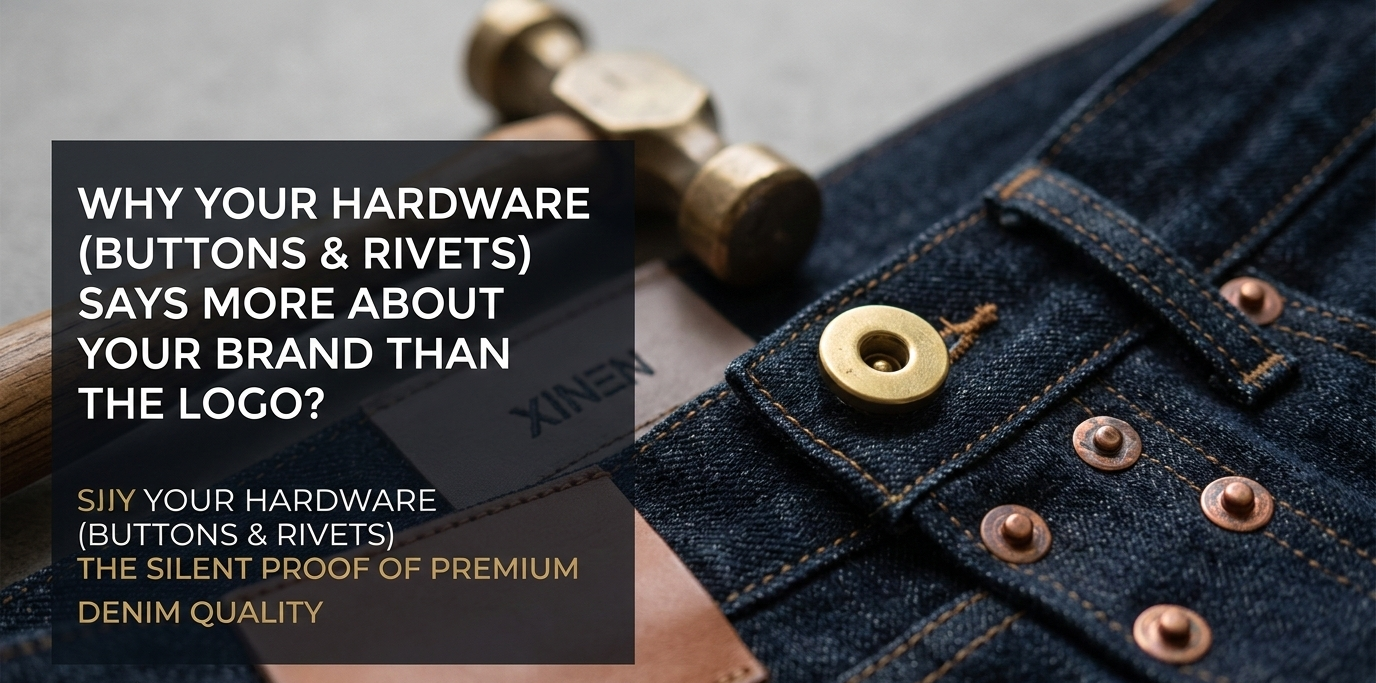
But the hardware? That’s a different story. The buttons, rivets, and zippers are the only parts of the garment that aren’t made of fabric. They are the “heavier” elements that your customer touches every single morning. If the fabric feels like a dream but the button feels like a hollow piece of tin, the illusion of luxury is instantly broken.
For an independent denim label, your hardware is your silent salesman. Here is why it matters more than your logo.
Does “Jingling” Hardware Kill Your Luxury Vibe?
Have you ever picked up a pair of “designer” jeans and noticed the buttons rattle or jingle? That is the sound of cheap manufacturing.
High-end hardware is usually made of solid brass, copper, or stainless steel. It has weight. When you button up a pair of high-quality custom jeans, there should be a satisfying, solid “click.” Cheap hardware is often made of thin zinc alloys or, even worse, hollow aluminum. It feels light, it sounds tinny, and it tells the customer one thing: “This brand cut corners where they thought I wouldn’t notice.”
In the Nordic market, where “quiet luxury” and minimalism are king, a solid, unbranded button often says more about quality than a loud, cheap logo.
Why Is Custom Hardware the Biggest Hurdle for Small Brands?
This is the part where most factories won’t be honest with you. Getting your logo engraved on a button is easy—if you are ordering 10,000 pairs.
For a low MOQ denim startup, custom hardware is a nightmare. Most hardware suppliers have a minimum order of 5,000 to 10,000 sets. If you only want to make 300 pairs of jeans, you’re stuck with a choice:
- Use “stock” hardware (unbranded).
- Pay for 5,000 buttons and store them for three years.
The secret to competing with giants? Don’t use “cheap” stock. Use premium unbranded hardware. There are high-end suppliers (like YKK or Morito) that offer “stock” buttons in heavy brass with beautiful finishes like “vintage copper” or “matte gunmetal.” These look and feel expensive, even without your logo on them.
Can Your Rivets Actually Prove Your Sustainability?
Hardware isn’t just about looks anymore; it’s about chemicals.
European and Nordic customers are incredibly sensitive to nickel allergies and environmental impact. If you use cheap, electroplated hardware, the plating can flake off, and the chemicals used in the plating process can be toxic.
Sustainable denim hardware focuses on “eco-plating” or “no-plating” finishes. This means using the natural color of the metal—like raw copper or tumbled brass—rather than dipping it in a vat of chemicals to make it look shiny. Using nickel-free denim buttons isn’t just a health choice; it’s a massive selling point for eco-conscious consumers who read the fine print.
Why Do Zippers Fail More Than Fabric?
The zipper is the most common “point of failure” in a pair of jeans. If a customer’s zipper splits or gets stuck after three months, they won’t blame the zipper company; they will blame your brand.
In professional garment production, we always tell our clients: do not save $0.50 on a zipper. Moving from a generic zipper to a genuine YKK #5 brass zipper is the cheapest “insurance policy” you can buy for your brand’s reputation. It’s a detail that 90% of customers won’t notice when it works—but 100% of them will notice when it breaks.
FAQ: The Truth About Denim Hardware
How much does “good” hardware actually cost?
To give you a straight answer: a cheap set of buttons and rivets for one pair of jeans might cost $0.15. A high-end, heavy-duty, nickel-free brass set might cost $0.80 to $1.20. While that sounds like a big jump, it is a tiny price to pay to ensure your $200 jeans don’t feel like $40 jeans.
Can I get my logo on buttons for a 300-piece order?
Yes, but you have to pay the “die charge” (the cost of making the mold) and usually buy the full 5,000-piece minimum from the supplier. We can keep the extra 4,700 buttons in our warehouse for your future collections. It’s an upfront investment, but it’s the only way to get true customization.
What is the most durable finish for buttons?
“Tumbled” or “Raw” finishes are the most durable. Because they aren’t coated in a thin layer of shiny paint, they won’t scratch or peel over time. They actually get a beautiful patina as the customer wears and washes the jeans—just like the denim itself.
Are “Donut” buttons better than solid ones?
“Donut” buttons (the ones with the hole in the middle) are classic vintage style. They aren’t necessarily “better” or “worse” in terms of quality, but they use slightly less metal. They are great for a “heritage” or “workwear” look, whereas solid flat-top buttons feel more modern and premium.