If you’ve been looking at the Western plus size denim market, you’ve probably noticed a pattern: most of it is cheap, flimsy, and fits like a bag.
For a long time, the industry treated “plus size” as an afterthought—just a standard pattern scaled up by 20%. The result? Waistbands that gap, thighs that blow out in two months, and fabric that loses its shape by lunchtime.
As a premium denim manufacturer, I can tell you that building a high-end inclusive collection isn’t about just making things “bigger.” It’s a completely different engineering challenge. If you want to charge a premium price, your jeans have to solve the problems that fast fashion ignores.
Is “scaling up” a standard pattern enough for premium plus size denim?
The short answer is: Absolutely not. In plus size denim pattern making, the proportions change. It’s not just about adding inches to the waist. For the Western market (US, UK, and Nordic countries), you have to account for different body shapes—some customers are “apple” shaped, some are “pear.”
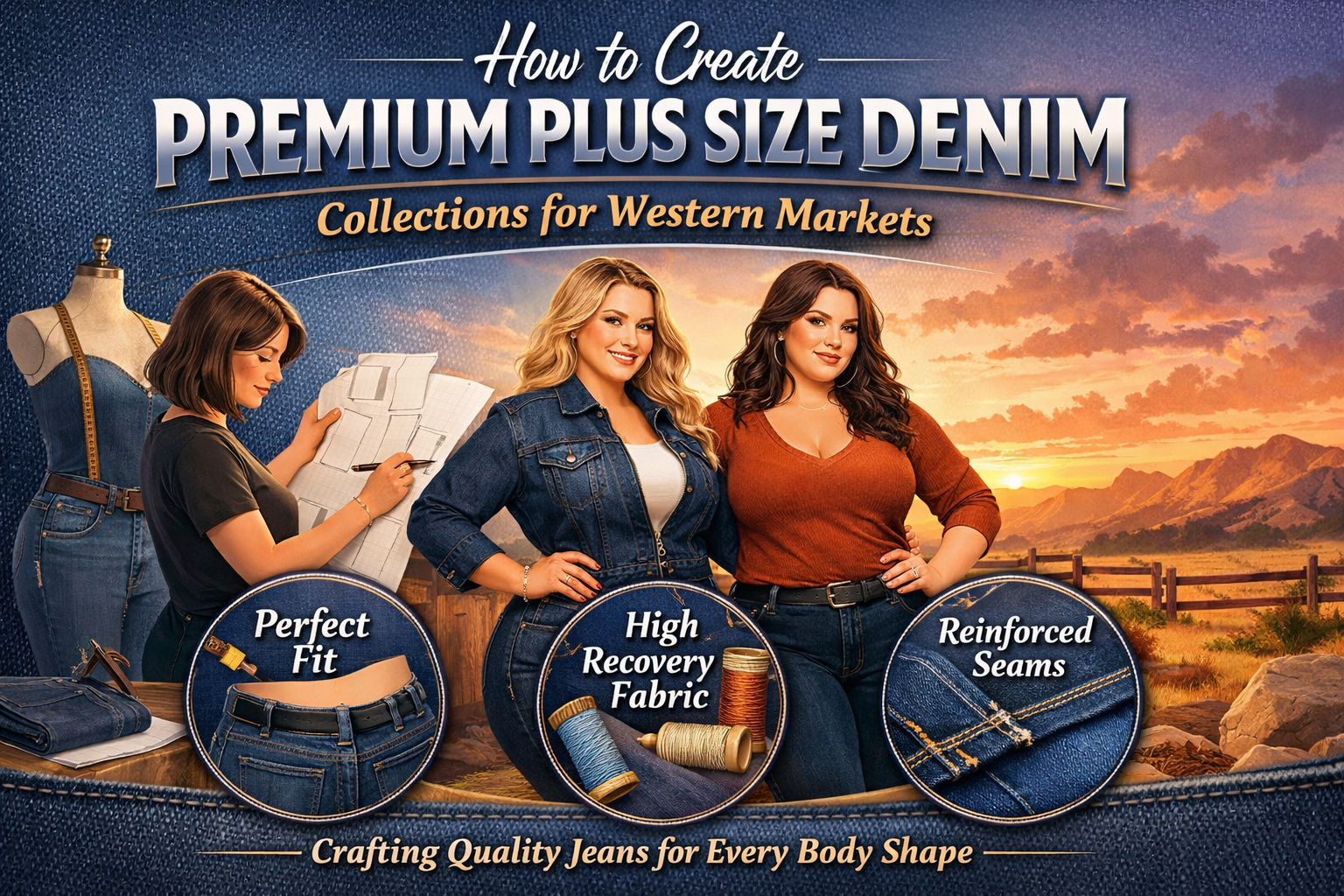
A premium jean needs a contoured waistband. Instead of a straight cut, the waistband should be curved to follow the natural line of the lower back. This prevents that annoying “gap” at the back when the customer sits down. We also adjust the placement of the back pockets; if they are too small or spaced too far apart, the jeans look unbalanced. In premium production, every size “bracket” needs its own specific tweaks.
Why is fabric “recovery” more important than just “stretch”?
Most people think plus size means “more stretch.” But here is the catch: too much stretch without high-recovery denim technology leads to “bagging out.”
If the fabric has 5% spandex but no “snap-back” power, the knees and the seat will look saggy after just two hours of wear. For a premium collection, we recommend fabrics with dual-core or multi-component yarns. These are fibers where the stretch is wrapped in a stronger material that forces the fabric back to its original shape.
Your customer isn’t just looking for something that fits in the dressing room; they are looking for something that still looks sharp at the end of a ten-hour day.
How do you prevent the dreaded “thigh rub” in production?
The #1 complaint in the plus size community is “inner thigh blowout.” Because the fabric in this area experiences constant friction, cheap denim fails almost immediately.
In high-end denim construction, we solve this in two ways:
- Reinforced Seams: We use a higher stitch density and stronger core-spun threads that can handle the tension.
- Fabric Weight: We avoid using paper-thin “jegging” material. A premium plus size jean should still feel like denim. A weight of 11oz to 12.5oz provides enough structure to smooth the silhouette while remaining durable enough to last for years, not months.
Can you maintain a premium aesthetic without losing comfort?
The “medical” look of many plus size brands—massive elastic waistbands and zero hardware—is exactly why customers are moving toward independent labels. They want premium inclusive sizing that looks like high fashion.
You can still use a traditional button-fly or a high-quality YKK zipper. The trick is in the “hidden” engineering. We can incorporate “tummy control” panels made of high-density power mesh inside the front pockets. It’s invisible from the outside, but it provides the support the customer wants. You get the authentic denim aesthetic with the comfort of modern shapewear.
FAQ: Manufacturing Plus Size Denim
Is the MOQ higher for plus size collections?
Usually, no. However, because plus size garments use significantly more fabric per unit (sometimes 30-40% more yardage than a size 26), your price per piece will be higher. You have to account for this in your retail margins.
What is the most common mistake brands make?
Ignoring the “rise.” As sizes go up, the front and back rise need to be adjusted carefully. If the back rise is too short, the jeans will constantly “slide down,” which is the most common fit complaint in the Western market.
Do I need special fabrics for plus size?
You don’t need them, but we highly recommend them. Using a standard 100% cotton rigid denim for plus size is risky unless the fit is very “wide-leg” or “oversized.” For skinny or slim fits, a performance stretch fabric is a must for the premium tier.
How do I handle “vanity sizing”?
Western markets, especially the US, are famous for vanity sizing (where a “Size 14” is actually much larger than the measurement chart suggests). We recommend providing a very clear centimeter-based size guide on your website to reduce return rates, which are typically higher in the plus-size category.