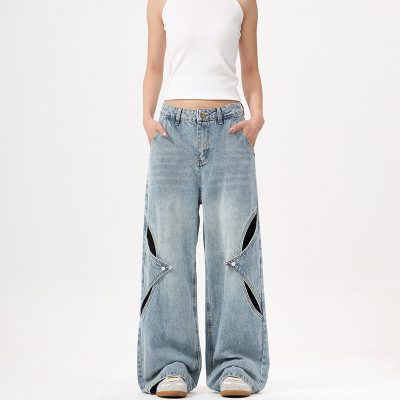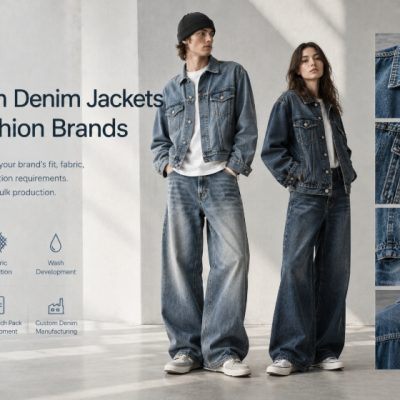
If you look at the best-selling styles for premium labels in London, Paris, or Copenhagen right now, they aren’t skinnies or flares. They are straight-leg jeans.
It sounds like the simplest design in the world—two straight tubes of fabric, right? Wrong. In premium denim manufacturing, the straight fit is actually the hardest to get “just right.” If the leg is too wide, it looks sloppy; if it’s too narrow, it’s just a slim fit.
As a factory partner, I’ve seen many brands struggle with this silhouette. Here is the realistic guide on how to design and produce a straight jean that actually sells.
Why is the “Knee-to-Hem” ratio the most important measurement?
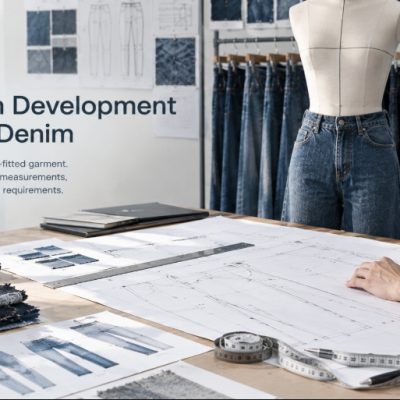
In straight leg jeans pattern design, the magic happens from the knee down. A “true” straight leg should have almost the same width at the knee as it does at the leg opening.
However, if you make it mathematically perfect, the jeans often look like they are “flaring out” because of an optical illusion. To get that premium, clean look, we usually suggest a subtle 0.5cm to 1cm taper from the knee to the ankle. This keeps the silhouette looking sharp and modern without losing the “straight” identity. If you get this wrong, the jeans either look like 90s “dad jeans” or 70s bell-bottoms.
Does fabric weight dictate the “straightness” of the silhouette?
Let’s be honest: you cannot make a high-quality straight jean with thin, 9oz jegging fabric. It just doesn’t work.
For a straight leg to hold its shape and hang vertically from the hip, you need “body” in the fabric. We recommend a 13oz to 14.5oz rigid denim (100% cotton) or a very low-stretch comfort denim (99% cotton, 1% elastane).
If the fabric is too light or has too much stretch, it will “collapse” around the knees and calves, destroying that crisp, architectural line that premium customers pay for. When sourcing for high-end straight denim production, always prioritize the “fall” of the fabric over the initial softness.
How do you manage shrinkage in bulk production for straight fits?
This is the silent killer of many denim startups. Denim is a living material; it shrinks when you wash it.
In a straight fit, if the factory doesn’t calculate the denim shrinkage rate correctly, the leg can twist (this is called “leg twist”) or become significantly shorter than the tech pack intended.
Pro Tip: For premium runs, we always do a “wash test” on a 1-meter square of your chosen fabric before we even cut the first sample. This ensures that the 82cm inseam you asked for doesn’t come out of the industrial dryer as a 78cm “surprise.”
What details elevate a basic straight jean to “Premium” status?
Since the silhouette of a straight jean is so simple, the “luxury” is found in the premium denim construction details.
- The Rise: A slightly higher back-rise is essential for a comfortable straight fit, ensuring the jeans don’t “slide down” when the wearer sits.
- Pocket Placement: In a straight fit, the back pockets should be centered and slightly higher to give the seat a “lift.” If they are too low or too wide, the straight cut looks heavy and unflattering.
- The Hem: A classic chain-stitch hem is a must for the premium market. It creates a beautiful “roping” effect after the first few washes that you simply can’t get with a standard lockstitch.
FAQ: Manufacturing Straight Leg Denim
Is the MOQ different for straight fits compared to skinny fits?
Usually, no. At Xinen, our low MOQ denim production starts at 300 pieces per style. However, because straight fits use more fabric yardage than skinny jeans, your raw material cost might be slightly higher per unit.
Can I use selvedge denim for a straight fit?
Straight fits are actually the best silhouette for selvedge denim manufacturing. Because the outseam is straight, you can showcase the “selvedge ID” (the finished edge of the fabric) when the wearer cuffs their jeans. This is a huge selling point for the “heritage” denim market.
How many washes should I offer for a straight-leg launch?
For a independent designer capsule collection, we suggest starting with two: a “Raw” or “One-Wash” (dark indigo) and a “Mid-Blue 90s Wash.” These two cover about 80% of consumer demand for this specific fit.
Should I use a zip fly or a button fly?
For a premium, “authentic” straight jean, a button fly is the gold standard. It feels more substantial and prevents the “zipper bulge” that sometimes happens with rigid fabrics. However, if you are targeting a more casual, “daily wear” market, a high-quality YKK zipper is perfectly acceptable.