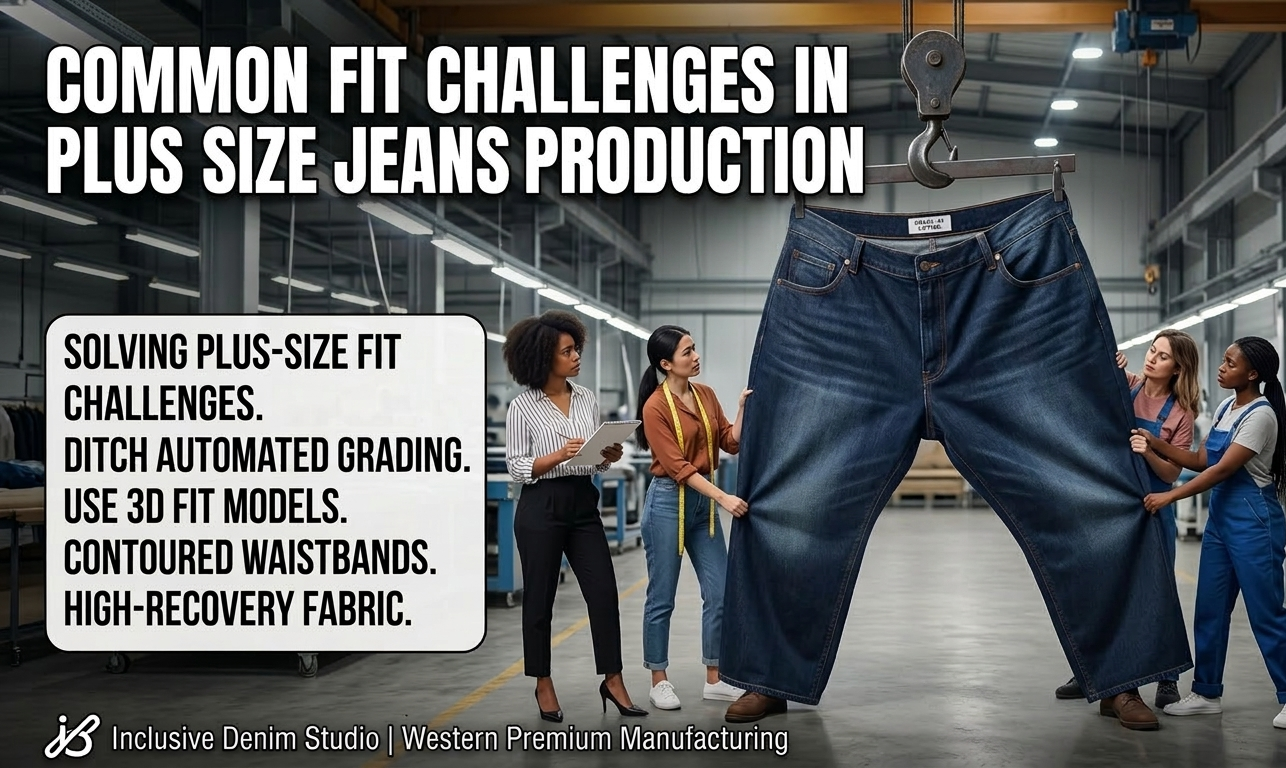
Expanding your denim line to include plus sizes isn’t just about making patterns “bigger.” It’s an entirely different fitting game. If your factory treats a size 44 like a scaled-up size 28, the results will be a disaster.
We see the production numbers every day. The single biggest driver of high return rates and customer dissatisfaction for emerging inclusive denim brands is poor fit. It’s not your fabric choice; it’s the engineering.
Plus-size customers are fed up with jeans that gap at the waist, sag at the knees, or slide down when they sit. To manufacture a successful premium plus size jean for Western markets, you have to get realistic about where standard grading fails. Here are the most common (and expensive) fit challenges you will face in production.
Why does the “Back-Rise to Front-Rise” ratio fail at higher sizes?
This is fit challenge #1. Standard grading often adds width evenly across the garment, but human bodies don’t grow that way. In plus size denim pattern development, the back of the body (the seat) requires much more room than the front.
If your factory doesn’t significantly increase the back-rise measurement relative to the front, the jeans will always feel like they are being pulled down. This creates the dreaded “plumber’s crack” and forces the customer to constantly yank their jeans up. It’s uncomfortable and embarrassing. The pattern must be contoured to wrap around a prominent seat while still hugging the lower back.
How do we solve the “contoured waistband” gapping problem?
Most plus-size customers are extremely familiar with “waist gap.” This happens when the jeans fit the hips and seat perfectly, but there is a massive space at the center back waistband.
You can’t solve this on a flat table; you solve this on a 3D plus size fit model. A standard straight waistband simply will not work. You need a contoured waistband construction—cutting the waistband on a curve. This allows it to follow the natural contour of the customer’s torso. In production, this adds time and cost, but it is the only way to avoid the need for your customer to wear a belt every day.
Why are thigh and knee proportions so hard to predict?
Thigh-to-calf ratio changes wildly in plus-size individuals. Some customers carry their weight primarily in the abdomen (“apple” shape), meaning their thighs remain relatively slim. Others carry it in the hips and legs (“pear” shape).
Standard grading assumes a linear increase in thigh width that doesn’t account for these differences. The production result? Jeans that strangle the thigh of one customer while pooling with excess fabric on another. The safest bet for a production run is a “straight” or “tapered” silhouette with a plus-size fit profile, but you must fit these patterns on multiple real human models, not just a mannequin.
Can we prevent inner thigh friction damage in production?
We call this “The Blowout Zone.” Friction between the thighs (often called “chub rub”) is inevitable, but cheap denim fails almost instantly in this area.
This fit challenge is actually a fabric and construction issue. If you use paper-thin, low-recovery “jegging” material, the jeans will wear through in three months. For a durable premium inclusive sizing jean, you need to use a sturdy, high-recovery stretch fabric (12oz to 14oz). In construction, we also recommend using a higher stitch density and stronger core-spun thread in the inseams and crotch point to add durability. You can also specify a reinforced “stay stitch” at the crotch intersection.
FAQ: The Reality of Plus Size Denim Production
Do I need a special fabric for plus size?
A special blend? No. But you do need a quality one. Plus-size denim requires high-recovery stretch technology. This means a fabric with at least 2% elastane or a dual-core yarn (like Lycra DualFX). Crucially, the “recovery” (the fabric’s ability to snap back after being stretched) must be excellent, or the jeans will “bag out” by lunchtime, destroying the intended fit.
Is pattern grading expensive?
Yes. You cannot use automated grading for a premium plus-size launch. Each size block (e.g., 38–40, 42–44, 46–48) should be pattern-fitted on a live model and adjusted. Automated grading will result in those tiny, disproportionate back pockets and a strange, boxy silhouette that customers hate.
Can I use the same MOQs for plus size?
Generally, factories (like Xinen) allow you to mix sizes within an order. For example, if your order is 300 pieces, you can allocate 150 to your core range and 150 to your plus range, provided they are the same style, wash, and fabric. This helps independent brands launch inclusive sizing without huge inventory risk.
What is the single best way to avoid returns?
Clear, accurate, centimeter-based size guides. Western customers are diverse. A size 40 jean from an Italian brand might measure 10cm smaller in the hips than a size 40 from an American brand. Don’t rely on “Size L” or “Size 16.” Give your customer the exact measurements.