If you’re launching a denim line or expanding your current collection, you might think a straight-leg jean is the easiest place to start. On paper, it’s just a vertical cut from the hip to the ankle. But in reality, the “perfect” straight fit is one of the hardest things to get right in premium denim manufacturing.
If the leg is too wide, it looks dated. If it’s too narrow, it’s basically a slim fit. To build a pair that customers actually keep (and don’t return), you have to move past the aesthetics and look at the engineering.
Here is a realistic guide on how to develop a high-quality straight jean that stays on the shelf for years, not weeks.
What fabric weight is best for a premium straight-leg silhouette?
The “hang” of a straight jean depends entirely on the weight and density of the fabric. If you use a thin, 9oz or 10oz fabric, the leg will “collapse” around the knees and ankles, making the jeans look cheap and flimsy.
For a true premium feel, we recommend a 12oz to 14oz denim fabric. This weight provides enough structure to hold that iconic vertical line.
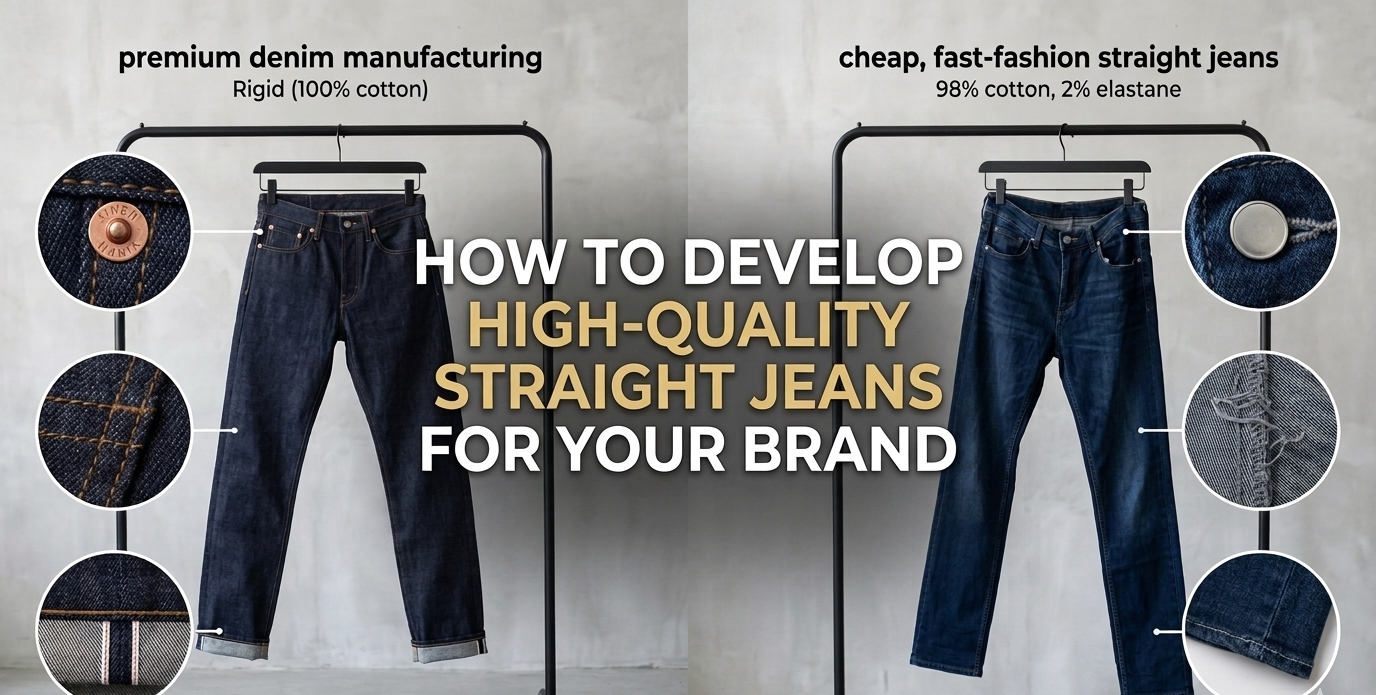
- Rigid (100% Cotton): This is the gold standard for high-end straight jeans. It provides an authentic vintage look and lasts for a decade.
- Comfort Stretch (99% Cotton, 1% Elastane): If your target market values daily comfort, 1% stretch is enough to make them wearable without losing the “straight” shape. Avoid high-stretch fabrics for this fit; they will eventually bag out at the seat.
How do you create a “straight” look that actually fits?
In straight-leg denim pattern development, there is a dirty little secret: a mathematically straight line from the knee to the hem often looks like a flare to the human eye.
To achieve that clean, architectural look, we usually suggest a subtle taper. Narrowing the leg opening by just 0.5cm to 1cm compared to the knee width creates an optical illusion of a perfectly straight leg.
You also need to consider the rise height. For Western markets, a mid-to-high rise is currently the safest bet. It provides better “coverage” and ensures the straight silhouette starts at the right point on the hip, which prevents the fabric from bunching up at the crotch.
Which construction details separate high-end straight jeans from fast fashion?
When a customer pays a premium price, they are looking for the details that fast fashion skips to save time. In high-end denim construction, these are the non-negotiables:
- Chain Stitching: A chain-stitched hem isn’t just for show; it allows the hem to “rope” and fade beautifully over time.
- Clean Internal Seams: Look at the inside. Are the seams overlocked neatly, or is there loose thread? Premium brands often use a “felled seam” or high-density overlocking.
- Hardware Quality: A plastic-feeling zipper or a thin zinc button will ruin the “hand feel” of the garment. Stick with brass or copper hardware and genuine YKK zippers.
How does the “wash” affect the final shape and saleability?
Straight jeans look best when the wash is “authentic.” This means the wear patterns (whiskers and honeycombs) should be placed exactly where they would naturally occur on a human body.
In artisan denim finishing, we use hand-scraping or laser technology to create these fades. If you’re working on a low MOQ denim production run, start with a “One-Wash” (dark indigo) and a “Mid-Stone Wash.” These are the two most requested finishes for straight fits.
Warning: Be careful with heavy “distressing” (holes and rips) on straight jeans. Because the fit is looser than a skinny jean, large holes can cause the leg to lose its structure and look sloppy after a few washes.
FAQ: Straight Denim Development
How do I handle shrinkage in 100% cotton straight jeans?
Rigid denim shrinks—it’s a fact. In production, we do a “wash test” first to see how much the fabric pulls in. We then adjust the pattern (e.g., making the inseam 3% longer) so that the final product matches your size chart after the industrial wash.
What is the standard leg opening for a straight jean?
For a “Classic Straight,” the leg opening is usually between 7.5 and 8.5 inches (flat measurement). If you go wider, you are moving into “Wide Leg” territory. If you go narrower, it becomes a “Slim Straight.”
Is selvedge denim worth the extra cost for this fit?
Straight jeans are the perfect silhouette for selvedge denim sourcing. Since the outseam is straight, you can use the “self-edge” of the fabric. It’s a major selling point for premium customers who like to cuff their jeans to show the red-white ID.
Why are my samples twisting at the leg?
“Leg twist” is common in right-hand twill denim. While some vintage enthusiasts love it, most modern consumers see it as a defect. We can minimize this by using “skewed” fabric or specific cutting techniques during the denim pattern making phase.