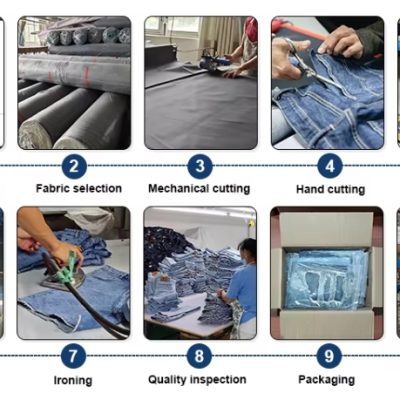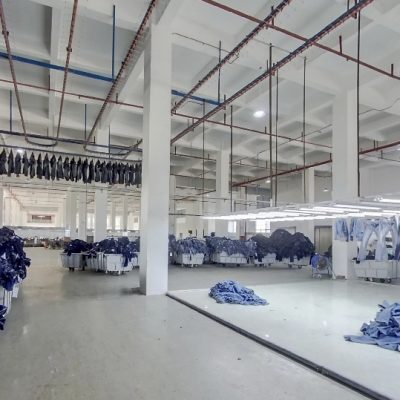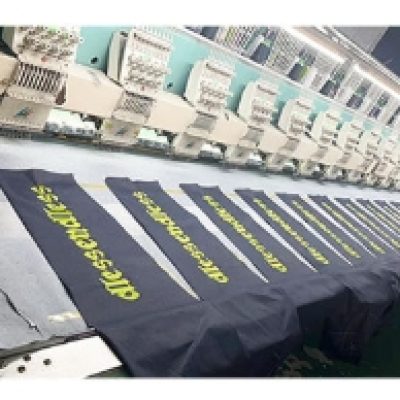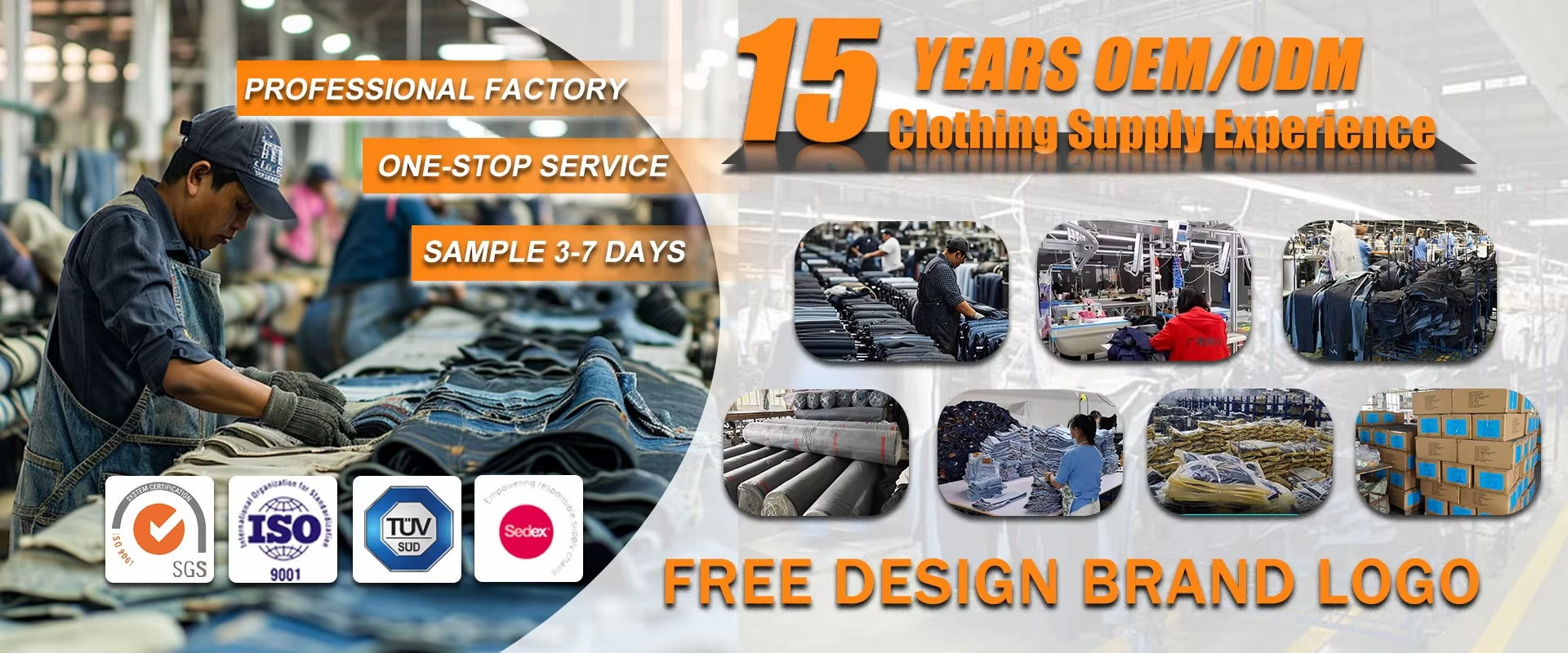
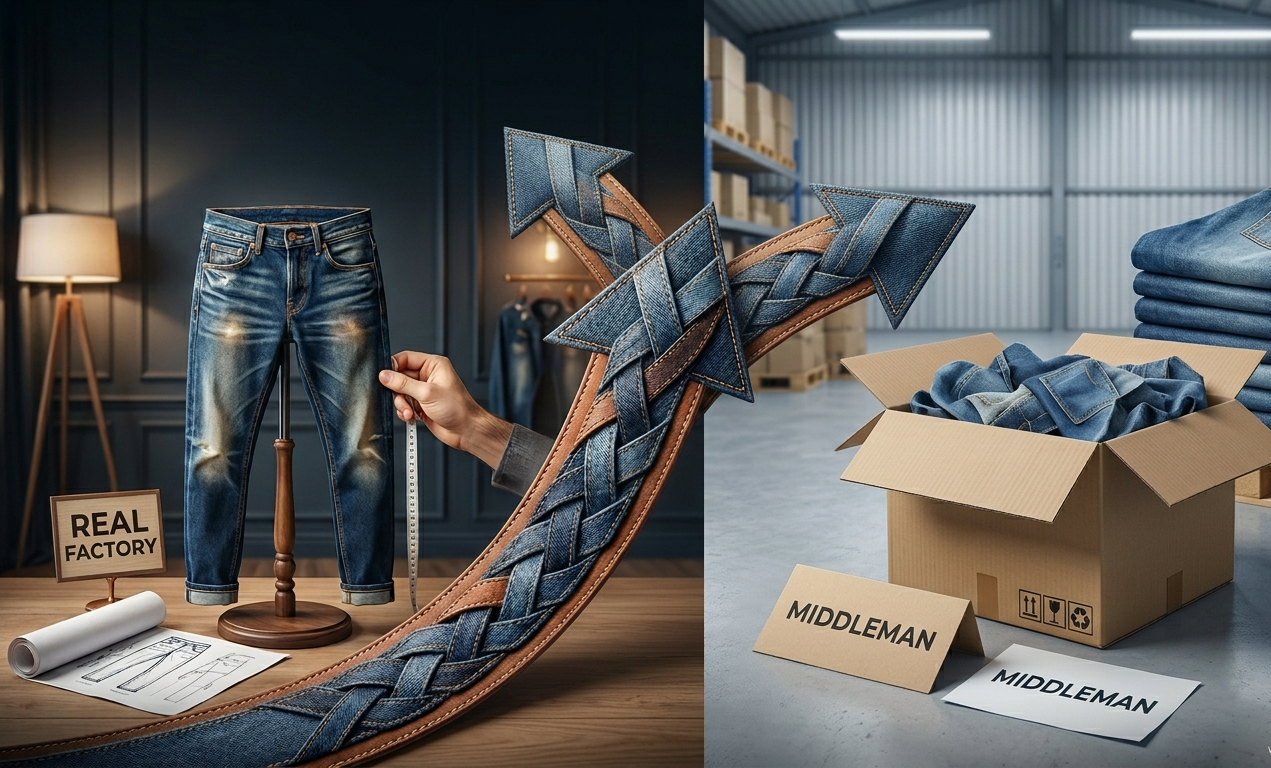
If you search for “custom jeans manufacturer” online, you will find thousands of suppliers. But here is the industry’s worst-kept secret: a massive percentage of them are not factories. They are trading companies or middlemen passing your orders (and your money) to third-party workshops.
Working with a middleman means higher costs, miscommunication, and zero control over quality and ethical standards. At Xinen Garment, we are a direct source factory. Over the years, we’ve seen countless brands come to us after bad experiences with trading companies.
To protect your brand and your budget, here are 4 foolproof ways to verify if you are dealing with a real denim factory or just a well-disguised middleman.
1. The “Everything” Supplier vs. The Denim Specialist
Denim is a highly specialized fabric. It requires heavy-duty sewing machines, specialized cutting tools, and extensive chemical washing facilities that regular clothing factories simply do not have.
- The Middleman: Look at their product catalog. If they offer custom jeans alongside silk dresses, knitted sweaters, and activewear, they are almost certainly a trading company sourcing from multiple different workshops.
- The Real Factory: A true denim manufacturer focuses on heavy woven fabrics—jeans, denim jackets, cargo pants, and workwear. At Xinen, our production lines are strictly calibrated for denim weights ranging from 8oz to 14oz.
2. Test Their Knowledge on the Wash Process
Washing is the soul of a pair of jeans. It determines the color, the hand-feel, and the shrinkage rate. This is where middlemen usually fail because they don’t understand the chemistry of the factory floor.
- How to test them: Ask specific technical questions. For example: “How do you prevent indigo bleeding on a light-wash sample?” or “Do you use ozone washing or traditional stone washing for this vintage look?”
- The Reality: A middleman will usually say, “Let me check with the engineer” or give a vague answer. A direct factory will immediately explain their enzyme ratios, pumice stone usage, or laser finishing capabilities.
3. How They Handle Pre-Production (PP) Samples
The Pre-Production (PP) sample is the physical prototype made before bulk cutting begins. It is the most critical step in quality control.
- The Middleman: They often try to skip the PP sample to save time, or they charge an unreasonably high non-refundable fee for it. They hate making samples because they have to negotiate with their sub-contracted workshops.
- The Real Factory: We insist on making a PP sample. At Xinen, we will not cut the bulk fabric until you have the physical PP sample in your hands and have signed off on the fit, stitching, and wash color.
4. The Ultimate Test: The Live Video Call
In 2026, there is no excuse for a supplier to refuse a live video call. Pictures can be stolen from other websites, but a live factory tour cannot be faked.
- The Action: Ask your contact for a quick, 5-minute video call via WhatsApp or WeChat during their working hours. Ask them to walk from their office down to the sewing line or the washing facility.
- The Result: Middlemen will give excuses about “factory rules” or “bad Wi-Fi.” At Xinen Garment, we welcome video calls. We are proud to show our clients our cutting tables, sewing lines, and QC inspection areas in real-time.
Key Takeaways
- Avoid suppliers whose catalogs look like a department store; real denim requires specialized machinery.
- Test your supplier’s technical knowledge about denim washing and fabric shrinkage.
- Never work with a supplier who tries to skip the Pre-Production (PP) sample phase.
- Trust but verify: Always ask for a live video tour of the production floor.
Frequently Asked Questions (FAQ)
Q: Are trading companies always bad to work with?
A: Not necessarily. Some trading companies offer good communication and design services. However, you are paying a premium (usually 20-30% higher) for those services, and you lose direct control over the manufacturing timeline and quality standards. If you have your own Tech Packs, going direct to a factory is always better.
Q: Can a real factory handle low MOQs?
A: Yes. While middlemen often demand high MOQs to make their margins worthwhile, a real factory with a flexible production line (like Xinen) can accommodate test runs as low as 100 pairs, and scale up to 10,000 pairs when you are ready.
Q: How do I verify your factory if I can’t visit China right now?
A: We regularly host virtual factory tours for our international clients. You can also request to see our business licenses, export certifications, and audit reports.