The hardest part of launching a denim brand isn’t the design; it’s the supply chain. Most large-scale manufacturers reject small orders, leaving startups stuck with middlemen or unverified suppliers. But every established brand making 10,000 pairs a month started with a 100-pair test run.
At Xinen Garment, we’ve built our production lines to support brands at every stage of their growth. Here is the realistic, step-by-step roadmap of how we take your denim brand from a small test batch to full-scale mass production.
Phase 1: The 100-Pair Stage (Proving the Concept)
When you are ordering 100 pairs, the goal isn’t to maximize profit margins; it is to perfect the fit, test the market, and finalize your wash formulas.
- Tech Packs & Pattern Making: We start with your tech pack. If you don’t have one, our pattern makers will work with your reference samples. At this stage, getting the grading (sizing) right is critical.
- The Wash Test: Denim washing is a chemical and physical process. We document the exact recipe (enzymes, stones, temperature, time) used on your approved sample so it can be replicated exactly, whether you order 100 or 10,000 pairs.
- Realistic Costs: Yes, the cost per unit (CPU) is higher at 100 pairs. Setup costs for cutting, custom hardware (buttons/rivets), and wash formulas are divided among fewer units.
Phase 2: The 1,000-Pair Stage (Standardization)
Once your initial 100 pairs sell out, it’s time to restock and scale. Moving to 1,000 pairs means we shift from “sample room” logic to “production line” logic.
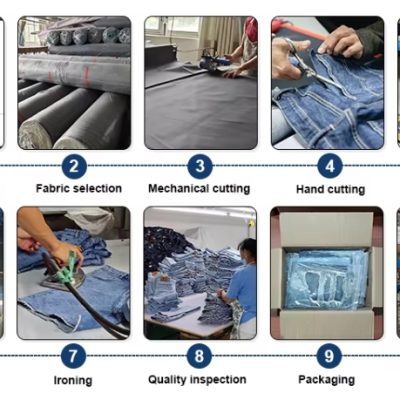
- Bulk Fabric Sourcing: Instead of buying fabric by the yard from open markets, we order bulk rolls directly from the weaving mills. This guarantees color consistency and reduces the unit price.
- Shrinkage Control: Denim shrinks after washing. When cutting for 1,000 pairs, we run strict shrinkage tests on the bulk fabric rolls to adjust the paper patterns accordingly. A 3% shrinkage variance can change a size 32 into a size 30.
- Pre-Production (PP) Samples: Before we cut the bulk fabric, we make a PP sample. Mass production only begins when you sign off on this exact physical sample.
Phase 3: The 10,000-Pair Stage (Mass Production & QC)
At 10,000 pairs, efficiency and strict Quality Control (QC) become the top priorities.
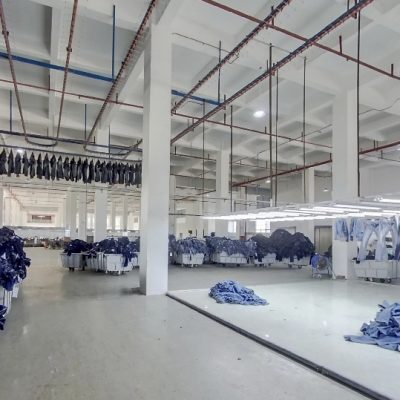
- Line Assembly: Your order is assigned to a dedicated sewing line. Workers specialize in specific tasks (e.g., one person only attaches pockets, another only sets zippers). This increases speed and drastically reduces human error.
- AQL 2.5 Quality Control: We implement standard AQL (Acceptable Quality Limit) inspections. We check for needle drops, seam strength, zipper functionality, and wash consistency across thousands of units.
- Packaging & Logistics prep: For large volumes, we optimize carton packing to save you money on shipping volume (CBM), whether you are shipping to an Amazon FBA warehouse or a private distribution center.
Key Takeaways
- Expect higher unit costs initially: 100-pair orders are for market testing. Profitability scales as your volume increases.
- Lock in your wash formulas: The recipe used for your first 100 pairs is saved at Xinen to ensure no color variance when you order 10,000.
- Always demand a PP Sample: Never skip the Pre-Production sample approval before bulk cutting, regardless of the order size.
- Partner with a direct factory: Working with Xinen means you don’t need to change suppliers as you grow. We handle both the low-MOQ test runs and the massive bulk orders under one roof.
Frequently Asked Questions (FAQ)
Q: Why does a 100-pair order take almost as long as a 1,000-pair order?
A: The setup time is identical. Sourcing the fabric, making the paper patterns, custom-molding your branded buttons, and testing the wash formula take the same amount of time whether we are cutting 100 pairs or 1,000. The only difference is the actual time spent on the sewing line.
Q: Can I use fully customized zippers and buttons for a 100-pair order?
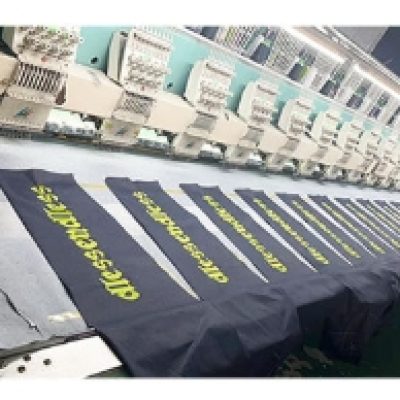
A: Hardware factories usually require an MOQ of 1,000 to 3,000 pieces for custom-engraved buttons or rivets. For a 100-pair order, we recommend paying for the hardware MOQ upfront. We will use what is needed for the first 100 pairs and hold the remaining hardware in our factory inventory for your future restocks.
Q: How do you guarantee the sizing won’t change between small and large batches?
A: Sizing discrepancies usually happen because of fabric shrinkage, not bad sewing. At Xinen, we conduct wash shrinkage tests on every new roll of bulk fabric before cutting. We then adjust the CAD patterns to compensate for that specific roll’s shrinkage rate.
Q: Can you ship directly to my Amazon FBA warehouse?
A: Yes. If you are an e-commerce brand, we can handle the polybagging, applying FBA-compliant barcodes, and packing into standardized cartons ready for direct freight forwarding.