For new apparel brands and wholesale buyers developing a men’s denim collection, surface customization and branding details determine whether a garment stands out in a competitive market. Because the basic construction of men’s jeans follows established patterns, visual differentiation relies heavily on three elements: embroidery, printing, and custom hardware.
However, applying these details to denim requires a thorough understanding of industrial garment processing. Unlike standard t-shirts or hoodies, denim undergoes heavy washing cycles—including stone, enzyme, and chemical rinses—that can degrade poorly executed surface designs. This guide covers the technical options available for men’s denim customization and how to select them for reliable bulk manufacturing.
1. Custom Embroidery Options for Men’s Jeans
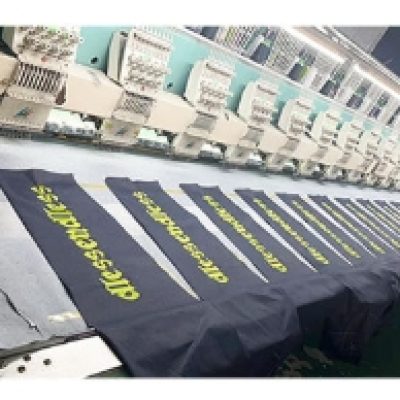
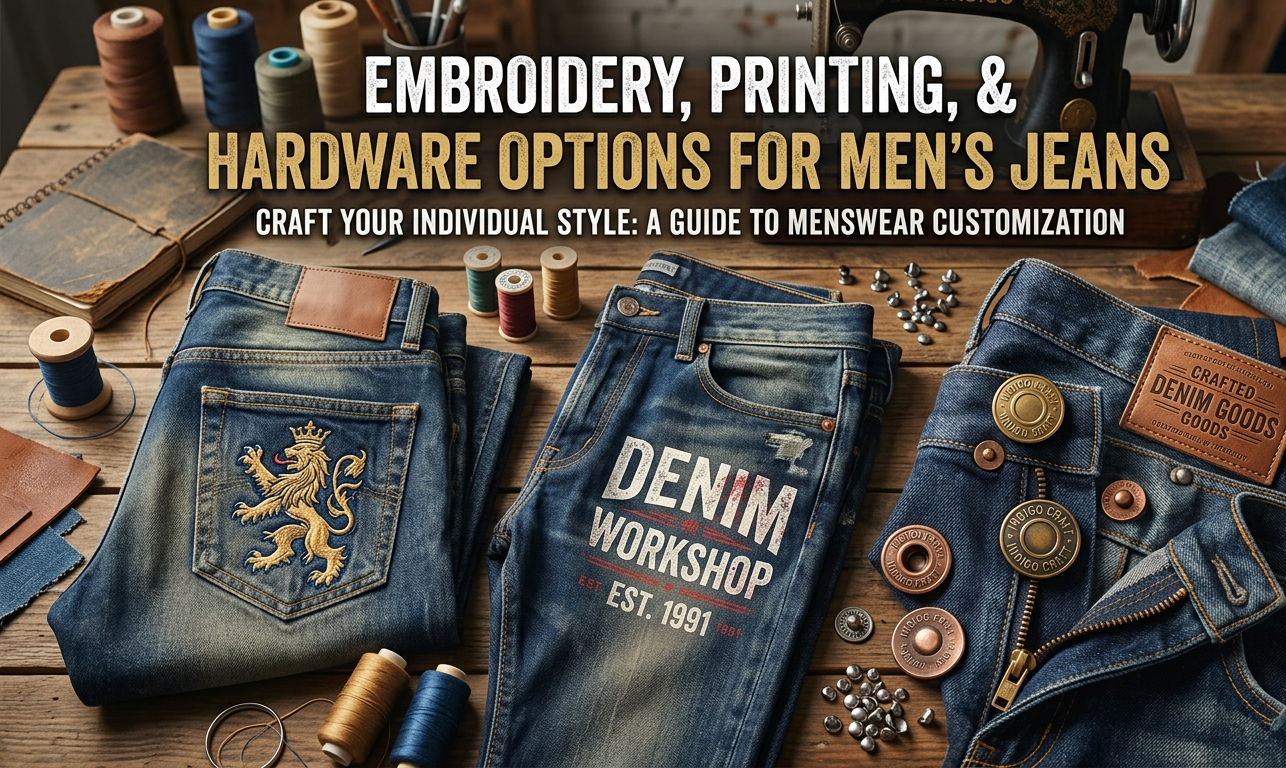
Embroidery provides a high-durability branding solution that handles industrial washing without peeling. For men’s jeans, embroidery is typically placed on the back pockets, coin pocket, waistband, or along the side seams.
- Flat Embroidery: This is the standard method for brand logos or pocket signatures. It uses high-speed multi-head embroidery machines before the panels are sewn together. For denim, manufacturers must use high-tensile polyester threads to prevent breaking during stone washing.
- 3D Puff Embroidery: This technique uses a foam underlay to lift the stitching, creating a raised, dimensional effect. It is common for bold streetwear branding on the thighs or back pockets.
- Chain-Stitch Embroidery: This method forms a series of looped stitches that resemble a chain. It delivers a vintage, heritage look that pairs well with heavy, rigid denim collections.
Production Warning: Puckering and Shrinkage
Because denim fabric contracts during heavy wash cycles, high-density embroidery designs can cause the surrounding fabric to pucker or warp. Your factory must adjust the stitch tension and use appropriate backing stabilizers to ensure the embroidery remains flat after the final wash.
2. Industrial Printing Techniques for Denim
Printing allows for complex graphics and text placement that embroidery cannot achieve. However, because indigo dye can bleed and industrial washing is abrasive, brands must select the right printing chemistry:
- Screen Printing (Plastisol vs. Water-Based): Plastisol ink sits on top of the fabric and creates a thick, vibrant layer. If subjected to a heavy stone wash, it will crack, which is useful for vintage or distressed styles. Water-based inks penetrate the fibers for a softer hand-feel but will fade slightly alongside the indigo dye.
- Discharge Printing: This is a highly stable technique for dark denim. Instead of adding color on top of the fabric, a discharge agent strips away the indigo dye, exposing the raw cotton color underneath. This print cannot peel, crack, or wash off because it alters the fabric fibers directly.
- Laser Printing/Engraving: Modern manufacturing uses computer-controlled lasers to burn away the indigo dye on finished jeans. This creates whiskers, scraping effects, or intricate patterns without using water or chemicals, ensuring 100% precision across bulk orders.
3. Custom Hardware and Trim Specifications
Hardware is a critical point of evaluation for B2B buyers and end-consumers. Poorly sourced metal components can rust, bend, or detach under stress.
- Buttons and Rivets: Brands can choose between zinc alloy, brass, and copper. Zinc alloy allows for precise, clean embossing or debossing of your brand logo through custom mold tooling. Copper and brass are preferred for heritage or rugged workwear styles because they develop a natural patina over time.
- Zippers: For men’s straight or slim jeans, a locking brass zipper slider is standard. The zipper tape must be pre-shrunk by the hardware supplier to prevent the fly area from buckling after the jeans are washed at the factory.
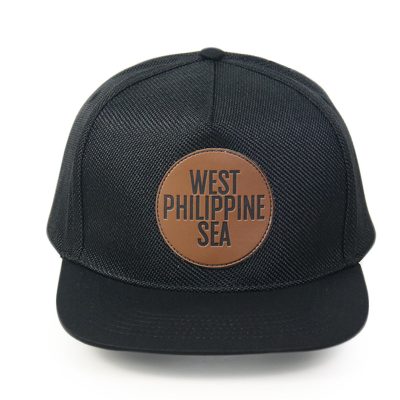
- Brand Patches: Positioned on the back right waistband, options include genuine cowhide leather, synthetic polyurethane (PU) leather, and washable heavy-duty kraft paper. Genuine leather offers the longest lifespan and handles the heat of industrial drying tunnels without warping.
4. Why Partner with Xinen Garment for Custom Men’s Denim
At Xinen Garment, we manufacture high-end custom denim for private labels, fast-fashion wholesalers, and clothing importers. We manage the technical variables of customization directly on the production floor.
- Wash-Tested Embellishments: We do not guess how an embroidery thread or print ink will react to industrial laundering. We run sample test batches through our washing facility to verify colorfastness and durability before starting bulk cutting.
- Precision Mold Production: We handle the creation of custom logo molds for your branded buttons, rivets, and leather patches, ensuring clean brand replication across your entire production run.
- Automated Sewing and Placement: Our facility utilizes programmable automated machinery to execute pocket embroidery and bartack hardware placement with tight, consistent dimensional tolerances.
- Direct Factory Sourcing: By eliminating trading companies and middleman procurement agents, we give your brand clear bulk pricing structures, transparent lead times, and direct communication with the engineers making your garments.
5. Frequently Asked Questions (FAQ)
What file formats are required for custom embroidery and printing designs?
We require vector artwork files in .AI, .PDF, or .EPS formats. This ensures our automated embroidery digitizers and printing plate systems replicate your branding dimensions accurately.
Is there an extra cost for custom logo buttons and rivets?
Yes, there is a one-time mold tooling fee to engrave your logo into the metal die. Once this mold is paid for, it is stored in our facility and can be reused for all your future production re-orders without additional setup costs.
Will the printing ink transfer onto other clothes during retail display or wear?
To prevent indigo bleeding and ink transfer (crocking), we use fixing agents and run the completed garments through thorough post-wash rinse cycles. We test bulk pieces to ensure they meet commercial colorfastness standards.
What is the minimum order quantity (MOQ) if we want fully customized hardware? Custom metal hardware production typically requires a higher minimum volume per batch compared to stock hardware. If your initial apparel order volume is lower than the hardware factory’s minimum, we can manufacture a bulk batch of your branded buttons and rivets to store in our warehouse for your future collections.