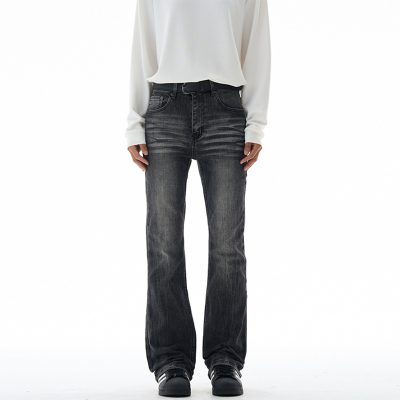
Launching a t-shirt brand is easy; launching a denim brand is a completely different game. Denim is a living, breathing fabric. It shrinks, the indigo dye fades, and the hardware requires heavy-duty machinery. Many new founders get stuck because traditional denim factories demand Minimum Order Quantities (MOQs) of 500+ pairs just to start.
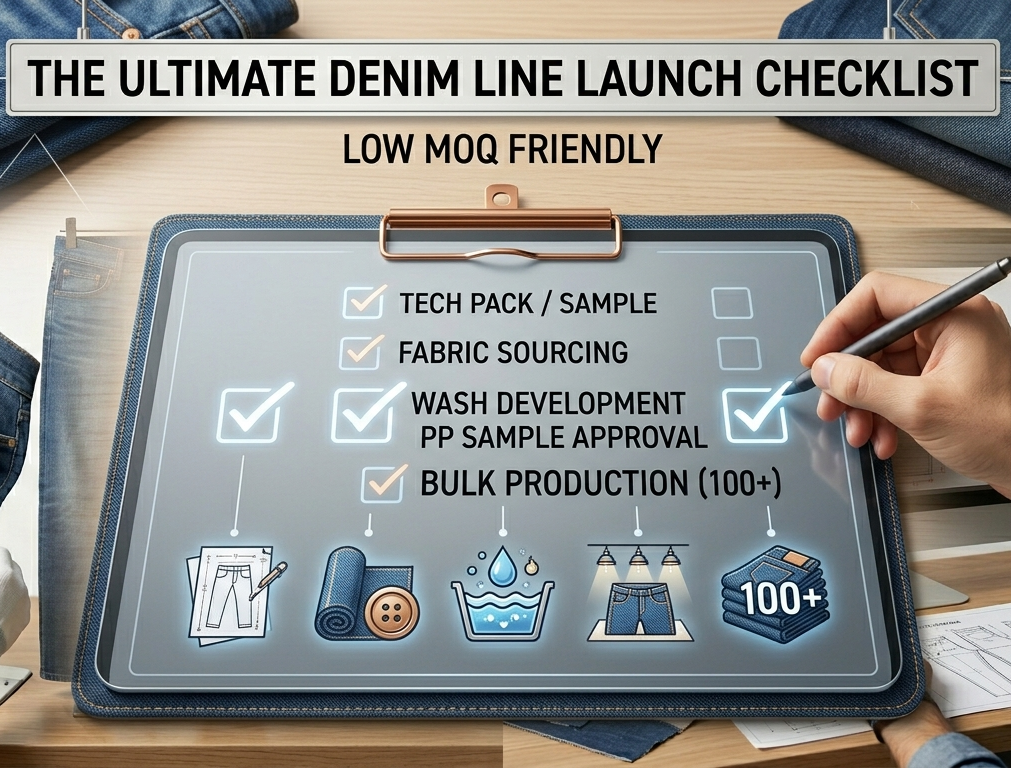
At Xinen Garment, we believe every great brand starts with a test run. We’ve built our custom manufacturing lines to be Low-MOQ friendly, allowing you to start your first collection with as few as 100 pairs per style.
If you are ready to move from an idea to a physical product, here is your ultimate factory-floor checklist for launching your first denim line successfully.
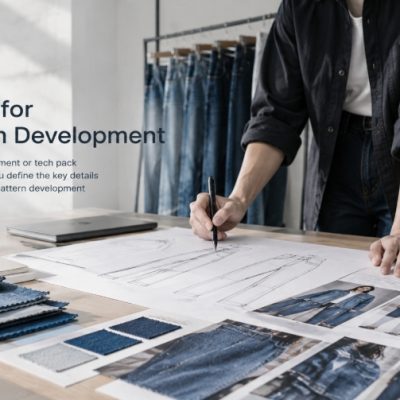
Step 1: The Blueprint (Design & Fit)
A factory cannot guess your vision. We need concrete measurements.
- Create a Tech Pack: This is your blueprint. It should include flat sketches, measurements, pocket placements, and stitching details (e.g., contrast gold thread vs. matching navy thread).
- OR Provide a Reference Sample: If you don’t know how to make a Tech Pack, don’t panic. Send us a physical pair of jeans that you love the fit of. Tell us: “Keep this waist and hip measurement, but make the leg opening 2 inches wider.” Our pattern makers will reverse-engineer it.
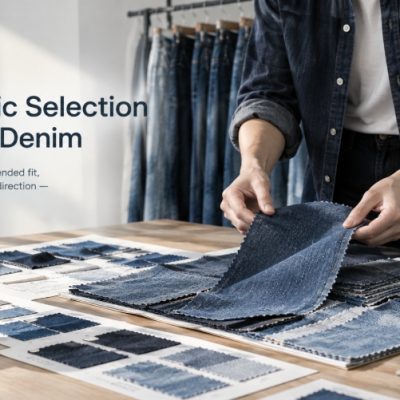
Step 2: Sourcing (Fabric & Hardware)
Choosing the right materials dictates the price, comfort, and durability of your jeans.
- Select Your Denim Weight: Are you making a lightweight summer jean (8-10oz), a standard everyday fit (11-12oz), or a rigid vintage jean (14oz selvedge)? **
- Choose the Fabric Blend: Do you want 100% rigid cotton, or do you need 2% Elastane (Spandex) for stretch and comfort?
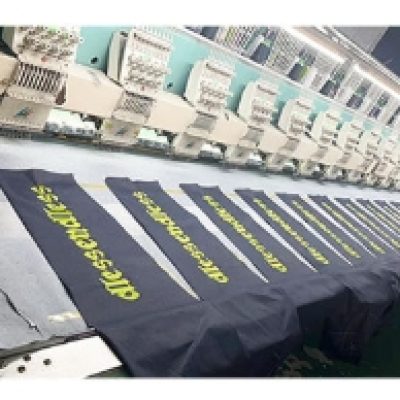
- Customize Hardware & Trims: Decide if you want standard unbranded buttons (faster and cheaper for 100 pairs) or custom logo-engraved buttons and leather back patches. We can source both.
Step 3: Wash Development (The Soul of Denim)
The raw fabric is just the canvas; the wash process is the art.
- Define the Wash Shade: Light blue, mid-blue, vintage dark wash, or raw indigo? Send us reference photos.
- Specify Distressing: Do you want clean hems, subtle whiskers behind the knees, or heavy distressing (rips and tears)?
- Shrinkage Testing: Leave this to us. Xinen tests the raw fabric roll for shrinkage before cutting, so your size 32 doesn’t shrink into a size 30 after the wash.
Step 4: The Pre-Production (PP) Sample
Never jump straight into bulk production. The sample phase is your safety net.
- Review the First Sample: We will cut, sew, and wash one prototype pair.
- Conduct a Fit Test: Have your fit model try it on. Check the drape, the crotch ease, and the pocket placement.
- Approve for Bulk: Once you say, “This is perfect,” we lock in the pattern and the chemical wash recipe. This ensures your 100-pair bulk order will look exactly like this approved sample.
Step 5: Low-MOQ Bulk Production
Once the sample is approved, the factory takes over.
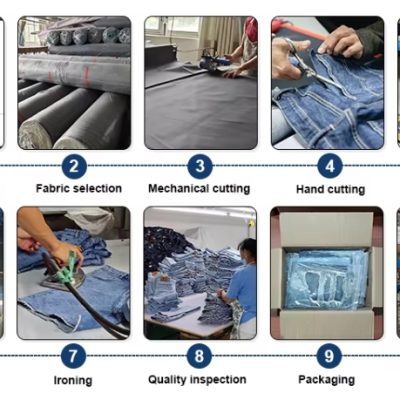
- Start Bulk Production: For a 100-pair test run, our specialized low-MOQ sewing line steps in. We maintain the exact same AQL quality control standards for 100 pairs as we do for 10,000 pairs. **
- Final QC and Packing: We check for loose threads, broken zippers, and symmetrical leg lengths. Then, we pack them in polybags and cartons, ready to ship to your warehouse or directly to Amazon FBA.
Key Takeaways
- Don’t let tech packs stop you: If you can’t draw one, a physical reference sample works just as well for our pattern makers.
- Fabric weight matters: A heavy 14oz rigid denim will fit completely differently than a 10oz stretch denim, even if you use the exact same paper pattern.
- The PP Sample is mandatory: Never skip sampling. It is the only way to perfect the fit and wash before spending money on bulk fabric.
- Start small, scale smart: Utilize our 100-pair MOQ to test your market without risking massive inventory deadstock.
Frequently Asked Questions (FAQ)
Q: How long does this entire process take?
A: Generally, allow 2-3 weeks for the initial sampling and wash development. Once you approve the sample, a 100-pair to 500-pair bulk production run takes an additional 3-4 weeks. Total time: 5-7 weeks.
Q: Do I need to buy and ship the fabric to you?
A: No. Xinen Garment handles full-package sourcing. We have direct relationships with the best denim mills in China, meaning we source the fabric, zippers, and buttons for you at wholesale prices.
Q: Why is the cost per unit (CPU) higher for a 100-pair order?
A: Setup costs. The time it takes to draft a paper pattern, calibrate the sewing machines, and formulate a specific enzyme wash recipe is the same whether we make 100 or 1,000 pairs. In smaller runs, those fixed setup costs are divided among fewer items. As you scale, your unit price will drop significantly.
Q: Can I mix sizes within my 100-pair order?
A: Yes! A standard 100-pair order allows you to break down the quantities across a full size run (for example, sizes 28 through 36) so you can offer your customers a complete inventory.