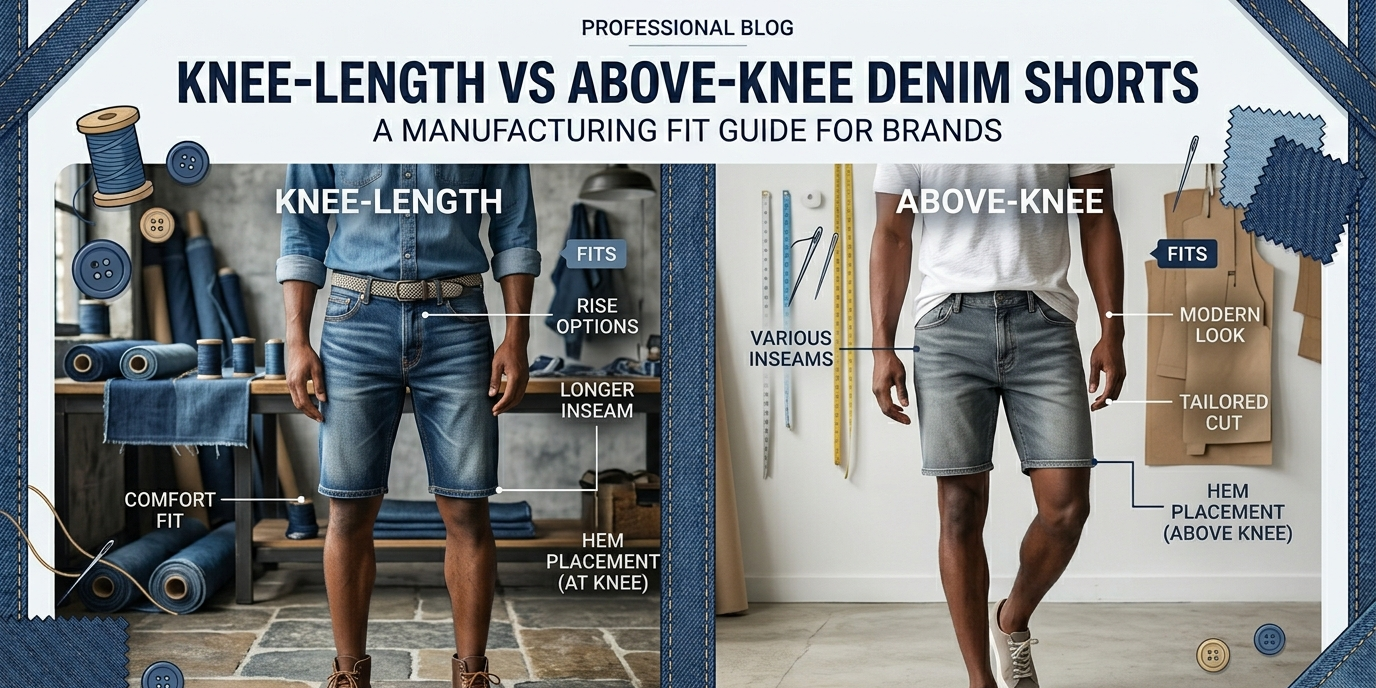
When fashion importers and e-commerce brands submit their summer Tech Packs, the most critical decision often isn’t the wash recipe—it is the inseam length. Denim shorts (jorts) are a staple category, but the market is strictly divided into two distinct silhouettes: knee-length and above-knee styles.
While both belong to the same product family, they are not manufactured the same way. A common mistake made by new private labels is assuming they can use the same CAD pattern and simply adjust the hemline. In reality, these two lengths require entirely different pattern engineering, fabric selections, and target market strategies.
At Xinen Garment, our pattern makers engineer custom denim shorts for Amazon FBA sellers, Shopify brands, and wholesalers daily. Here is the factual, factory-floor guide to choosing and manufacturing the right denim short length for your brand.
What Is the Technical Difference Between Knee-Length and Above-Knee Jorts?
The technical difference lies in the inseam measurement and the corresponding pattern grading. Knee-length jorts feature an inseam of 10 to 14 inches requiring a wider, relaxed leg opening, while above-knee shorts feature a 5 to 8-inch inseam that must be tailored closer to the mid-thigh.
- The Knee-Length Block: This style provides extensive coverage, falling right at or below the kneecap. It is heavily associated with workwear, utility styling, and the resurgence of 90s/Y2K baggy streetwear.
- The Above-Knee Block: Ending cleanly above the knee, this style is the standard for mainstream casual summer fashion. It offers a lighter, more relaxed, and youthful aesthetic that dominates fast-moving e-commerce platforms.
Why Do Knee-Length Denim Shorts Require Specific Pattern Engineering?
Knee-length denim shorts require a lowered front rise and an expanded thigh block so the rigid fabric can drape heavily below the knee without restricting the wearer’s movement.
- Fabric Weight & Drape: Because of their length, knee-length styles look best when they have structure. We highly recommend using 100% rigid cotton (11oz to 13oz). If the fabric is too thin or stretchy, the long shorts will cling awkwardly to the legs.
- The Market Position: This style is highly stable. It appeals to the streetwear market seeking oversized proportions, as well as the practical utility menswear market that prioritizes functional coverage and durability.
How Does Fit Grading Change for Above-Knee Denim Shorts?
Above-knee denim shorts require a carefully tailored leg opening and a standard front rise to prevent the fabric from awkwardly flaring out or riding up the thigh during movement.
- Mobility is Key: Because the hem sits on the mid-thigh, comfort is critical. While 100% cotton works, this length often benefits from a stretch denim blend (e.g., 98% Cotton / 2% Elastane) to provide flexibility.
- The Merchandising Advantage: Above-knee styles are universally understood by the consumer. For fast-fashion brands and summer capsule collections, this length is easier to merchandise across multiple light-blue enzyme washes and heavy distressed variations.
Can Factories Simply “Cut Shorter” to Make Above-Knee Styles?
No. Simply cutting a knee-length pattern shorter destroys the garment’s proportion, resulting in an excessively wide and unbalanced leg opening mid-thigh.
- The Sizing Trap: If a brand attempts to save development costs by using a baggy knee-length CAD pattern and just chopping 4 inches off the inseam, the resulting shorts will flare out like a bell.
- Two Separate Tech Packs: If you want to offer both lengths to your customers, you must submit two distinct Tech Packs. The grading rules for the hips, thighs, and leg openings must be engineered separately for each style to ensure a proper fit.
Which Inseam Length Will Generate More Sales for Your Brand?
Above-knee styles generally drive higher volume in mainstream fast-fashion and summer e-commerce, while knee-length styles command higher loyalty in the streetwear, skate, and utility markets.
- For Mainstream/Casual Brands: If your target audience wears basic tees, slim fits, and prefers a clean summer look, start with the above-knee (7-inch inseam) style. It carries less inventory risk.
- For Streetwear/Trend Brands: If your audience follows the current oversized, boxy outerwear trends, you must stock the knee-length (11-inch+ inseam) baggy jort. Selling a short, tight short to this demographic will result in zero sales.
Why Choose Xinen Garment for Your Denim Shorts Production?
Xinen Garment works directly with denim brands, wholesalers, and e-commerce sellers who need practical, scalable manufacturing support. We understand that product development is not just about sewing fabric—it is about engineering a fit that prevents customer returns.
- Technical Pattern Making: We draft precise CAD patterns tailored specifically to your chosen length, ensuring the rise, inseam, and leg opening proportions are mathematically correct.
- Startup-Friendly MOQs: We allow brands to test the market with realistic Minimum Order Quantities (starting at 100-300 pieces per style/wash).
- FBA & E-commerce Ready: We handle the final mile. From custom hardware to strict quality control, poly-bagging, and Amazon-compliant barcoding, your inventory arrives ready to sell.
- Direct Factory Communication: No trading company delays. You speak directly with the facility cutting your fabric and managing your wash recipes.
Frequently Asked Questions (FAQ)
Q: What is the standard inseam for above-knee denim shorts?
A: The standard inseam for above-knee men’s denim shorts ranges from 5 to 8 inches, depending on how high above the knee the brand wants the hem to sit.
Q: Are knee-length denim shorts still in style for 2026?
A: Yes. Driven by the massive resurgence of Y2K streetwear and utility fashion, heavy, baggy knee-length jorts (11 to 14-inch inseams) remain a dominant and highly profitable category.
Q: Do I need to choose different fabrics for the two lengths?
A: It is highly recommended. Knee-length styles require heavier, rigid 100% cotton to maintain a boxy structure. Above-knee styles often require lighter weights or a 2% stretch blend for thigh comfort.
Q: Which denim shorts length has a lower return rate in e-commerce?
A: Return rates depend entirely on accurate sizing charts, but above-knee stretch shorts generally have lower return rates in mainstream markets because the elastane provides a more forgiving fit across different body types.
Q: Can Xinen Garment develop both styles for my new collection?
A: Yes. If you provide reference photos, physical samples, or detailed Tech Packs, our pattern team will reverse-engineer both the above-knee and knee-length silhouettes for your bulk production.