Many founders approach us with beautiful sketches for a denim jacket collection, only to realize that their designs are impossible to manufacture within their budget. A sketch is just an idea. Designing for production requires a completely different mindset.
When you design a collection, you are not just choosing colors and fits; you are making decisions that dictate raw material consumption, machine setups, and wet processing timelines. At Xinen Garment, we bridge the gap between design concepts and industrial reality every day.
If you want to build a scalable and profitable denim outerwear line, here is how you should structure your design process from a factory perspective.
What Must Be Included in a Production-Ready Tech Pack?
A factory cannot manufacture a jacket based on a mood board. We need a comprehensive Tech Pack, which acts as the absolute legal and technical contract for your garment.
- The Bill of Materials (BOM): This is the exact recipe for your jacket. It must specify the fabric weight (e.g., 13oz rigid cotton), thread type (e.g., Tex 60 polyester core-spun), thread color, and specific hardware requirements (17mm brass shank buttons, copper rivets).
- Technical Callouts: Do not just say “make it high quality.” You must explicitly request construction details like “double-needle flat felled seams on the armholes” or “bar tacks at pocket stress points.”
- Accurate Size Charts: Providing a “Medium” sample is not enough. You must provide a full grading rule (how the measurements scale from XS to XXL) so our pattern makers can digitize the blueprints.
How Do You Manage Fabric Yields Across a Full Collection?
The biggest mistake startups make is selecting a different raw fabric for every single jacket in their collection. This fractures your purchasing power and makes it impossible to hit factory MOQs.
- The Core Fabric Strategy: To keep costs low and meet MOQs, design your collection around one or two core fabric rolls. For example, purchase a bulk roll of high-quality 12oz to 13oz midweight denim.
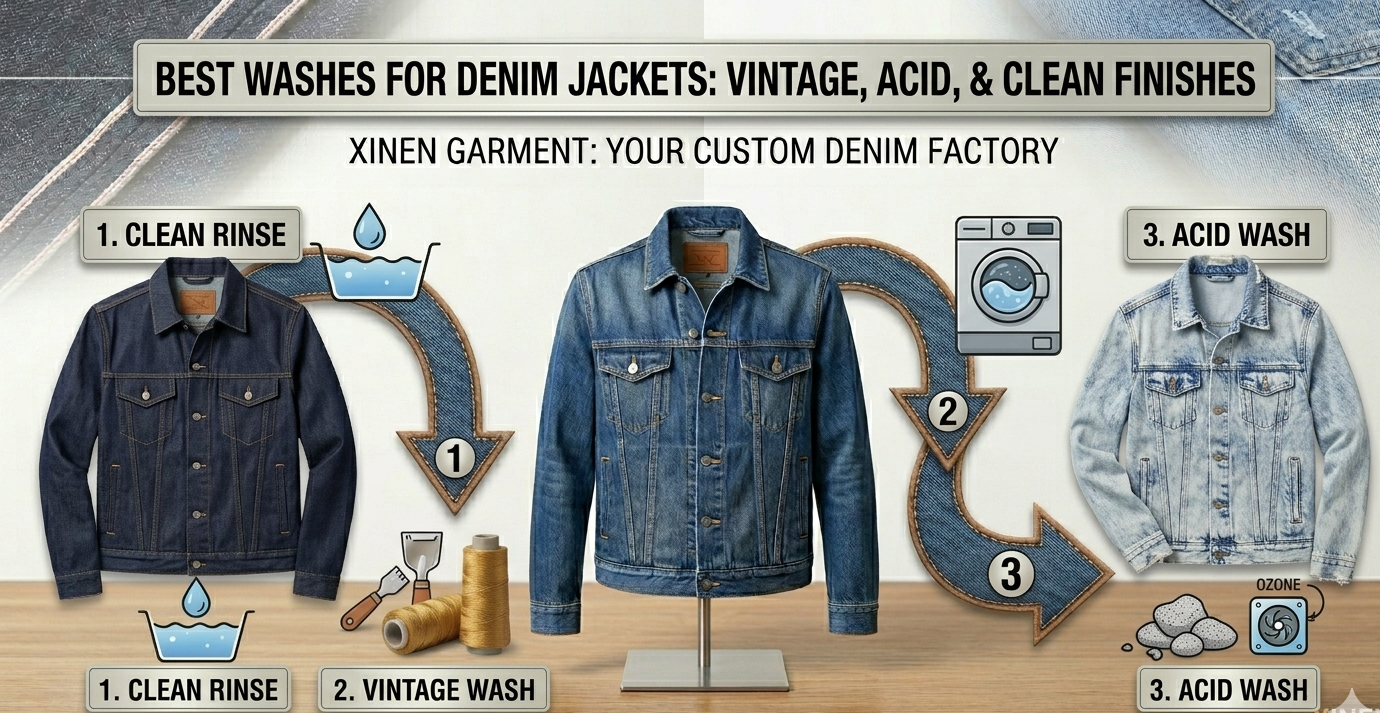
- Differentiate with Washes, Not Fabrics: You can use that exact same 13oz raw denim roll to produce a dark Clean Rinse trucker jacket, a heavily faded Vintage Wash oversized jacket, and a customized Acid Wash shacket. This strategy allows you to offer visual variety to your customers while only paying for one bulk fabric order.
Why Must You Account for Wash Shrinkage During the Design Phase?
Denim design is heavily reliant on wet processing. Because cotton shrinks when exposed to hot water and industrial agitation, the wash you choose directly alters the physical size of the jacket.
- The Shrinkage Reality: If your collection features one dark unwashed jacket and one heavy stone-washed jacket, they cannot use the same paper pattern. The heavy wash will shrink significantly more.
- Factory Intervention: At Xinen, we conduct wash tests before bulk cutting. We calculate the specific shrinkage percentage of your chosen wash and mathematically scale up your CAD patterns. When designing, you must allocate time and budget for these pre-production wash tests to ensure sizing consistency across your collection.
How Can You Avoid the “Sample Approved, Bulk Rejected” Trap?
It is the nightmare scenario for any buyer: the Pre-Production (PP) sample is perfect, but the bulk delivery is a disaster with uneven washes and sizing inconsistencies.
- The Root Cause: This usually happens when a brand pushes a factory to rush production, bypassing proper shade bands or failing to standardise the wash recipe. It can also happen if the grading rules were poorly calculated between sizes.
- The Solution: Design your timeline carefully. Always demand a Size Set (one sample of every size) to verify grading before cutting bulk fabric. Furthermore, require a physical Shade Band (samples showing the lightest and darkest acceptable wash limits) so there is a clear, objective standard for bulk quality control.
Key Takeaways
- Tech Packs are mandatory: Detailed BOMs and flat sketches prevent costly manufacturing errors.
- Consolidate your fabrics: Use one core fabric weight (like 13oz) across multiple styles and use different washes to create variety.
- Wash dictates fit: Different wash recipes require different pattern adjustments due to varying shrinkage rates.
- Control the bulk: Always approve size sets and shade bands to ensure the bulk order matches your approved PP sample.
Frequently Asked Questions (FAQ)
Q: How many styles should I include in my first denim jacket collection?
A: For a startup, less is more. We recommend launching with 2 to 3 strong core styles (e.g., one classic trucker, one oversized fit) offered in 2 different washes each. This keeps your SKU count manageable and helps you hit factory MOQs easily.
Q: Can I use custom hardware for my entire collection?
A: Yes. We highly recommend developing one custom-engraved shank button and using it across your entire collection. This standardizes your BOM, unifies your brand identity, and easily absorbs the hardware supplier’s MOQ.
Q: How long does it take to design and manufacture a new collection?
A: From the initial Tech Pack submission to the final delivery, you should allocate 60 to 90 days. This allows ample time for pattern making, fabric sourcing, PP sampling, wash testing, bulk production, and quality control.
Q: Do I need to provide physical patterns, or can Xinen Garment create them?
A: You only need to provide the Tech Pack with measurements, or a physical reference jacket. Our in-house technical design team will draft, digitize, and grade the CAD patterns for you.