Developing a custom men’s denim line is fundamentally different from creating women’s fast fashion. Men’s jeans are a highly technical garment where success relies almost entirely on three factors: exact pattern engineering, durable fabric sourcing, and consistent wet processing. A minor error in the crotch grading or shrinkage calculation can ruin an entire production run.
Many startup founders and e-commerce brands waste months sampling with trading companies because they do not understand the industrial steps required to move from a design sketch to bulk manufacturing.
At Xinen Garment, we engineer and manufacture custom men’s denim for wholesale importers, Shopify brands, and Amazon FBA sellers worldwide. Here is the direct, factory-floor guide to properly developing custom men’s jeans without wasting your budget on failed prototypes.
What Must Be Included in a Men’s Denim Tech Pack?
A professional men’s denim Tech Pack must include a complete Bill of Materials (BOM), strict point-of-measure (POM) grading rules, and precise hardware specifications.
If you send a factory a simple photo of a jean and say “make this,” you are guaranteeing a failed sample. To develop a scalable product, your Tech Pack must communicate the engineering details:
- The BOM (Bill of Materials): You must specify the exact fabric composition (e.g., 98% Cotton / 2% Elastane) and fabric weight (e.g., 12oz).
- Hardware Sourcing: Specify the metal used for shank buttons and rivets (e.g., copper, brass, alloy) and the zipper brand (e.g., YKK). Cheap alloy hardware will bend or rust after an industrial enzyme wash.
- Stitch Specifications: Define the thread thickness (Tex size) and color (e.g., traditional gold/tobacco contrasting thread or a tonal dye-to-match thread).
How Do You Choose the Right Fabric for Men’s Jeans?
You must choose your denim fabric based strictly on the intended fit and the target demographic of your brand, balancing heavy rigid cotton for structural fits against stretch blends for mass-market comfort.
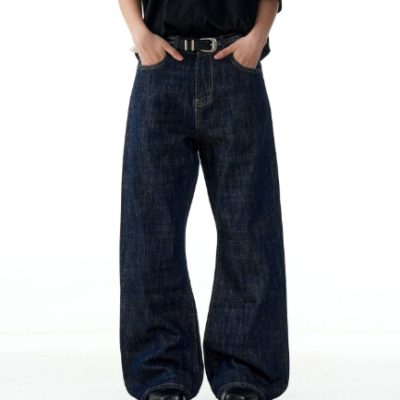
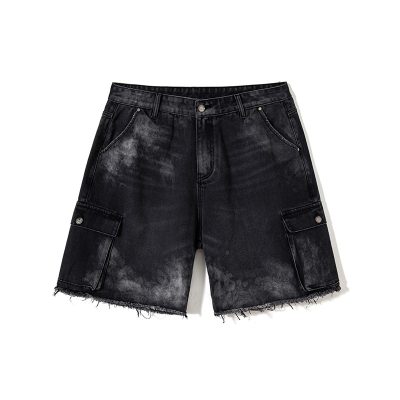
- For Streetwear & Vintage Fits: If you are developing baggy jorts, wide-leg fits, or authentic 90s straight cuts, you must use 100% rigid cotton (12oz to 14oz). Heavy rigid denim holds its architectural shape and reacts best to aggressive stone washing.
- For Slim, Tapered, or E-Commerce Fits: If you are selling to a broad Amazon or fast-fashion demographic where immediate comfort is required, use a stretch blend (1% to 2% Elastane). This acts as a sizing buffer, significantly lowering your customer return rates.
Why is Pattern Grading the Most Critical Step in Men’s Denim?
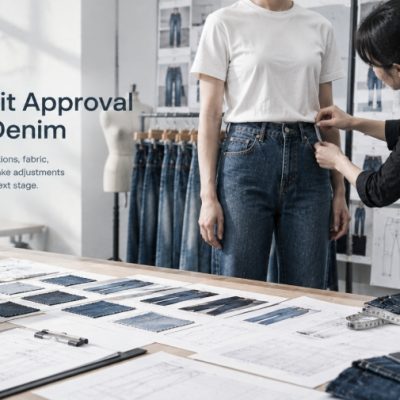
Pattern grading is the most critical step because men’s jeans require complex engineering around the front rise, back yoke, and thigh block to ensure the garment allows for mobility without sagging.
- The Anti-Fit Block: Unlike activewear, denim has little to no horizontal stretch. The factory CAD pattern maker must draft the hips and crotch drop mathematically to prevent the fabric from bunching tightly when the wearer sits down.
- Inseam and Rise Proportions: If you decide to grade a size 32 up to a size 38, you cannot simply make the entire pattern larger. The rise must scale differently than the leg opening. A professional factory engineers these grading rules to ensure the jean fits the same across all body types.
How Does the Wash Lab Affect Your Final Prototype?
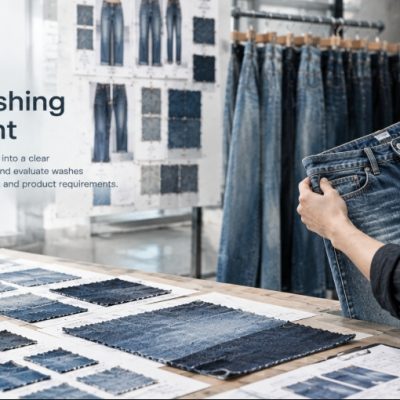
The wash lab affects your final prototype by introducing chemical abrasion and high-temperature water, which permanently alters the fabric’s color and forces the cotton to shrink before it reaches the customer.
- Controlling Shrinkage: Heavy wet processing (like a vintage acid wash) will cause the fabric to shrink significantly more than a basic rinse. At Xinen Garment, we perform strict wash-shrinkage tests before cutting the pattern. If the wash shrinks the fabric by 5%, we digitally expand your CAD pattern by exactly 5% so the final washed garment perfectly matches your Tech Pack measurements.
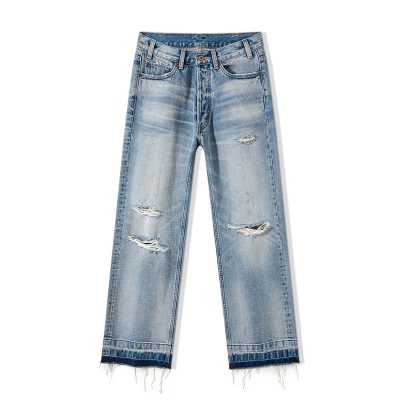
- Creating Authentic Fades: To replicate years of natural wear, our technicians manually hand-sand the thighs and apply localized potassium permanganate (PP) sprays to create high-contrast whiskers and honeycombs.
Why Choose Xinen Garment for Your Custom Denim Development?
Xinen Garment operates as a direct technical partner for B2B apparel brands, providing end-to-end manufacturing solutions from initial CAD drafting to final Amazon FBA preparation. We eliminate trading company markups and manufacturing guesswork.
- Technical Pattern Making: Our in-house engineers translate your concepts into mathematically accurate CAD patterns, ensuring your men’s jeans fit perfectly and minimize e-commerce return rates.
- In-House Wash Control: We do not outsource our wet processing. By keeping the wash lab in-house, we guarantee that the vintage fade on your Pre-Production (PP) sample exactly matches your bulk production run.
- Startup-Friendly Scaling: We support independent brands with practical Minimum Order Quantities (starting at 100-300 pieces), allowing you to validate your men’s denim line in the market without crippling inventory costs.
- Retail Ready: From custom branded leather patches and woven labels to strict moisture-control packaging and FNSKU barcoding, your garments leave our facility ready for immediate retail sale.
Frequently Asked Questions (FAQ)
Q: How much does it cost to develop a custom denim sample?
A: Sampling costs typically range from $200 to $250 per style, depending on the complexity of the vintage wash and whether custom-molded hardware (like branded buttons) is required. This fee is often refundable or credited towards your bulk production order.
Q: How long does the custom denim development process take?
A: Developing the initial Tech Pack, cutting the pattern, and finishing the first physical prototype usually takes 10 to 15 days. If revisions are needed based on your fit feedback, a second prototype adds another 7 to 10 days.
Q: Can I use my own custom labels and hardware?
A: Yes. Xinen Garment specializes in private label manufacturing. We source and attach your custom leather patches, woven waist labels, and branded metal hardware during the production process.
Q: Should I launch with multiple washes or just one?
A: If you are a startup, we highly recommend launching with one core fit in 2 or 3 essential washes (e.g., a dark clean rinse, a mid-blue enzyme wash, and a light vintage wash). This keeps your development costs low while offering variety to your customers.