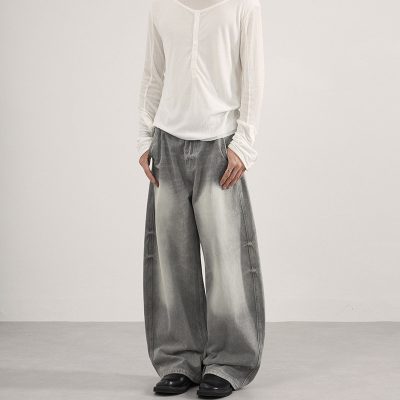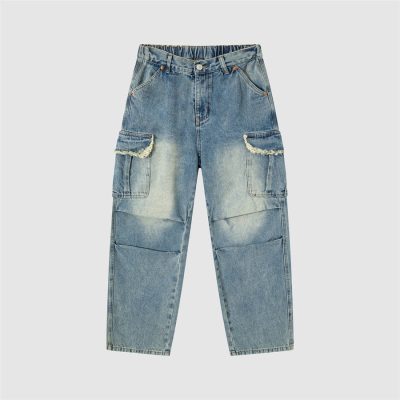
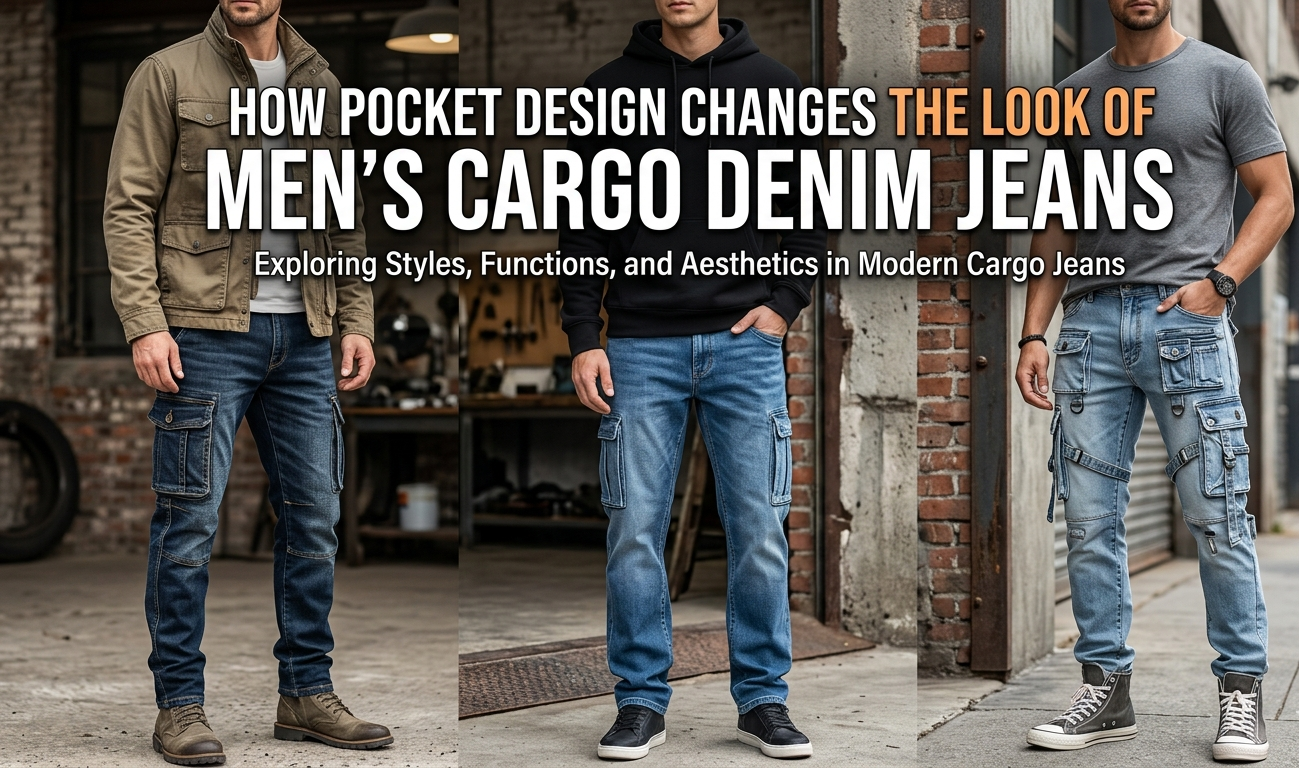
For private labels, fast-fashion importers, and wholesale buyers building a utility denim line, product differentiation relies heavily on specification details. Because the overall silhouette of a men’s cargo jean is typically a loose or relaxed straight cut, the design, placement, and architecture of the side pockets dictate the garment’s market positioning, production cost, and final retail value.
When a brand prepares a tech pack for a cargo collection, treating side pockets as a simple aesthetic addition is a critical error. The choice between pocket styles alters the fabric drape, changes the manufacturing complexity, and determines whether the product appeals to streetwear, heritage workwear, or smart-casual consumer demographics.
This technical guide breaks down how specific pocket designs alter the look of men’s cargo denim and what parameters you must manage during production.
1. Pocket Architecture: Flat Patch vs. 3D Bellows Pockets
The structural depth of the pocket is the primary factor determining the visual profile of the jeans. Manufacturers divide cargo side pockets into two main construction categories:
Flat Patch Pockets
- The Construction: These pockets are sewn flat directly onto the side leg panels without any expanding side folds.
- The Visual Impact: Flat patch pockets create a streamlined, cleaner silhouette. They do not add bulk to the thigh area when empty, making the cargo pant appear more integrated and less aggressive.
- Market Positioning: This configuration is highly marketable for contemporary, minimalist, or smart-casual menswear brands where utility is suggested rather than purely functional. It requires less fabric and fewer sewing steps, lowering your bulk cut-and-make (CM) costs.
3D Bellows (Gusseted) Pockets
- The Construction: These pockets feature extra folded fabric panels (pleats) on the sides and bottom that allow the pocket to expand outward.
- The Visual Impact: 3D bellows pockets create a rugged, high-volume aesthetic. They project a heavy, tactical look that emphasizes the authentic utilitarian heritage of cargo pants.
- Market Positioning: This style is standard for streetwear, heavy workwear, and outdoor lifestyle apparel lines. From a manufacturing perspective, bellows pockets require automated folding, ironing, and complex top-stitching, which increases labor time but justifies a premium retail price point.
2. Flap Geometry and Closure Mechanics
The top flap of a cargo pocket acts as a focal point. Altering its geometry and hardware transforms the design without changing the core pattern block of the leg.
- Square and Rectangular Flaps: Straight, hard-edged flaps project a clean, modern, and industrial appearance. They are common in minimalist streetwear designs.
- Angled or Pointed Flaps: Flaps with angled corners or a center point convey a traditional military or vintage outdoor look. They break up the horizontal lines of the side leg and draw focus to the hardware detail.
- Concealed vs. Exposed Closures: Securing the flap with hidden metal snaps preserves a clean fabric surface, allowing the wash texture to stand out. Utilizing exposed alloy rivets, heavy-duty zippers, or contrast bartacks shifts the garment toward a tactical, technical aesthetic.
3. Production Variables and Structural Balance
When scaling your cargo designs from a pre-production sample to mass manufacturing, changing the pocket specifications introduces physical variables that your brand must monitor.
- Outseam Counterbalancing: Heavy 3D pockets add significant weight to the side seams (outseams). If your patterns are not balanced correctly by the factory pattern room, this weight will pull the outseams forward, causing the leg panels to twist unnaturally after the final wash.
- Fabric Weight Thresholds: Cargo pockets consist of multiple layers of fabric and stabilizing interfacing. To prevent the pocket attachment points from sagging or tearing, you must specify mid-to-heavyweight denim, strictly between 12oz and 14.5oz. Lightweight denim cannot support the structure of expanding utility pockets.
- Differential Wash Fading: Because bellows pockets have multi-layered edges and folds, they react differently during industrial laundering (such as stone or enzyme washing). The friction from pumice stones abrades the raised edges of the folds faster than the flat leg fabric, creating high-contrast highs and lows that emphasize the pocket architecture.
Why Choose Xinen Garment for Custom Cargo Denim Production
At Xinen Garment, we translate complex utility designs into consistent, retail-ready bulk orders for international B2B clients, clothing brands, and fast-fashion wholesalers.
- Advanced Pattern Engineering: Our pattern makers adjust pattern blocks based on exact fabric shrinkage data and outseam balance metrics, ensuring your cargo jeans hold their intended shape across your full size run.
- Heavy-Duty Production Floors: We utilize automated sewing machinery and dense bartack stitching to reinforce every pocket corner, flap joint, and belt loop, ensuring the pockets can withstand daily physical strain and heavy commercial washing.
- Legally Safe, Custom Hardware: We support your private label by molding high-quality, custom-branded metal snaps, rivets, and zippers based exclusively on your original vector designs, ensuring complete trademark safety.
- Direct Factory Operations: By manufacturing directly from our facilities in China (including Foshan and Guangxi), we remove third-party agent markups, providing clear bulk pricing, strict quality control tolerances (+/- 0.5 inches), and reliable delivery timelines.
4. Frequently Asked Questions (FAQ)
Can we combine different reference images to design our custom cargo pockets?
Yes. When submitting design adjustments to our sample room, please gather your reference images and structural notes and merge them cleanly into a single technical sheet. This consolidated layout ensures our sewing technicians understand the exact relationship between your chosen pocket shape, flap geometry, and hardware placement.
How do you prevent the pocket flaps from curling upward after an enzyme or stone wash?
We fuse a high-durability industrial stabilizer fabric (interfacing) inside every pocket flap before assembly. This keeps the multi-layer fabric crisp and flat, preventing the corners from curling after drying.
What is the minimum order quantity (MOQ) for custom-shaped cargo pockets?
MOQs are evaluated based on fabric availability and wash complexity rather than the pocket shape itself. Because custom pockets require a dedicated cutting die and assembly line adjustment, we review your tech pack specifications to provide an accurate minimum volume.
How do we guarantee that pocket placement remains proportionate for very large or small sizes?
We do not use a single fixed pocket size for all garments. Our technical team grades the pocket dimensions proportionally across your size matrix so that the pocket looks identical whether it is on a size 30 or a size 40 waistband.