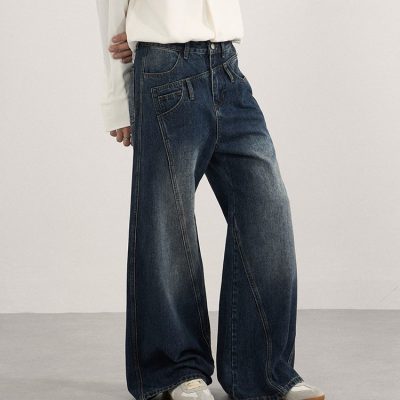
The “Skinny Jean Era” is officially a chapter in the history books. For denim importers, wholesalers, and private label startups, the market has fragmented into two dominant silhouettes: the Straight Leg (the new classic) and the Wide Leg (the volume driver).
According to 2025-2026 sourcing data, successful women’s fashion brands are no longer betting on a single fit. Instead, they are analyzing their “Customer Avatar” to determine the split. A 50/50 split works for some; an 80/20 split works for others.
If you are a buyer planning your next bulk order, you cannot rely on guesswork. You need to understand the technical specifications, the fabric costs, and the specific consumer psychology behind these two cuts. Here is your manufacturing guide to choosing the right lineup.
Who is Actually Buying Wide Leg vs. Straight Leg Jeans in 2026?
Before you send a Tech Pack to your women jeans factory, you must identify who will wear the product. Data from social listening tools (Reddit/TikTok) and search intent analysis reveals a clear demographic divide.
The Straight Leg Customer: “The Modern Professional”
- Target Age: 28 – 45 (Millennials & Gen X).
- The Need: Versatility. This customer needs a jean that works with a blazer for the office and a t-shirt for the weekend.
- The Fit Logic: They want to transition away from skinny jeans but are intimidated by extreme volume. The Straight Leg Jean is their “Safe Haven.”
- Boutique Labels Strategy: Market this as the “Timeless Cut” or “90s Original.” It has the lowest return rate in e-commerce because the fit is predictable.
The Wide Leg Customer: “The Trend Adopter”
- Target Age: 16 – 30 (Gen Z & Young Millennials).
- The Need: Silhouette and Comfort. This customer rejects “restriction.” They want pants that pool at the shoe (stacking) and sit high on the waist.
- The Fit Logic: The wider, the better. They prioritize “The Look” over practicality.
- Streetwear Brands Strategy: This is your hero product. If you are a streetwear brand, 70% of your SKU count should be wide or baggy fits.
Visual Insight: The Demographic Split
(Recommended Chart for this Section)
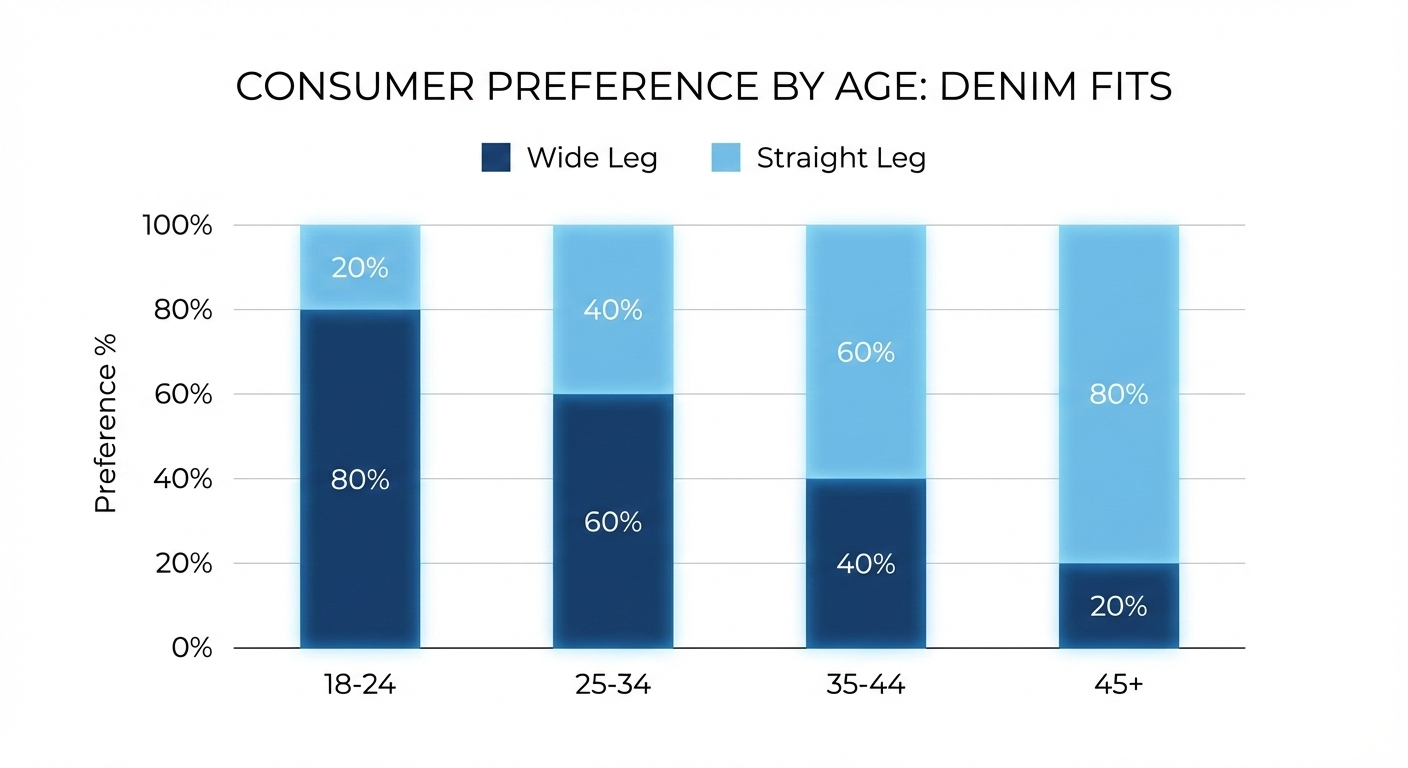
Chart Suggestion: A Stacked Bar Chart titled “Consumer Preference by Age Group.”
- Y-Axis: Percentage of Preference.
- X-Axis: Age Groups (18-24, 25-34, 35-44, 45+).
- Data Logic: > * 18-24 group is 75% Wide Leg / 25% Straight.
- 35-44 group is 30% Wide Leg / 70% Straight.
- Why this works: It helps the buyer decide their inventory ratio based on their brand’s target age.
What Are the Critical Manufacturing Specs for Straight Leg Jeans?
When sourcing straight leg jeans, the definition of “Straight” varies by region. As a straight jeans manufacturer, here is the global standard we recommend for bulk production:
- The Leg Opening (Sweep): For a Size 28, the leg opening should be between 14.5 inches and 16 inches. Anything narrower (13″) is a “Slim Straight”; anything wider (17″+) starts to look like a bootcut.
- The Rise: A “Mid-High Rise” (10 to 10.5 inches) is the best seller. It covers the stomach but isn’t as aggressive as a rib-cage high rise.
- Fabric Choice: This style requires “Structure with Give.” Do not use 100% rigid cotton for mass-market straight legs—it can feel too stiff for the office.
- Recommendation: 98% Cotton / 2% Elastane (11oz – 12oz). This offers the “vintage look” with the comfort consumers expect.
Why Are Wide Leg Jeans Harder to Manufacture Correctly?
Wide leg jeans are the most technically difficult item for denim manufacturers to get right. If you look at negative reviews on women’s fashion brand sites, the complaints are always the same: “It fits my hips but gaps at the waist” or “The legs twist when I walk.”
To avoid this in your private label line, pay attention to these three points:
- The “Darting” Technique: Because the hip is wide, the waist needs to be pulled in significantly. Simple side seams aren’t enough. We recommend adding back darts or a curved waistband pattern to contour the lower back.
- Fabric Weight (GSM): This is non-negotiable. You cannot make a good wide-leg jean with lightweight fabric. It will flutter and look cheap.
- Requirement: Minimum 12.5oz to 14oz Rigid Denim (100% Cotton). The fabric needs weight to fall vertically from the hip to the floor.
- The Inseam Length: Wide leg jeans must hit the floor or the top of the shoe.
- Importer Note: If you sell in Asia, a 29″ inseam is standard. If you sell in the US/EU, you must offer a 32″ inseam (Regular) and a 34″ inseam (Tall). A short wide-leg jean (unless cropped intentionally) is a slow seller.
How Does Fabric Yield Impact Your FOB Price?
This is the conversation wholesale buyers often avoid, but it is critical for your margins.
Wide Leg Jeans cost more to make.
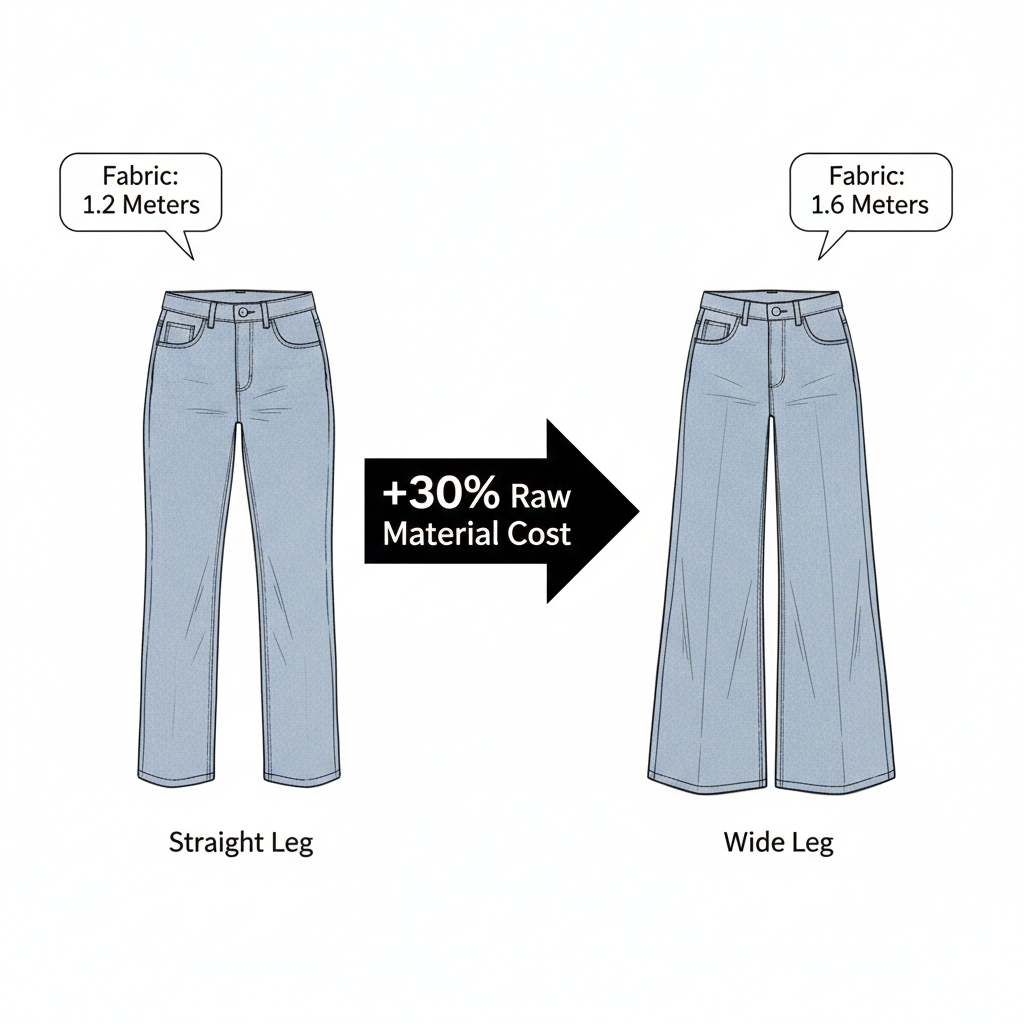
- The Math: A straight leg jean (Size 28) typically consumes 1.2 to 1.3 meters of fabric. A wide leg jean can consume 1.5 to 1.7 meters.
- The Impact: That is a 25-30% increase in raw material cost.
- Shipping: Wide leg jeans are heavier and bulkier when folded. Fewer units fit in a standard carton, which slightly increases your freight cost per unit.
Buyer Strategy: Do not try to negotiate a wide-leg price down to a skinny-jean price. If a factory agrees to that, they are likely swapping your fabric for a lower-grade, lighter material, which will ruin the silhouette. instead, accept the higher FOB and retail the wide leg at a premium price point (e.g., $89 vs $69).
Visual Insight: Cost & Yield Comparison
(Recommended Chart for this Section)
Chart Suggestion: A “Cost Driver” Doughnut Chart or Split Bar Chart.
- Title: “FOB Cost Factors: Straight vs. Wide.”
- Visual: Show two bars side by side.
- Key Insight: Highlight the “Fabric Cost” portion of the bar. For Wide Leg, this portion should be visibly larger (approx. +30%).
- Why this works: It justifies the price difference to the buyer visually.
Which Style is Best for Your Specific Brand Type?
We work with hundreds of clients, from denim importers to boutique labels. Here is our data-driven recommendation for your mix:
Scenario A: The Private Label Startup
- Goal: Low risk, high customer satisfaction.
- Mix: 70% Straight Leg / 30% Wide Leg.
- Why: Straight leg fits are easier to grade across sizes (XS-XL), reducing your return rate during the launch phase.
Scenario B: The Gen-Z Streetwear Brand
- Goal: Virality and “Fit Pics.”
- Mix: 80% Wide Leg / 20% Baggy Straight.
- Why: Your customer sees Straight Leg as “boring.” You need heavy 14oz wide denim with unique washes (Acid Wash, Dirty Tint) to stand out.
Scenario C: The Mass Market Wholesaler
- Goal: Volume turnover.
- Mix: 40% Straight / 40% Wide / 20% Bootcut.
- Why: You need to serve everyone. Ensure your Wide Leg pattern is not too extreme (keep the leg opening around 20-22 inches) to maintain mass appeal.
Conclusion: Sourcing for Profitability
The choice between Wide Leg and Straight Leg is not just about fashion—it is about understanding your customer’s age, lifestyle, and willingness to pay.
- Straight Leg is your cash cow: steady sales, lower fabric costs, easier fit.
- Wide Leg is your brand builder: higher price point, trend-relevant, requires premium fabric.
For apparel importers and brands, the winning strategy in 2026 is not to choose one, but to balance the two based on clear manufacturing specs.
Need help refining your fit? As a specialized women jeans factory, we have the patterns and the fabric library to execute both styles perfectly. We understand the difference between a “Vintage Straight” and a “Palazzo Wide,” and we ensure your bulk orders meet international quality standards.
FAQ for Denim Buyers
Q: What is the Minimum Order Quantity (MOQ) for custom wide leg jeans?
A: Because wide leg jeans require more fabric consumption, we typically require an MOQ of 300 pieces per wash/style to maximize fabric roll efficiency. However, for boutique labels using our stock 13oz fabrics, we can sometimes accommodate smaller test runs.
Q: Can I use the same fabric for both straight and wide leg jeans?
A: Ideally, no. Straight leg jeans benefit from a 98/2 or 99/1 cotton-elastane blend for comfort. Wide leg jeans perform best in 100% rigid cotton to maintain the architectural shape of the pant. Using high-stretch fabric for wide legs often results in a “cheap” draping effect.
Q: What is the trend outlook for 2027? Will wide leg jeans disappear?
A: No. Google Trends data indicates that Wide Leg has become a “Core Category,” much like Skinny Jeans were in 2010. While extreme “Baggy” fits might fluctuate, the tailored Wide Leg is established as a staple for the next 3-5 years.
Q: Do you offer “Asian Fit” and “Western Fit” patterns?
A: Yes. As a global denim manufacturer, we have specific grading rules for different markets. The primary differences are in the “Rise” curve and the “Thigh” circumference. We can adjust these specs for your specific export market.