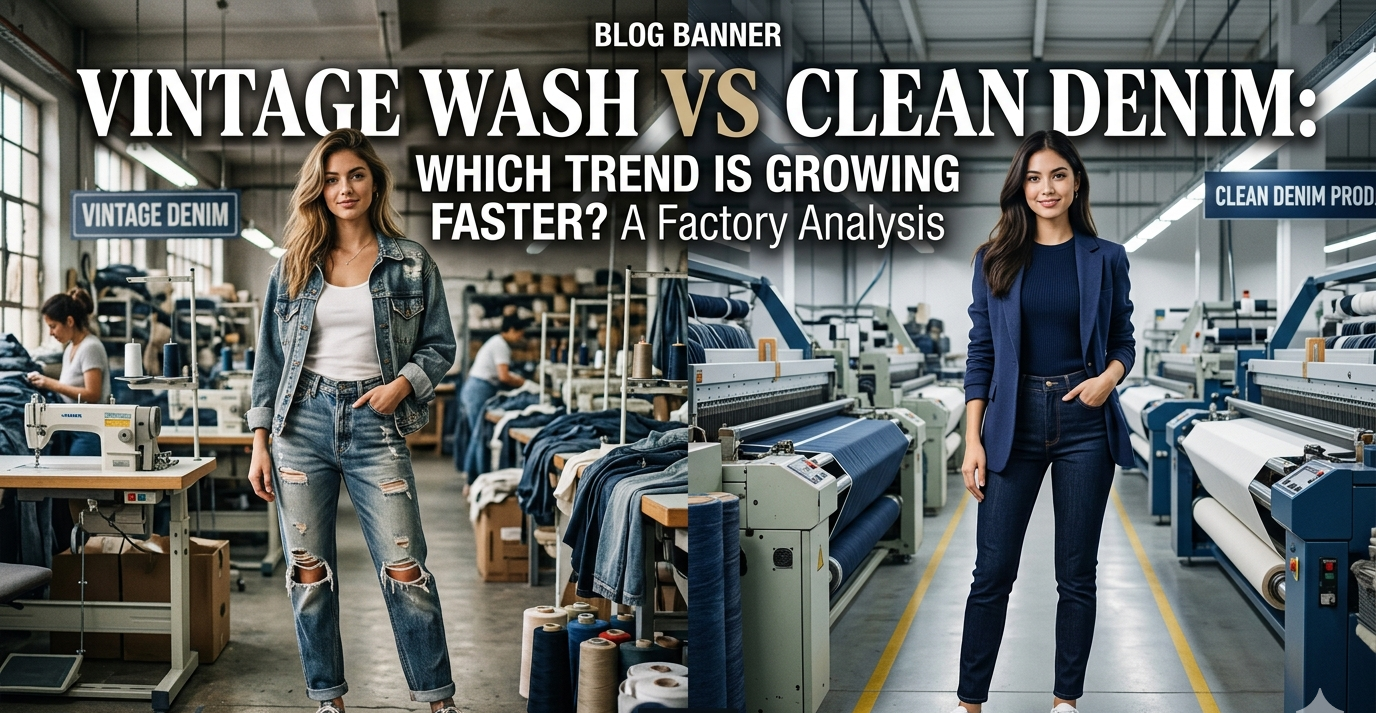
For clothing brand founders and e-commerce sellers, deciding between a heavily distressed vintage wash and a clean denim look is not just a design choice. On the factory floor, this decision dictates your Cost Per Unit (CPU), production lead times, and, most importantly, your sizing consistency across bulk orders.
While fashion magazines debate aesthetics, at Xinen Garment, we track trends through wholesale Tech Packs and bulk manufacturing orders. If you are an Amazon FBA seller or Shopify brand planning your next denim collection, here is the factual, manufacturing-level breakdown of how vintage wash and clean denim compare, and which one is actually driving more volume.
What is the Technical Difference Between Vintage Wash and Clean Denim?
The fundamental difference lies in the wet processing stage: clean denim undergoes minimal treatment (usually just a basic softening rinse to prevent immediate shrinkage), whereas vintage wash denim requires heavy chemical and mechanical abrasion to artificially age the fabric.
- Clean Denim (Rinse/Raw): The fabric retains its original, deep indigo dye. The production process is fast, mathematically predictable, and highly consistent. It offers a polished, uniform aesthetic.
- Vintage Wash: This requires complex recipes involving pumice stones, enzyme baths, potassium permanganate (PP) spray, and manual hand-sanding. The goal is to create high-contrast fading, whiskering, and honeycombs. It is highly labor-intensive and technically demanding to execute consistently across thousands of units.
Which Denim Trend Is Growing Faster in the Market?
Currently, Vintage Wash is experiencing explosive, faster-paced growth driven by the massive resurgence of Y2K streetwear and 90s nostalgia, but Clean Denim remains the stable, high-volume backbone for premium menswear and everyday casual wear.
- The Vintage Surge: Over the last few seasons, wholesale orders for heavy enzyme washes, “dirty washes” (tinting the denim with yellow/brown hues), and heavily distressed jorts have skyrocketed. If your brand targets Gen Z, streetwear demographics, or trend-driven fast fashion, you must incorporate vintage washes to stay relevant.
- The Clean Denim Foundation: Clean, dark indigo denim is not a “fast trend”—it is a permanent category. It dominates the smart-casual market. Brands selling premium workwear, selvedge jeans, and office-appropriate denim rely entirely on clean finishes. While its growth is slower, its lifecycle is infinite.
How Do Production Costs Compare Between the Two Styles?
Vintage wash denim is significantly more expensive to manufacture than clean denim due to the extensive manual labor, specialized chemicals, and longer machine processing times required in the wash lab.
- The Cost of Clean: Producing a clean rinse jean is highly cost-effective. Once the garment is sewn, it requires a short, standard wash cycle. You save money on labor and chemical inputs, allowing you to allocate more budget toward premium hardware or heavier 14oz fabrics.
- The Cost of Vintage: Every fade, whisker, and distressed hole on a vintage jean requires human hands. Workers must manually sand the thighs and carefully apply PP spray to specific zones. Furthermore, heavy stone washing degrades the fabric slightly, meaning the factory must use higher-quality core yarns to prevent the garment from tearing during production. This naturally raises your CPU.
Which Style Is Safer for Amazon and Shopify Startups?
For new Amazon and Shopify sellers aiming to minimize return rates, Clean Denim (or a very light, uniform enzyme wash) is the much safer starting point because it guarantees strict sizing consistency.
- The Sizing Risk of Vintage Washes: Heavy wet processing is brutal on fabric. Submerging cotton in high-temperature chemical baths for hours causes unpredictable shrinkage. If a factory lacks precise shrinkage-control protocols, a size Medium from “Batch A” might fit differently than a size Medium from “Batch B,” leading to devastating return rates on Amazon.
- The Consistency of Clean Denim: Because clean denim bypasses aggressive wet processing, the CAD pattern grading translates perfectly to the final garment. If you order 500 pairs of clean denim jeans, the sizing will be virtually identical across the entire production run.
Why Choose Xinen Garment for Your Custom Denim Production?
Whether your Tech Pack demands a complex 90s acid wash or a pristine, raw selvedge jacket, Xinen Garment provides the technical infrastructure to manufacture it flawlessly. We build supply chain stability for global B2B clients, importers, and e-commerce brands.
- In-House Wash Lab: We do not outsource our wet processing. Our in-house engineers control the exact temperature, chemical formulation, and tumbling times, ensuring that the vintage wash on your Pre-Production (PP) sample matches your bulk delivery exactly.
- Strict Shrinkage Control: Before cutting your bulk fabric, we run exhaustive wash-shrinkage tests. We then adjust your digital patterns to compensate for the exact shrinkage rate of your chosen wash, guaranteeing consistent sizing and lowering your e-commerce return rates.
- Startup-Friendly MOQs: We allow brands to test both vintage and clean styles with realistic Low MOQs (starting at 100-300 pieces), empowering you to validate market demand without massive upfront inventory risks.
- Direct Factory Pricing: By eliminating trading company markups, we give you transparent BOM (Bill of Materials) and labor cost breakdowns, maximizing your profit margins.
Frequently Asked Questions (FAQ)
Q: Can I use the same CAD pattern for both a clean denim and a vintage wash style?
A: No. Heavy vintage washes cause the fabric to shrink significantly more than a simple clean rinse. A professional factory will draft two separate patterns with different shrinkage tolerances to ensure both final garments fit identically.
Q: Why do some vintage wash jeans look cheap or unnatural?
A: Cheap vintage washes usually rely heavily on generic sandblasting or poorly applied chemical sprays to save time. Authentic-looking vintage fades require a layered process of stone washing, hand-sanding, and precise localized tinting, which requires skilled labor.
Q: Is clean denim the same as raw denim?
A: Not necessarily. “Raw denim” has never touched water after the dyeing process and is extremely stiff. Most “clean denim” sold today undergoes a very quick, light rinse (often with softeners) to remove excess starch and prevent extreme shrinkage for the end consumer, while still maintaining that dark, uniform look.
Q: Which denim style is more sustainable?
A: Clean denim is inherently more sustainable as it requires drastically less water, zero pumice stones, and fewer chemicals compared to heavy vintage washing.