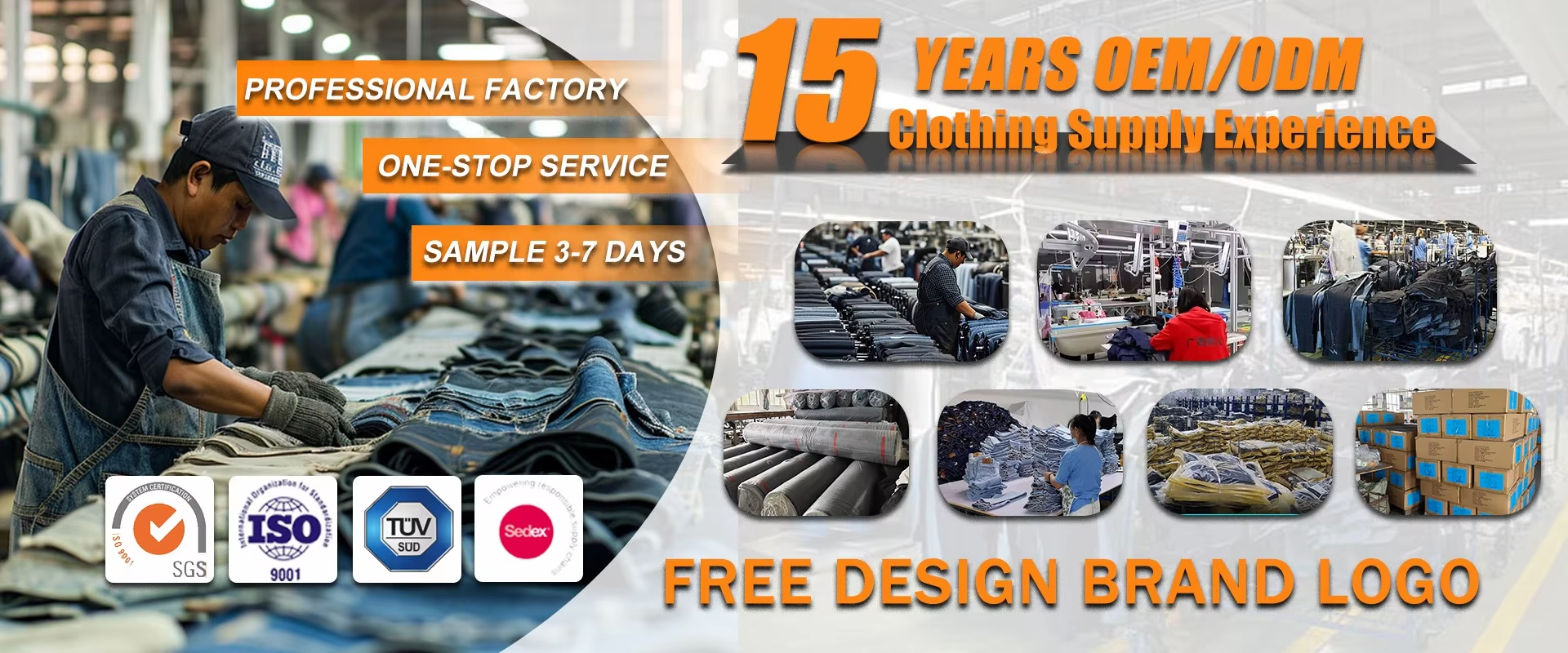
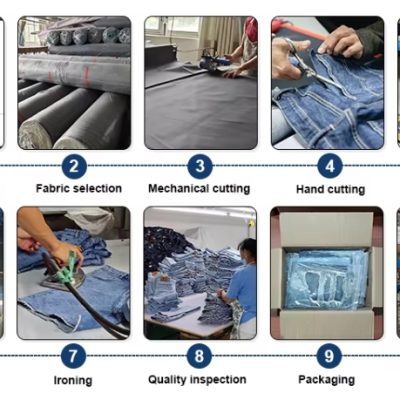
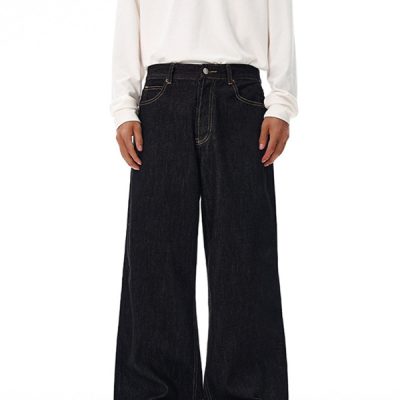
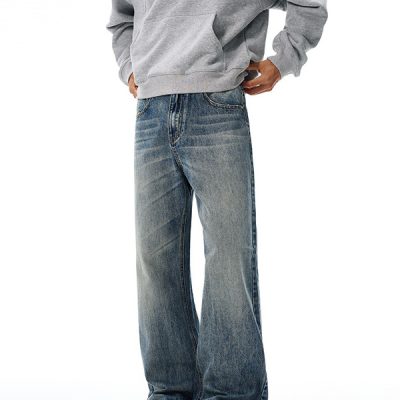
Once a custom denim product has been fully developed, tested, and approved, the focus shifts from design and refinement to structured production control. The primary purpose of bulk production is to transfer the approved product into a repeatable manufacturing process while maintaining the confirmed specifications as the core operational reference.
Moving a product from development into manufacturing requires clear technical documentation, coordinated material preparation, and systematic quality oversight. Because denim manufacturing is a hands-on physical process that includes cutting, sewing, washing, and finishing, established reference points ensure that bulk garments reflect the characteristics of the approved sample.
+------------------+     +-------------------+     +--------------------+
|  DEVELOPMENT     | --> | PRODUCTION REF.   | --> | BULK PRODUCTION    |
|  • Fabric        |     |  • Approved Sample|     |  • Material Checks |
|  • Pattern/Fit   |     |  • Tech Pack      |     |  • Cutting/Sewing  |
|  • Wash Sample   |     |  • Specs & Grade  |     |  • Bulk Wash       |
|  • Trims/Hardware|     |  • Approved Wash  |     |  • QC & Packing    |
+------------------+     +-------------------+     +--------------------+
When Is a Denim Product Ready for Bulk Production?
A custom denim product is ready for bulk manufacturing when all critical design and technical variables have been established and signed off. Initiating bulk production before key specifications are confirmed increases the risk of discrepancies during cutting, assembly, or washing.
Depending on the requirements of the project, a production-ready package typically includes:
- An Approved Sample: A physical garment representing the target fit, silhouette, and construction.
- Confirmed Measurement Specifications: Written specs defining critical dimensions across all points of measure.
- A Finalized Pattern & Grading: Approved digital or physical production patterns for the main size and all target size extensions.
- Specified Denim Fabric: A selected, tested, and confirmed denim fabric style.
- Confirmed Trims & Hardware: Finalized thread colors, main labels, care tags, buttons, rivets, zippers, and pocketing fabric.
- An Approved Wash Reference: A physical wash sample or clearly defined wash standard outlining target shade, contrast, and distressing levels.
- Packaging Requirements: Instructions for folding, polybagging, labeling, and carton packing, where applicable.
Exact approval requirements depend on the specific product and brand workflow. Some established labels provide complete tech packs and approved prototypes, while emerging brands may work through step-by-step development to establish these standards.
From Approved Sample to Production
Transitioning a project from sample sign-off to finished goods involves clear, sequential steps to align production lines with agreed-upon standards.
- Review the Approved Sample: Examine the physical prototype against all technical documentation.
- Confirm Written Specifications: Finalize measurement charts, seam construction details, and finishing instructions.
- Confirm & Reserve Materials: Verify bulk availability and specifications for shell fabric, pocketing, threads, and metal hardware.
- Finalize Production Patterns: Check pattern grading and markers to ensure accurate cutting across all sizes.
- Align Wash & Finishing Directions: Establish the target wash benchmark for the wet-processing facility.
- Issue Production Orders: Release verified technical packages to cutting and sewing teams.
- In-Line Quality Checks: Inspect panel cutting, seam construction, and sub-assemblies during manufacturing.
- Bulk Wash & Finishing: Process sewn garments according to the approved washing protocol.
- Post-Wash QC & Trim Application: Check dimensions, shade continuity, and apply final branding, rivets, buttons, and labels.
- Final Inspection & Packaging: Conduct final checks against approved specifications before packing garments for dispatch.
What Becomes the Production Reference?
In professional custom denim manufacturing, production teams rely on both physical and written references to verify accuracy throughout assembly and processing.
| Production Reference | Operational Purpose | Key Elements Covered |
| Approved Sample | Physical standard for overall appearance, proportion, and construction detail. | Visual silhouette, hand-feel, pocket placement, seam styling, overall drape. |
| Measurement Sheet | Quantitative standard for dimensions and tolerances across all sizes. | Waist, hip, rise, thigh, knee, leg opening, inseam, yoke depth. |
| Production Pattern | Geometric template used for fabric cutting and assembly. | Panel shapes, seam allowances, notch locations, grainlines, size grading. |
| Fabric Standard | Reference for bulk material properties and shade direction. | Fabric weight (oz), weave structure, stretch/recovery, raw shade. |
| Wash Benchmark | Physical or visual reference for wet and dry processing target. | Base shade, abrasion level, whiskering, scraping, tinting, softeners. |
| Construction Sheet | Detailed instructions for stitch types and structural assembly. | Stitching density (SPI), thread gauge/color, seam types, reinforcement bartacks. |
| Trim & Branding Pack | Bill of materials (BOM) for all hardware, labels, and packaging elements. | Buttons, rivets, zippers, main labels, care labels, leather patches, hangtags. |
Not every project requires every written reference, but combining a physical approved sample with detailed technical data provides the clearest guidance for production.
Material Confirmation Before Production
Bulk denim manufacturing relies on the coordination of multiple raw materials. Before cutting begins, components are checked against agreed-upon specifications to minimize variations during bulk assembly.
- Denim Shell Fabric: Bulk rolls are inspected for shade consistency, weight, width, and surface flaws before layout.
- Pocketing & Lining: Material used for front pocket bags and internal waistbands is checked for strength, composition, and color.
- Sewing Threads: Core-spun or cotton threads are matched for color, thickness, and tensile strength to handle high-tension denim seams.
- Metal Hardware: Buttons, rivets, and zippers are verified for finish, durability, closure action, and secure attachment specifications.
- Labels & Trims: Woven labels, care tags, size tags, and leather or synthetic back patches are checked for accuracy, placement, and legibility.
Materials are sourced and confirmed according to project specifications to ensure all components perform correctly during sewing and subsequent washing processes.
Production and Quality Control
Quality management in denim production requires ongoing checks at critical stages rather than relying solely on a final audit. Because denim undergoes severe mechanical and chemical processing during washing, structural and dimensional checks occur throughout assembly.
Raw Material Inspection
       │
       ▼
Cutting & Panel Checks ──► Measure & Inspect Cut Panels
       │
       ▼
Sewing Line Inspection ──► Monitor Seams, SPI & Hardware Application
       │
       ▼
Bulk Wash Monitoring   ──► Compare Washing & Abrasion to Approved Benchmark
       │
       ▼
Post-Wash Measurement  ──► Check Shrinkage & Dimensional Specs
       │
       ▼
Final QC & Packaging   ──► Inspect Trims, Finishing & Final Garment
Key Inspection Areas
- Material Inspection: Verifying fabric weight, face appearance, and trim accuracy prior to cutting.
- Construction Checks: Monitoring stitch density, seam strength, pocket symmetry, waistband attachment, zipper installation, and bartack placement.
- Dimensional & Measurement Checks: Measuring garments pre-wash and post-wash against the approved measurement sheet to verify size consistency.
- Appearance & Finishing Checks: Comparing bulk washed garments against the approved wash sample for tone, abrasion pattern, and hand-feel.
- Final Inspection: Verifying trim application, thread trimming, folding, barcoding, and carton packing.
For more details on how quality checks are integrated into our operations, explore our dedicated approach to Quality Control.
Why Approved Samples Matter During Bulk Production
A physical approved sample serves as an essential, tangible reference for workshop supervisors, sewing machine operators, and wash technicians. While technical drawings describe dimensions, a physical garment clearly demonstrates three-dimensional construction, seam tension, and aesthetic finishing details.
However, a sample alone does not convey all necessary production data. It must operate alongside comprehensive technical documentation, such as a Denim Tech Pack Development file, to manage details like:
- Measurement tolerances across different sizes.
- Grade rules for size scaling.
- Specific internal construction preferences.
- Labeling and regulatory care requirements.
Combining physical samples with written technical specifications ensures that visual standards and numerical measurements remain aligned throughout the manufacturing run.
Managing Size Ranges in Bulk Production
Most commercial denim runs involve multiple sizes derived from a single approved sample size (often a sample size 30 or 32 for men, or 26 or 27 for women). Scaling a design across a full size range requires precise pattern grading.
Sample Size (e.g., Size 30) ── Approved Physical Sample
       │
       ├── Grade Up   ──► Sizes 32, 34, 36, 38 (Applied Grade Rules)
       └── Grade Down ──► Sizes 26, 28 (Applied Grade Rules)
Key considerations for managing size runs include:
- Grade Rules: Establishing proportional increments for waist, hip, rise, thigh, and leg opening measurements across sizes.
- Proportional Aesthetics: Adjusting feature sizes—such as back pocket dimensions or knee distress positioning—so they remain visually balanced on larger or smaller garments.
- Pre-Production Verification: Checking pattern markers to ensure pattern pieces maintain correct structural geometry across all graded sizes.
Clear, pre-confirmed grading parameters prevent fit distortions when expanding from an approved prototype into a complete size run.
Production Issues That Need Clarification Before Bulk
Identifying and resolving ambiguities prior to bulk cutting prevents delays and structural errors during assembly. Common technical points that should be clarified beforehand include:
- Fabric Shade or Weight Discrepancies: Clarifying acceptable shade variations or roll-to-roll batch differences before cutting panels.
- Unclear Measurement Points: Confirming exact measurement methods (e.g., measuring the waistband flat vs. pulled taut).
- Hardware Placement Standards: Specifying exact distances for rivet placement, coin pocket positioning, and label alignment.
- Wash Intensity Targets: Defining acceptable ranges for wet-process effects, such as localized scraping or vintage tinting.
- Trim & Packaging Instructions: Clarifying care label placement, hangtag attachment methods, or specific polybag labeling formats.
Addressing these parameters early ensures that line operators work with clear, unambiguous instructions.
Bulk Production and Wash & Finishing
Denim bulk manufacturing differs from standard apparel production due to the wash and finishing stage. Garments are stitched in a “raw” or dry state and subsequently processed in bulk washing facilities to achieve their target appearance, color, and softness.
Sewing Assembly (Raw Denim)
       │
       ▼
Bulk Wet/Dry Processing (Washing, Laser, Ozone, Abrasion)
       │
       ▼
Stabilized Finished Garment (Target Shade, Fit & Hand-feel)
During bulk washing, the production team uses the approved wash reference to guide:
- Color Tone & Shade: Matching the overall cast, depth, and background indigo shade.
- Dry Processing Details: Replicating localized hand-scraping, laser whiskering, or subtle edge abrasion according to the approved pattern.
- Dimensional Stabilization: Accounting for fabric shrinkage during wet processing so that final washed garments match target measurements.
Because industrial washing involves natural denim fibers, chemistry, and water processing, slight natural variations can occur between wash batches. Quality control focuses on keeping production within agreed-upon tolerances relative to the approved wash sample.
For a detailed look at development techniques prior to bulk, visit our Wash & Finishing guide.
Quality Control During Bulk Production
Quality management spans every major operational milestone in the factory. Monitoring production at multiple checkpoints ensures issues are addressed before garments progress to final packaging.
+---------------------+-------------------------------------------------------+
| QC Phase            | Core Focus Areas                                      |
+---------------------+-------------------------------------------------------+
| Input Control       | Fabric inspection, trim verification, shade sorting   |
| Cutting Control     | Pattern alignment, bundle checking, notch precision   |
| Sewing In-Line      | Stitch density (SPI), seam strength, hardware tension  |
| Post-Wash Inspection| Dimension checks against spec, shade band evaluation   |
| Final Audit         | Thread trimming, trim accuracy, packaging, polybagging|
+---------------------+-------------------------------------------------------+
Integrating these checks helps ensure that finished products entering final packaging reflect the agreed-upon construction, fit, and aesthetic standards.
Preparing Finished Denim for Shipment
Once bulk garments have passed final quality checks and wash evaluations, they are prepared for storage and distribution according to brand requirements.
Standard finishing and packaging procedures include:
- Garment Trimming & Pressing: Removing loose threads and pressing garments to set the final shape.
- Hardware & Trim Check: Ensuring all main labels, size tags, care labels, hangtags, and leather patches are securely attached and correct.
- Folding & Polybagging: Folding garments to brand specifications and placing them in protective polybags with clear size labeling.
- Carton Packing & Marking: Packing garments into corrugated shipping cartons organized by style, color, and size, labeled for logistics handling.
Order details, quantities, and carton marks are double-checked against final packing lists before goods are staged for shipment.
What We Need From Your Brand Before Bulk Production
To ensure a smooth transition into bulk manufacturing, having clear technical details organized upfront accelerates setup and line preparation.
Production Readiness Checklist
- [ ] Approved Sample: Physical prototype signed off for fit, style, and construction.
- [ ] Measurement Table: Complete measurement specification sheet including all points of measure and target sizes.
- [ ] Tech Pack / Specification Sheet: Document detailing construction, stitch types, thread colors, and seam details.
- [ ] Confirmed Material Selections: Selected denim fabric, pocketing, and internal components.
- [ ] Trim & Hardware Specifications: Approved buttons, rivets, zippers, main labels, and care labels.
- [ ] Approved Wash Standard: Confirmed physical wash sample or detailed wash specification.
- [ ] Size Breakdown & Grading Parameters: Final order quantities per size and established size grade rules.
- [ ] Packaging Guidelines: Folding, polybagging, hangtag attachment, and carton labeling instructions.
If certain items—such as grading rules or technical specifications—are incomplete, they can be finalized during the pre-production review process.
From Development to Production
Bulk production is the final step in a structured, connected development process. Each phase builds upon the decisions and sign-offs established in the preceding steps.
01 Product Brief ──► 02 Fabric Selection ──► 03 Fit & Pattern Development
                                                       │
06 Bulk Production ◄── 05 Wash & Finishing ◄── 04 Sampling & Fit Approval
- Product Brief: Defining the initial product concept, target aesthetics, and functional requirements.
- Fabric Selection: Sourcing, testing, and selecting the denim fabric.
- Fit & Pattern Development: Creating initial patterns and establishing baseline fit ergonomics.
- Sampling & Fit Approval: Constructing prototypes, evaluating fit, and signing off on the physical sample.
- Wash & Finishing: Developing wet and dry wash recipes to achieve desired aesthetics and hand-feel.
- Bulk Production: Manufacturing the approved product in volume according to confirmed technical specifications.
While minor adjustments may occur depending on the scope of a project, maintaining a clear development flow ensures that bulk garments accurately reflect your brand’s intended design. For specific product capabilities, view our manufacturing guidelines for Custom Jeans and Denim Jackets.
Frequently Asked Questions
When is a custom denim product ready for bulk production?
A denim product is ready for bulk production when the physical sample, measurement specifications, pattern, fabric, hardware, trims, and wash standards have been formally reviewed and approved by the brand.
Does bulk production always require an approved sample?
Having a physical approved sample is strongly recommended because it provides a three-dimensional reference for construction, fit, and appearance. While production can technically proceed from a comprehensive tech pack, a physical sample significantly reduces the risk of misinterpretation on the sewing line.
What information is needed before production starts?
Key requirements include a complete tech pack, approved sample, confirmed measurement table with size grading, finalized bill of materials (fabric and trims), approved wash reference, and clear packaging instructions.
Can production be made directly from a tech pack without a physical sample?
If a brand provides a fully detailed, production-ready tech pack with verified measurements, patterns, and material specifications, manufacturing can be evaluated directly. However, producing a pre-production sample is generally advised to verify fabric behavior and fit before cutting bulk quantities.
How is quality checked during bulk denim production?
Quality is monitored at multiple operational stages, including raw material inspection, cut panel checks, in-line sewing inspections, post-wash measurement and shade evaluations, and final pre-packaging audits.
How closely will bulk production match the approved wash sample?
Bulk washing aims to match the approved wash sample in shade, tone, and processing detail. However, because industrial denim washing involves natural fibers and manual dry-processing techniques, minor batch-to-batch variations can occur within acceptable commercial tolerances.
How are different sizes handled during manufacturing?
Sizes are expanded from the approved master pattern using confirmed grading rules. Pattern markers are generated for each size to ensure that proportion, fit, and structural details remain consistent across the entire size range.
What happens after bulk production is completed?
After garments pass final quality inspections, they are folded, labeled, tagged, polybagged, and packed into cartons according to brand packaging instructions, accompanied by verified packing lists for shipment.
Ready to Move Your Denim Product Into Production?
Once your product requirements, fit sample, materials, and finishing direction are fully confirmed, the next step is to transfer your design into structured bulk production. If you have an approved sample or production-ready specifications, our team can review your project details and discuss production planning.