Product Overview
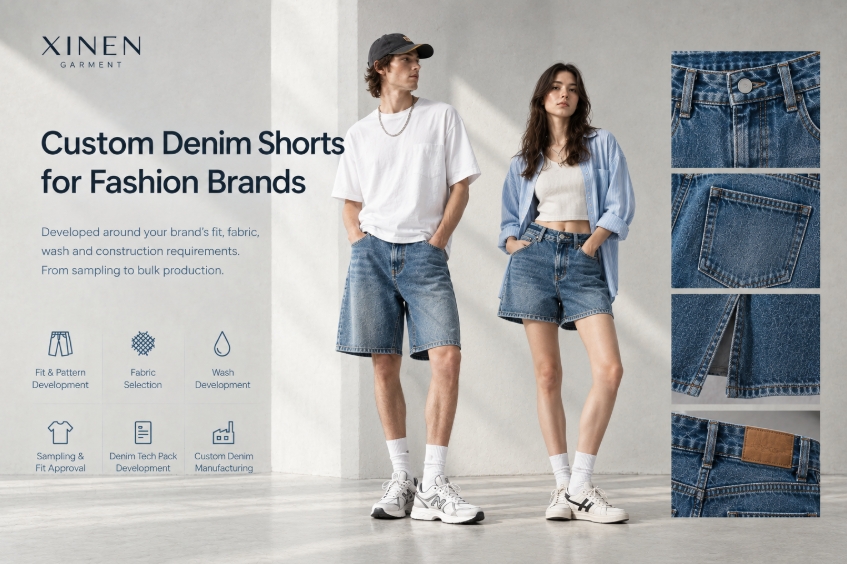
Xinen Garment develops and manufactures custom denim shorts for fashion brands requiring exact control over silhouette, denim weight, wash characteristics, and structural finishing.
Developing custom denim shorts involves dedicated pattern construction. A denim short is not simply a pair of jeans cut shorter at the inseam; reducing leg length fundamentally alters the visual balance, rise interaction, and leg opening fall relative to the wearer’s thigh. Achieving a balanced silhouette requires specific calibration across the waist, front and back rise, hip and seat curve, thigh width, and hem circumference.
We work with established denim labels, streetwear brands, independent fashion labels, and contemporary apparel collections. Rather than offering off-the-shelf blanks or pre-made stock, we build custom denim shorts from your specific technical specifications, measurement sheets, physical reference garments, or visual design concepts.
Short Product Description
Custom denim shorts developed for fashion brands requiring precise specification over fit proportions, fabric weight, wash characteristics, hardware, and structural finishing. Styles can be developed from a tech pack, measurement chart, reference garment, or design concept, supported by full prototype sampling and fit evaluation prior to bulk production.
Applications
Custom denim shorts serve as core warm-weather staples, casual outerwear, or statement fashion items across various market segments. Depending on pattern proportions, fabric selection, and wet processing, custom styles can be executed for:
- Premium Denim Collections: Refined, classic-fit or tailored denim shorts engineered from mid-to-heavyweight rigid or selvage denims, featuring clean stitching and authentic wash wear.
- Streetwear Collections: Oversized, dropped-crotch, or wide-leg silhouettes, heavy-weight denims, pronounced hand-sanding, localized destruction, tinting, or utility hardware details.
- Contemporary Casualwear: Versatile, clean-finished shorts with balanced proportions, soft hand feel, and moderate washing designed for daily seasonal wear.
- Resort & Summer Collections: Lightweight or fluid denim shorts designed with comfortable rise and leg proportions for warm climates.
- Unisex Fashion Collections: Proportionally balanced straight or boxy cuts engineered with rise and thigh dimensions that suit broader size ranges.
- Vintage-Inspired Denim Collections: Heritage-focused styles incorporating period-correct pocket shapes, raw or turned-up hems, exposed button flies, and authentic vintage wash tones.
The appropriate construction method, fabric weight, and wash procedure should be selected based on your brand’s specific design direction and target consumer.
What Can Be Customized?
Developing custom denim shorts with Xinen Garment allows you to specify every structural, material, and aesthetic component of the garment.
                  CUSTOMIZATION PARAMETERS
┌───────────────────────────┐   ┌───────────────────────────┐
│     FIT & SILHOUETTE      │   │       FABRIC & WASH       │
│ Waist, Rise & Seat Curve  │   │ Fabric Weight & Structure │
│ Thigh & Inseam Proportions│   │ Rigid vs. Stretch Weave   │
│ Leg Opening & Hem Line    │   │ Wet & Dry Wash Processing │
└─────────────┬─────────────┘   └─────────────┬─────────────┘
              │                               │
              └───────────────┬───────────────┘
                              │
┌─────────────────────────────▼─────────────────────────────┐
│                 CONSTRUCTION & HARDWARE                    │
│ Pocket Layout & Placement | Button Fly vs. Zipper Fly     │
│ Hem Treatments (Raw, Frayed, Clean) | Shank Buttons & Patches│
└───────────────────────────────────────────────────────────┘
Fit & Silhouette
- Waist & Rise: Low-rise, mid-rise, high-rise, or relaxed drop-crotch waist configurations.
- Hip & Seat Curve: Calibrated seat shaping to prevent back-waist gaping or excess fabric pooling below the yoke.
- Thigh & Leg Opening: Tapered, straight, wide, or flared leg openings tailored to the intended silhouette.
- Inseam & Total Length: Short-length, mid-thigh, Bermuda-style, or below-the-knee inseam measurements.
- Front & Back Balance: Proportioning the front rise against the back rise to maintain an even hemline around the leg.
Denim Fabric
- Fabric Weight: Lightweight (8 oz–10 oz) for fluid summer styles, mid-weight (11 oz–13 oz) for classic structure, or heavyweight (14 oz+) for structured, durable shorts.
- Composition: 100% cotton rigid denim, low-stretch cotton blends, or specialized fiber weaves.
- Texture & Character: Slub character, open-end weave, left-hand twill, right-hand twill, broken twill, or selvage edge options.
- Base Color: Pure indigo, green-cast, red-cast, black, gray, unbleached natural, or piece-dyed denim bases.
Wash & Finishing
- Base Wash Tones: Clean rinses, light stone washes, bleached fades, medium vintage indigo, or dark faded black.
- Dry Processing: Hand-sanding, whiskering along the front lap, edge grinding on pockets and hems, localized scraping, or 3D creasing.
- Distressing & Wear: Localized destruction, pocket wear, knee/hem fraying, or repaired patch details.
Construction & Details
- Hem Treatment: Clean folded double-needle hem, raw-edge frayed hem, single-turn cuffed hem, or step-hem detail.
- Fly Closure: Traditional shank button fly or metal zipper fly with auto-lock slider.
- Pocket Layout: Standard 5-pocket setup, enlarged streetwear patch pockets, carpenter utility pockets, or welt coin pockets.
- Stitching Specs: Thread weight, poly-core or cotton thread composition, contrast thread color schemes, and needle gauge spacing.
- Hardware & Branding: Engraved metal shank buttons, rivets, leather or faux-leather back waistband patches, and internal woven labels.
Custom Denim Shorts Styles
We manufacture a wide range of custom denim short silhouettes based on your brand’s specifications:
- Classic Denim Shorts: Traditional 5-pocket fitted construction with a standard waist, regular thigh, and clean-finished hem.
- Straight-Leg Denim Shorts: Straight cut through the hip and thigh, maintaining a consistent leg opening width down to the hem.
- Relaxed Denim Shorts: Extra room through the seat and thigh for ease of movement and a casual profile.
- Baggy Denim Shorts: Generous thigh and hip dimensions, lower rise, and wide leg openings typical of modern streetwear styling.
- Longer Denim Shorts: Inseam lengths extending toward or just below the knee, paired with wider leg profiles.
- Short Denim Shorts: Higher leg cutlines with shorter inseams, tailored for vintage or athletic-inspired fits.
- Bermuda-Style Denim Shorts: Tailored, longer-length shorts terminating just above the knee with a slender or straight leg opening.
- Cut-Off Denim Shorts: Casual styling featuring raw, unhemmed, or frayed leg openings, often combined with manual distressing.
- Distressed Denim Shorts: Developed with manual scraping, pocket edge grinding, targeted hole destruction, and worn highlights.
- Vintage-Wash Denim Shorts: Focus on realistic age processing, including marbling, localized fading, and subtle tinting.
- Utility / Carpenter Denim Shorts: Feature side hammer loops, utility tool pockets, reinforced flat-felled seams, and heavy stitching.
- Unisex Denim Shorts: Neutral waist-to-hip proportions and straight leg openings designed to accommodate diverse body shapes.
Developing the Fit of Custom Denim Shorts
Altering the length of a pant pattern changes its overall balance. When creating custom denim shorts, every measurement point must be calibrated together to ensure the garment sits correctly on the waist and drapes cleanly around the legs.
       KEY PATTERN CALIBRATION POINTS
┌─────────────────────────────────────────┐
│ Waist Circumference & Band Curve        │
├─────────────────────────────────────────┤
│ Front & Back Rise Ratio                 │
├─────────────────────────────────────────┤
│ Hip & Seat Volume Balance               │
├─────────────────────────────────────────┤
│ Thigh Width & Cross-Crop Angle          │
├─────────────────────────────────────────┤
│ Inseam Length vs. Leg Opening Circumference│
└─────────────────────────────────────────┘
Consider how key pattern adjustments interact:
- Rise & Waist Placement: Changing the front or back rise alters where the waistband rests on the body. A high-rise short requires tighter waist calibration and a curvier hip line, whereas a low-rise short requires a wider waist opening to sit comfortably on the lower hips.
- Thigh Width & Leg Opening: Trimming an inseam on a tapered jean pattern often leaves the leg opening too narrow, causing the hem to bind against the thigh when sitting or walking. A proper short pattern widens the leg opening relative to the thigh to preserve comfort and a clean line.
- Hem Balance: Because the human thigh tapers downward, the front hem and back hem must be angled correctly on the pattern so the finished short appears horizontal when worn.
Pattern makers translate your design direction into a balanced master pattern. Physical sampling allows for live fit testing to evaluate drape and movement before bulk production. Detailed pattern workflows are outlined under denim fit and pattern development.
How Denim Fabric Affects Custom Denim Shorts
Fabric selection directly influences how denim shorts hold their shape, drape around the thigh, and wear over time.
┌───────────────────────────┬───────────────────────────┐
│    HEAVYWEIGHT (13-14 OZ) │  LIGHT/MID-WEIGHT (8-12 OZ)│
├───────────────────────────┼───────────────────────────┤
│ Rigid leg opening shape   │ Softer drape & flexibility│
│ High structural body      │ Comfortable warm-weather wear│
│ Defined wash contrast     │ Subtle crease break-in    │
└───────────────────────────┴───────────────────────────┘
Fabric Weight
- Heavy-Weight Denim (13 oz and above): Gives shorts a structured, boxy silhouette. The leg opening remains rigid and flare-resistant, making this ideal for streetwear, utility, and wide-leg styles.
- Mid-Weight Denim (11 oz to 12.5 oz): The traditional industry standard. Offers a balance of structural shape, durability, and comfort for classic 5-pocket shorts.
- Light-Weight Denim (8 oz to 10.5 oz): Produces a softer, more fluid drape that conforms to the body. Well-suited for resort wear, pleated styles, or relaxed summer collections.
Rigid vs. Stretch Weaves
- 100% Cotton Rigid Denim: Holds crisp pattern lines, maintains a clean leg opening shape, and develops authentic vintage wear marks, whiskering, and seam puckering during wet processing.
- Stretch Denim: Incorporates elastane or stretch blends for flexibility around the waist and seat. However, stretch fabrics drape closer to the body and may alter the boxy silhouette characteristic of classic denim shorts.
Changing fabric type or weight after pattern approval alters how the garment hangs and may require pattern adjustments. Guidance on selecting materials is available under denim fabric selection.
Wash Development for Denim Shorts
Washing transforms raw, stitched denim panels into a finished garment with specific color depth, hand feel, and wear highlights.
                  SHORTS WASHING SEQUENCE
┌──────────────┐     ┌──────────────┐     ┌──────────────┐     ┌──────────────┐
│ Raw Sewn     │ ──> │ Manual Dry   │ ──> │ Wet Wash     │ ──> │ Final Drying │
│ Assembly     │     │ Processing   │     │ Processing   │     │ & Shrinkage  │
└──────────────┘     └──────────────┘     └──────────────┘     └──────────────┘
Wash Dynamics on Shorts
Because shorts have less fabric surface area than full-length jeans, dry and wet processes must be scaled appropriately:
- Whiskering & Lap Placement: Whiskering patterns along the front fly and lap must be scaled down so they do not overpower the shorter leg length.
- Hem Processing: Raw, frayed, or turned hems react strongly to wash processing. Frayed edges require controlled washing and bar-tack reinforcement to prevent unraveling beyond the designated stay-stitch line.
- Shrinkage Management: Denim shrinks differently across the warp (length) and weft (width). Master patterns are enlarged prior to cutting to account for expected wash shrinkage, ensuring finished garments meet target measurements.
Washes are developed against visual references or physical swatches. Further information is available under custom denim wash development.
Sampling and Fit Approval for Denim Shorts
Creating a physical pre-production sample is an essential step in custom denim short manufacturing.
                     SAMPLING & EVALUATION
┌──────────────┐     ┌──────────────┐     ┌──────────────┐     ┌──────────────┐
│ First Cut &  │ ──> │ Assembly &   │ ──> │ Live Fitting │ ──> │ Pattern      │
│ Sewing       │     │ Wash Process │     │ & Inspection │     │ Correction   │
└──────────────┘     └──────────────┘     └──────────────┘     └──────────────┘
When evaluating a prototype sample, review these key areas:
- Waistband & Rise Seating: Confirm that the waist sits comfortably without gaping at the back or pulling across the front fly.
- Seat & Hip Fit: Check that there is sufficient room across the seat without excess fabric bunching below the back yoke.
- Thigh Clearance & Inseam: Ensure the thigh width allows comfortable movement and that the inseam length matches the target silhouette.
- Leg Opening Balance: Verify that the leg opening sits level around the leg and does not flare outward unnaturally.
- Hem Finish: Inspect raw edge fraying, turned hems, or double-needle stitching for secure execution.
- Wash Shade & Details: Review overall color shade, hand-sanding placement, edge distress, and hand feel against approved targets.
Revisions identified during sample evaluation are updated directly on the digital master pattern prior to bulk cutting. Procedures are detailed under denim sampling and fit approval.
Can Denim Shorts Be Developed From a Tech Pack or Reference Garment?
We support multiple starting points for new denim short projects based on your brand’s available development assets.
                      DEVELOPMENT INPUTS
┌───────────────────────────────────────────────────────────────┐
│ Option A: Complete Tech Pack                                  │
│ (Measurement table, construction callouts, hardware specs)    │
├───────────────────────────────────────────────────────────────┤
│ Option B: Physical Reference Garment                          │
│ (Sample provided to clone or modify fit, fabric, or details)  │
├───────────────────────────────────────────────────────────────┤
│ Option C: Design Sketches & Visual References                 │
│ (Style concept photos combined with target size guidelines)   │
└───────────────────────────────────────────────────────────────┘
If you provide a physical reference garment:
- Our technical team measures the garment across all key points.
- We evaluate fabric weight, weave structure, seam construction, and wash methods.
- We incorporate your requested changes (e.g., “increase inseam by 2 cm”, “widen leg opening”, “change to dark vintage wash”).
- A master pattern is constructed based on the updated specifications.
If starting from a denim tech pack development document, we review your specifications for manufacturing feasibility, verifying rise ratios, leg openings, and seam allowances before cutting the sample.
Denim Shorts for Different Fashion Brands
Different fashion sectors approach custom denim shorts with distinct functional and aesthetic goals:
Premium Denim Brands
- Focus: High-grade rigid fabrics, authentic selvage details, traditional flat-felled seam construction, custom metal hardware, and realistic vintage wash techniques.
- Execution: Precise pattern grading, high-density stitching, subtle edge abrasions, and durable interior finishing.
Streetwear Brands
- Focus: Oversized, baggy, or longer-length silhouettes, heavyweight denims, pronounced wash effects, tinting, localized destruction, and prominent branding patches.
- Execution: Wide thigh and leg opening dimensions, heavy-duty hardware, and pronounced wash contrast.
Independent Fashion Labels
- Focus: Unique pattern cuts, tailored waistlines, distinctive pocket designs, and specific wash shades that align with seasonal concepts.
- Execution: Custom development starting from physical reference garments, sketches, or custom measurement charts.
Contemporary Apparel Brands
- Focus: Balanced fits, consistent sizing across production runs, clean wash finishes, and versatile styles suitable for seasonal warm-weather ranges.
- Execution: Standardized fit blocks, high-repeat consistency, and clean interior labeling.
From Approved Denim Shorts to Bulk Production
Once the pre-production sample is approved, the style transitions into large-scale production within our custom denim manufacturing facility.
                       PRODUCTION FLOW
┌────────────────┐     ┌────────────────┐     ┌────────────────┐
│ Pattern        │ ──> │ Precision      │ ──> │ Assembly &     │
│ Grading        │     │ Fabric Cutting │     │ Structural     │
└────────────────┘     └────────────────┘     │ Sewing         │
                                              └───────┬────────┘
                                                      │
┌────────────────┐     ┌────────────────┐             │
│ Final Quality  │ <── │ Wash Processing│ <───────────┘
│ Inspection &   │     │ & Hardware     │
│ Packing        │     │ Attachment     │
└────────────────┘     └────────────────┘
- Pattern Grading: Scaling approved fit dimensions across your full size range according to your grading rules.
- Fabric Inspection & Spreading: Testing bulk fabric rolls for shade uniformity, flaws, and weight before layout.
- Computerized Cutting: Precision-cutting body panels, pocket bags, waistbands, and fly components.
- Sub-Assembly & Sewing: Assembling pockets, waistbands, flies, and structural seams using specified thread tension and stitch types.
- Wash Processing: Executing the approved wash formula across bulk production batches under monitored wet-processing conditions.
- Hardware & Finishing: Attaching shank buttons, rivets, zippers, waistband patches, and secondary brand labels.
- Final Quality Inspection: Inspecting finished garments for dimensional tolerances, stitch integrity, hardware security, and wash consistency under denim quality control protocols.
Learn more about timelines and workflow stages on our custom denim production process page.
What Should a Brand Provide Before Developing Custom Denim Shorts?
To initiate a custom denim short development project efficiently, provide as much of the following information as possible:
- Product Concept / Visual Direction: Reference photos, mood boards, or sketches illustrating the target short style.
- Reference Garment or Tech Pack: A physical sample to evaluate/modify, or a technical pack containing measurement tables.
- Target Silhouette & Fit Goals: Specific requirements for rise (low, mid, high), thigh fit (slim, regular, wide/baggy), and inseam length.
- Fabric Preferences: Desired fabric weight (e.g., 11 oz, 13 oz), fiber composition (100% cotton vs. stretch), and base color.
- Wash References: Visual images or physical swatches demonstrating target wash shade, distressing, and wear effects.
- Hem & Pocket Specs: Preferred hem finishing (clean hem, raw/frayed edge, cuffed) and pocket configurations.
- Hardware & Branding Specifications: Details for shank buttons, rivets, zippers, leather patches, and woven labels.
- Order Volumes & Size Breakdown: Estimated production quantities per style and target size distribution.
If complete documentation is not available, our development team can assist in refining your specifications during initial consultations.
Quality Control for Custom Denim Shorts
Maintaining consistent construction quality and dimensional accuracy across bulk production requires systematic inspection checkpoints.
                 QUALITY CONTROL CHECKPOINTS
┌──────────────────┐     ┌──────────────────┐     ┌──────────────────┐
│ In-Line Sewing   │     │ Wash Batch Shade │     │ Final Outgoing   │
│ Checks (Seams,   │ ──> │ & Shrinkage      │ ──> │ Inspection       │
│ Stitch Density)  │     │ Verification     │     │ (Measurements,   │
└──────────────────┘     └──────────────────┘     │ Hardware Security│
                                                  └──────────────────┘
- Measurement Audits: Verifying key dimensions—including waist, front rise, back rise, hip, thigh, inseam, and leg opening—against approved tech pack tolerances.
- Left/Right Symmetry: Checking that leg lengths, pocket heights, and hem angles are identical on both sides of the garment.
- Hem Execution: Ensuring raw fray lines are secured with stay-stitching and that clean hems lie flat without twisting.
- Hardware Attachment Integrity: Testing shank button security, rivet setting, and zipper operation.
- Seam Construction: Inspecting flat-felled or overlocked seams, bar-tack reinforcement at pocket corners, and thread trimming.
- Wash Shade Uniformity: Sorting finished shorts by wash lot to ensure shade consistency across production runs.
All quality checks are benchmarked against approved pre-production samples and technical specifications.
When Are Custom Denim Shorts Ready for Bulk Production?
A custom denim short style is ready for bulk manufacturing after all technical parameters have been confirmed and approved in writing:
- [x] Master Pattern Approved: All fit modifications verified and finalized on the master digital pattern.
- [x] Grading Chart Confirmed: Size jump rules checked across all target sizes.
- [x] Bulk Fabric Approved: Fabric weight, composition, and shade lot confirmed.
- [x] Golden Sample Approved: Pre-production physical sample signed off for fit, construction, wash finish, and hem treatment.
- [x] Hardware & Trims Confirmed: Shank buttons, rivets, zippers, waist patches, and neck labels produced and checked.
- [x] Bill of Materials (BOM) Finalized: Complete technical specification sheet confirmed by both client and production team.
What Can Affect the Final Result?
The finished appearance, fit, and hand feel of custom denim shorts depend on several interacting variables:
- Fabric Shrinkage Rates: Different denim fabrics shrink at different rates in the warp and weft during wet processing, which must be accurately calculated into the master pattern.
- Manual Distressing Differences: Hand-sanding, localized destruction, and edge abrasion are applied manually, meaning subtle variations between individual garments are natural.
- Hem Treatment Behavior: Raw edges fray dynamically during washing; the density of the stay-stitching determines how much unraveling occurs.
- Post-Approval Specification Changes: Modifying fabric weight, wash targets, or pocket dimensions after sample sign-off alters the final garment balance and requires pattern re-evaluation.
Evaluating these factors during the sampling stage ensures reliable results in bulk production.
Frequently Asked Questions
Can you develop custom denim shorts from a reference garment?
Yes. You can send a physical reference short to our facility. We will measure its dimensions, evaluate its pattern construction, fabric weight, and seam details, and build a new production pattern based on your requested adjustments.
Can I customize the length and leg opening?
Yes. Inseam length, total outseam length, thigh circumference, and leg opening width can all be specified to match your target silhouette.
Can you manufacture baggy or relaxed denim shorts?
Yes. We regularly develop baggy, wide-leg, and oversized denim shorts. Patterns are specifically engineered with broader thigh dimensions and wider leg openings to ensure proper drape without distortion.
Can I choose the denim fabric?
Yes. You can select from various fabric weights (ranging from lightweight 8 oz denims to heavyweight 14 oz+ options), compositions (100% cotton rigid or stretch blends), weave structures, and base indigo/black shades.
Can you develop custom washes for denim shorts?
Yes. Washes are fully customizable—ranging from clean rinses and stone washes to vintage treatments featuring hand-sanding, whiskering, localized abrasion, tinting, and distressing.
Can denim shorts be developed from a tech pack?
Yes. If you provide a complete technical pack with measurement specs, construction callouts, and wash targets, we will create the initial pattern and prototype sample directly from your documentation.
How does sampling and fit approval work?
We build a physical prototype sample based on your tech pack or reference garment. The sample is washed to your specified finish and shipped to you for live fit and quality evaluation. Any pattern or detail updates are refined before final sign-off for bulk manufacturing.
Can an approved denim shorts style be repeated in future production?
Yes. Once a pattern, fabric selection, hardware spec, and wash formula are finalized and approved, all technical files are archived. This allows for consistent execution across future re-orders or seasonal wash updates.
Discuss Your Custom Denim Shorts Project
If you have a reference garment, tech pack, measurement chart, or design concept, send your project details to our team. We will review your fit specs, fabric preferences, wash targets, and construction requirements and discuss how to develop your style.