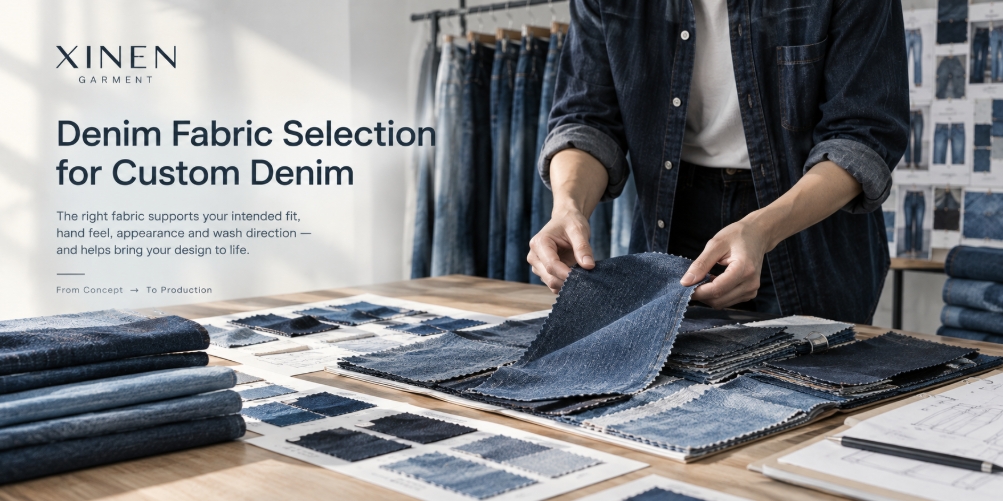
Once the foundation of your project is established in the Product Brief, selecting the appropriate denim fabric becomes one of the next critical development decisions.
In custom denim development, choosing a fabric is far more complex than picking a color shade or selecting the heaviest option available from a swatch card. A denim fabric serves as the structural base of the entire garment. The way a pair of jeans hangs, holds its shape, feels against the skin, and reacts to industrial washing depends directly on the material chosen during this phase.
Because every fabric behaves differently under tension, stitching, and wet processing, fabric selection cannot be treated as an isolated choice. It must be evaluated in direct relation to your intended fit, garment structure, hand feel, visual appearance, and wash requirements.
At Xinen Garment, our role during custom denim development is to guide brands through evaluating how different denim textiles interact with their specific design objectives, ensuring the final garment performs as intended once produced.
Why Fabric Selection Matters in Denim Development
The physical characteristics of a denim fabric directly dictate the technical performance and visual outcome of the finished product. A fabric that works well for a relaxed jacket may produce unsatisfactory results if applied to a fitted pair of trousers, just as a fabric intended for a clean dark wash may behave unpredictably under heavy vintage abrasion.
During the development phase, fabric selection directly influences:
- Fit and Silhouette: The weight, weave density, and yarn structure determine how firmly a garment holds a line or how naturally it drapes over the body.
- Garment Structure: A structured, heavy-weave denim supports defined shapes, functional pocketing, and sharp seams, whereas lighter or softer weaves create a more fluid garment body.
- Hand Feel: Surface character, yarn tightness, and fiber content define whether the garment feels dry, crisp, soft, smooth, or substantial upon contact.
- Drape: How the fabric falls affects volume, leg lines, and movement, particularly in wider cuts or layered styles.
- Stretch or Rigidity: The presence or absence of elastic fibers impacts pattern development, movement tolerances, recovery after wearing, and seam stress.
- Surface Appearance: Slub character, yarn thickness, weave twill line, and indigo shade depth set the initial visual texture of the raw garment.
- Wash Response: Different cotton grades, dye methods, and weave structures react uniquely to washing techniques, abrasion, and fading processes.
- Construction Details: Heavy or rigid denims require distinct needle types, thread tensions, and seam allowances compared to lighter or high-stretch options.
- Overall Product Character: The combination of these factors gives the finished piece its specific market positioning and consumer appeal.
Selecting fabric with these variables in mind avoids common development pitfalls, such as unexpected shrinkage, distorted seams after washing, or garments that fail to hold their intended shape.
What We Consider When Selecting Denim Fabric
When evaluating denim fabric selection for jeans or jacket development, we review six primary material attributes against your product brief.
1. Fabric Composition
The fiber blend forms the core foundation of the textile.
- 100% Cotton Denim: Offers classic structure, traditional drape, and distinct fading characteristics over time. It provides a authentic feel often favored for heritage, streetwear, and structured silhouettes.
- Stretch Blends: Incorporate small proportions of elastane or performance fibers to provide flexibility and immediate comfort, which can be essential for closer fits.
- Alternative Fiber Blends: Combining cotton with cellulose fibers (like viscose or lyocell) or recycled content can alter hand feel, weight perception, and surface sheen.
Composition should always be selected based on the end-use requirements of the product rather than an assumption that one blend is inherently superior to another.
2. Stretch and Rigidity
Understanding the difference in garment behavior between rigid and stretch denim is vital for pattern making and sizing.
- Rigid / Non-Stretch Denim: Holds a defined silhouette, creates prominent crease lines, and maintains structure across stress points. It requires precise pattern drafting since the fabric offers no give during wear.
- Stretch Denim: Offers varying degrees of flexibility and recovery. While it enhances comfort in body-skimming fits, pattern dimensions must account for stretch behavior both raw and post-wash to prevent bagging out or over-stretching at stress seams.
3. Fabric Weight and Structure
Denim fabric weight is measured in ounces per square yard ($oz/yd^2$). Weight influences thermal comfort, body, durability, and drape:
- Lightweight Denim: Generally offers higher flexibility and softness, suitable for warm-weather collections, shirts, skirts, or fluid drape requirements.
- Midweight Denim: Provides a versatile balance between structural integrity and everyday comfort, making it a standard choice across broad apparel categories.
- Heavyweight Denim: Delivers pronounced structure, high durability, and distinct crease retention, often chosen for rugged workwear, raw denim programs, or structured outerwear.
The suitable weight depends entirely on the intended garment function, seasonal context, and brand aesthetic.
4. Hand Feel
Hand feel refers to the tactile quality of the fabric before and after garment finishing. A fabric can feel firm, crisp, dry, soft, brushed, or smooth.
In premium denim development, hand feel communicates quality to the customer. Achieving the desired hand feel involves selecting both the right raw fabric and the appropriate wet finishing process, as washing can significantly alter initial fabric stiffness.
5. Surface and Color
The visual appearance of raw denim is defined by the dyeing method and yarn structure:
- Indigo Direction: Pure indigo, green-cast, red-cast, or vintage-tinted indigo bases shade differently as they undergo abrasion and washing.
- Black Denim: Ranges from stay-black reactive dyes to sulfur-dyed blacks designed to fade into subtle greys.
- Ecru and Natural Tones: Unbleached, seed-embedded, or piece-dyed fabrics offer alternate colorways for non-indigo collections.
- Surface Texture: Ring-spun yarns create slub textures and character lines, while open-end yarns provide a flatter, more uniform surface appearance.
6. Wash Compatibility
Fabric selection and Wash Development are intrinsically linked. A fabric must be physically capable of enduring the chemical or mechanical wash processes specified in your design brief.
For instance, achieving high-contrast whiskering or vintage localized scraping requires a fabric dyed in a way that allows indigo removal without weakening the underlying yarn structure. Conversely, clean, uniform wash directions require stable fabrics that minimize surface pilling and uneven color loss.
Matching Fabric to the Intended Fit
Fabric choice and garment fit must be developed in tandem. A pattern that sits perfectly in a 12 oz rigid cotton may drape incorrectly or feel restrictive if cut in a different weight or stretch blend.
+------------------------+---------------------------------+-----------------------------------+
| Intended Fit           | Key Fabric Considerations       | Typical Fabric Behavior           |
+------------------------+---------------------------------+-----------------------------------+
| Baggy & Wide-Leg       | Medium to heavy weight;         | Holds wide leg shape without      |
|                        | rigid structure or low stretch  | collapsing at the hem             |
+------------------------+---------------------------------+-----------------------------------+
| Straight & Relaxed     | Midweight cotton or             | Balances classic structure with   |
|                        | subtle comfort stretch          | natural drape for daily wear      |
+------------------------+---------------------------------+-----------------------------------+
| Slim & Fitted          | Comfort or high-stretch blends; | Allows movement while maintaining |
|                        | good elastic recovery           | shape retention at knees/seat     |
+------------------------+---------------------------------+-----------------------------------+
| Structured Outerwear   | Mid-to-heavyweight rigid;       | Provides collar body, pocket      |
|                        | dense weave structure           | definition, and clean paneling    |
+------------------------+---------------------------------+-----------------------------------+
- Baggy and Wide-Leg Cuts: Require fabrics with sufficient body to maintain the intended silhouette without clinging or collapsing inward, while avoiding excessive stiffness that prevents natural movement.
- Straight and Relaxed Cuts: Rely on a balance between structure and comfort. A midweight rigid or subtle comfort-stretch fabric allows the leg line to fall straight from the hip.
- Slim or Fitted Styles: Benefit from stretch integration to maintain wearability and flexibility through the thigh, knee, and hip blocks.
- Jackets and Outerwear: Depend on fabric density to support pocket construction, collar structure, heavy hardware, and panel stitching.
Aligning fabric characteristics early directly supports accurate Fit & Pattern Development.
Matching Fabric to Construction
Garment construction details must reflect the physical capabilities of the selected fabric:
- Seams and Topstitching: Heavyweight denims require robust thread gauges and wider needle spacing, whereas lightweight fabrics demand finer needles to prevent yarn breakage along seam lines.
- Waistbands: The choice between rigid and stretch denim dictates whether waistband construction requires bias cutting, specific interlinings, or continuous chain-stitching to ensure dimension stability.
- Pockets and Rivets: High-density fabrics support heavy pocketing materials and reinforced hardware placement, minimizing tear risks during wear.
- Pleats, Panels, and Hems: Complex paneling or sharp pleats require fabrics that respond well to pressing and hold creased edges through production and washing.
Fabric Selection for Different Denim Products
Different apparel categories present unique structural and functional demands during fabric selection:
Custom Jeans
- Primary Considerations: Fit intention, waist retention, seat structure, movement flexibility, and wash potential.
- Development Focus: Balancing comfort and longevity while selecting a shade cast that aligns with planned wash treatments.
Baggy & Wide-Leg Jeans
- Primary Considerations: Drape, leg volume, fabric weight, and silhouette stability.
- Development Focus: Ensuring the leg profile remains full and structured without sweeping awkwardly while walking.
Straight & Relaxed Jeans
- Primary Considerations: Balanced structure, everyday durability, and classic aesthetic.
- Development Focus: Selecting materials that support clean vertical lines and versatile wash finishes suitable for core range offerings.
Denim Shorts
- Primary Considerations: Thigh comfort, pocket bag security, raw hem behavior (if specified), and light-to-midweight comfort.
- Development Focus: Choosing fabrics that maintain comfort during summer wear without losing pocket stability.
Denim Skirts
- Primary Considerations: A-line vs. fitted silhouette, walkability, vent construction, and hem weight.
- Development Focus: Ensuring sufficient fabric body to prevent riding up, while selecting weights appropriate to the length and cut.
Denim Jackets
- Primary Considerations: Shoulder structure, chest panel integrity, arm articulation, and hardware support.
- Development Focus: Selecting mid-to-heavyweight fabrics that hold shape across broad paneling and button closures.
What Happens During Fabric Selection?
To keep development organized, we follow a clear step-by-step process to narrow down and confirm your denim fabric direction:
- Review the Product Brief: Examine fit goals, design references, target wash directions, and product category requirements.
- Identify Fabric Performance Criteria: Define the required weight range, stretch properties, hand feel expectations, and yarn character.
- Review Suitable Options: Evaluate fabric swatches and available material specifications aligned with the brief.
- Compare Physical Properties: Compare fiber blends, weave densities, indigo shades, and surface textures against design goals.
- Assess Wash Compatibility: Confirm that the prospective fabric options can withstand and achieve the intended wash finish.
- Confirm Fabric Direction: Select the material option best suited for prototype creation.
- Proceed to Pattern Development: Pass confirmed fabric parameters (expected shrinkages and elasticity) to the pattern-making team.
Working with Fabric References
When Your Brand Has a Fabric Reference
If you bring an existing fabric swatch, supplier reference, vintage original, or reference garment:
- We review the physical sample to evaluate weight, composition, yarn structure, and stretch properties.
- We use this reference to guide material sourcing, identifying matching or functionally comparable fabric options within our network.
- Note: Physical references serve as a benchmark for comparison. Exact fiber matches depend on current mill availability, technical suitability, and development parameters.
When Your Brand Does Not Have a Fabric Reference
If you do not have a specific fabric code or technical swatch:
- We begin with your aesthetic goals, reference images, desired fit, target hand feel, and intended wash finish.
- We present suitable fabric directions based on these practical criteria.
- You do not need deep technical textile knowledge to start—our development team translates your visual and tactile goals into realistic fabric options.
Fabric Selection and Wash Development
Fabric selection and wash development are co-dependent processes. The identical wash recipe executed on two different denim fabrics will yield distinct visual and physical results.
[02 Fabric Selection] ──> [Wash Direction] ──> [Wash Development] ──> [Sample Review]
Because indigo density, dye penetration, yarn twist, and fiber type alter how chemicals, enzymes, and abrasions act on the textile, wash testing must occur on the selected fabric itself. Evaluating swatches or garments made from alternative fabrics can lead to misleading expectations. Final wash approvals should always be based on physical samples produced in the chosen development material.
Fabric Selection and Sampling
Fabric selection is refined through physical sampling. While fabric swatches provide valuable tactile and visual information, cut-and-sew prototype development reveals how the material performs as a finished three-dimensional garment.
During Sampling & Fit Approval, we assess:
- Real-world drape and silhouette execution.
- Exact shrinkage ratios post-industrial wash.
- Seam tension, puckering, or stitch stress under strain.
- Tactile hand feel across full garment panels.
If prototype fitting highlights unexpected material behavior, fabric specifications or pattern dimensions can be adjusted prior to final bulk approval.
What We Need From Your Brand
To streamline fabric selection, providing clear contextual details during initial discussions is helpful. Useful inputs include:
- Product Type: (e.g., Five-pocket jeans, wide-leg trousers, oversized trucker jacket)
- Intended Fit: (e.g., Rigid wide-leg, slim stretch, relaxed straight)
- Visual References: Photos, tech packs, or physical benchmark garments
- Fabric Reference: Swatches, material codes, or composition targets (if available)
- Hand Feel Goal: Crisp, soft, heavy, fluid, or textured
- Stretch Preference: Rigid, comfort stretch, or high stretch
- Color & Wash Intent: Raw indigo, medium vintage wash, sun-bleached, solid black, or garment-dyed
- Collection Context: Target market positioning and seasonal requirements
- Tech Pack Information: Measurements and construction specs (if available)
If you do not have all of these details prepared, our team can work from your core concept to help define appropriate material targets.
What Happens After Fabric Selection?
Fabric selection is stage two of our complete development process:
01 Product Brief
  └──> 02 Fabric Selection
        └──> 03 Fit & Pattern Development
              └──> 04 Sampling & Fit Approval
                    └──> 05 Wash & Finishing
                          └──> 06 Bulk Production
Once your fabric direction is established, we proceed to creating custom patterns engineered to your fabric’s specific weight, elasticity, and shrinkage traits.
Next Step in Development:
Proceed to 03 — Fit & Pattern Development
Frequently Asked Questions
1. How do I choose the right denim fabric for custom jeans?
Choose your denim fabric by balancing your intended fit, target hand feel, desired wash finish, and structural requirements. Rather than picking a fabric solely by color or weight, consider how its composition, stretch, and weave will perform during pattern drafting, sewing, and industrial washing.
2. Should I choose fabric before developing the pattern?
Yes. Fabric characteristics—especially shrinkage rates, fabric weight, and stretch percentage—directly influence pattern measurements. Patterns must be drafted or adjusted specifically for the physical behavior of the confirmed fabric to ensure accurate garment sizing after wet processing.
3. What is the main practical difference between rigid and stretch denim?
Rigid denim (100% cotton) holds a structured silhouette, offers traditional wearing-in character, and creates distinct crease patterns, but requires precise fit drafting. Stretch denim incorporates elastic fibers to provide flexibility and ease of movement, making it suitable for fitted styles, though it requires patterns that account for stretch recovery.
4. Does fabric weight affect the fit of jeans?
Yes. Heavier fabrics (13+ oz) hold structure, resist collapsing, and create defined silhouettes, whereas lighter fabrics (under 11 oz) drape closer to the body and offer more fluid movement. The same pattern cut in different fabric weights will fit and feel noticeably different on the body.
5. Can the same denim fabric be used for different products?
In many cases, yes. A versatile midweight denim can often be applied across jeans, skirts, and lightweight outerwear within the same collection to ensure visual consistency. However, structural requirements must be reviewed for each garment type to confirm the weight and drape are appropriate.
6. Can you work from a fabric swatch or reference garment provided by our brand?
Yes. We can analyze physical swatches or reference garments you provide to assess weight, composition, yarn character, and hand feel, using those parameters to source and suggest suitable material options for your development.
7. What if I do not know the exact fabric specification for my project?
You do not need precise technical specifications to begin. We can establish suitable fabric options based on your design references, intended fit, desired hand feel, visual wash goals, and product category during initial development discussions.
8. Does the fabric need to be finalized before wash development?
Yes. Because different denim fabrics react uniquely to wet processing, abrasion, and washing chemicals, wash development must be conducted on the actual selected fabric to ensure accurate, repeatable color and texture results.
Need Help Selecting Denim for Your Product?
Once your product direction is clear, fabric selection is about finding a practical balance between fit, hand feel, appearance, construction, and intended wash. Whether you already have a physical fabric swatch or are still defining your material direction, our team is available to review your requirements and discuss appropriate fabric options for your project.