The biggest myth in the fashion industry is that you need a massive budget to launch a collection. The reality is that constraints breed creativity. Some of the most profitable brands started with just five styles.
Designing on a budget is not about making “cheap” clothes; it is about asset utilization. Every pattern you make and every fabric you source costs money. The secret is to get maximum output (styles) from minimum input (fabrics/patterns).
Here is the operational blueprint for designing a high-impact collection with limited funds.
1.The “One Fabric, Many Forms” Rule (Consolidation)
The most expensive mistake new designers make is selecting a different fabric for every sketch. This kills your budget because:
- You pay multiple sourcing fees.
- You fail to reach MOQ (Minimum Order Quantity) surcharges.
- You have leftover scrap waste for each different roll.
The Budget Strategy: Pick one hero fabric and design 3–4 different silhouettes from it.
- Example: Buy 300 yards of Black Heavyweight French Terry.
- Design: A Hoodie, A Crewneck, A Jogger, and Shorts.
- Result: You negotiate a bulk price for the fabric, and the collection looks cohesive.
2.Leverage “Pattern Blocks” to Save Development Costs
Pattern making is expensive ($150–$500 per style). If you design 10 completely unique shapes, you pay that fee 10 times.
The Budget Strategy: Use one “Master Block” to create multiple SKUs.
- The Master Block: A classic T-shirt fit.
- Variation A: The classic Tee.
- Variation B: The same body, but cropped length (No new pattern needed for the chest/shoulders).
- Variation C: The same body, but with long sleeves.
By modifying an existing block rather than starting from scratch, you cut pattern-making costs by 50%.
3.The Power of Colorways (The Multiplier Effect)
How do you make a collection look huge without designing new clothes? Colorways.
If you can only afford to develop 3 styles (e.g., a Tee, a Hoodie, a Pant), you can expand your offering by producing them in 3 colors.
- 3 Styles x 1 Color = 3 SKUs (Looks small/empty).
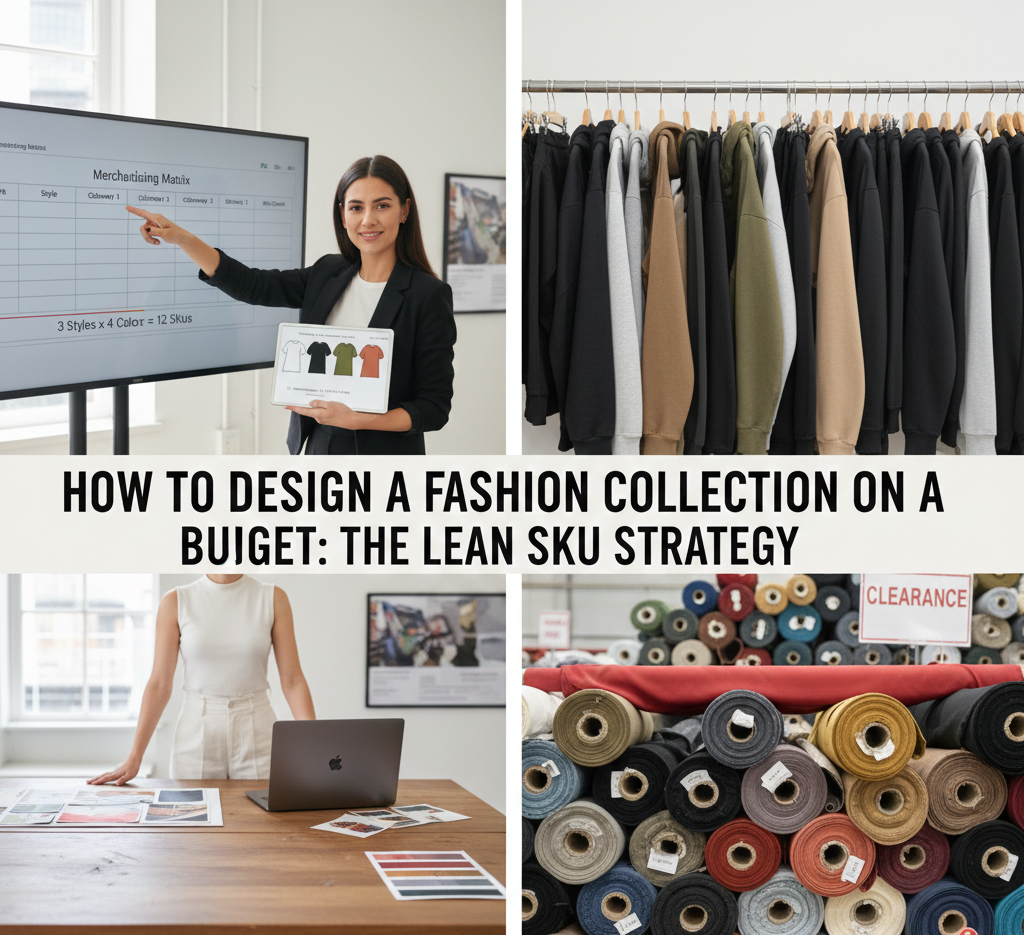
- 3 Styles x 4 Colors = 12 SKUs (Looks like a full brand launch).
Pro Tip: Use Lab Dips effectively. Dyeing the same fabric in different colors is cheaper than buying different types of fabric. It adds visual variety without adding technical complexity.
4.Use “Deadstock” for Low Commitments
If you cannot afford the high MOQs of custom fabric mills (often 1,000+ yards), look for Deadstock.
What is Deadstock? Leftover fabric from major brands that is sitting in a warehouse.
- Pros: Instant availability, low price, low/no MOQ (you can buy just 50 yards).
- Cons: Once it’s gone, it’s gone. You cannot reorder.
- Best For: Limited edition drops or “Capsule Collections.”
5.Comparison: The Amateur vs. The Strategist
Here is how a budget is spent differently between a novice designer and a strategic designer.
| Feature | The Amateur Approach (High Cost) | The Strategic Approach (Low Cost) |
| Styles | 10 totally unique shapes. | 3 Core Shapes x 3 Variations. |
| Fabrics | 8 different fabrics. | 2 Core Fabrics. |
| Colors | Custom dyed for every item. | 3 Core Colors shared across all items. |
| Sampling | Physical samples for every idea. | Digital 3D samples (CLO3D) first. |
| Result | High development fees, low cohesion. | Low development fees, strong brand story. |
Designing on a budget requires you to think less like an artist and more like a merchandiser. By consolidating your fabrics, reusing your pattern blocks, and multiplying your SKUs through color, you can launch a collection that looks expensive but was engineered for efficiency.
Creativity isn’t about having endless options; it’s about what you can build with the pieces you have.