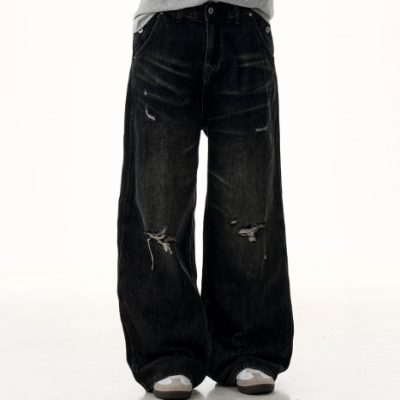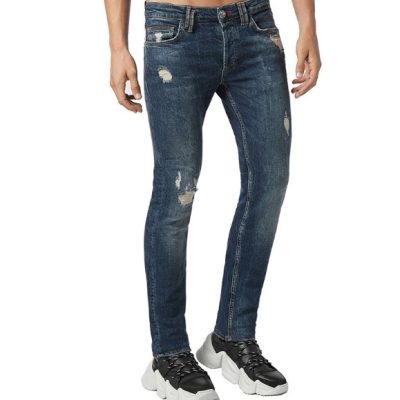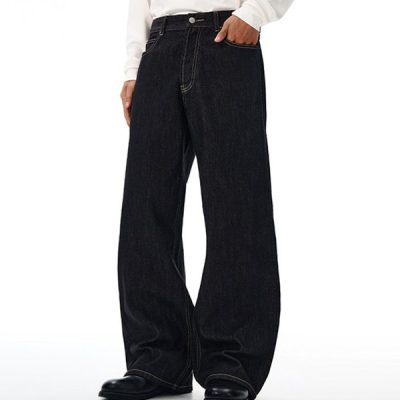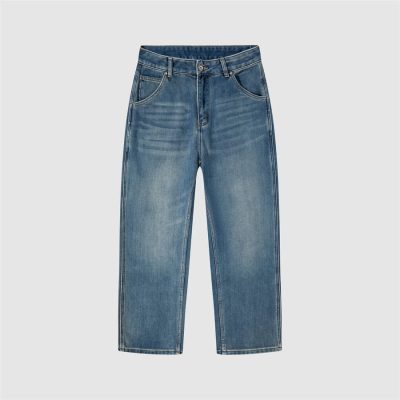

In the denim laundry, the “Whisker” (also known as Moustache or Hige) is the most critical element of the dry process. It mimics the natural wear lines that form at the crotch when a wearer sits down.
However, creating these lines artificially is where most brands fail. Cheap jeans feature “Zebra Stripes”—flat, parallel white lines that look painted on. Premium jeans feature “Organic Whiskers”—faded gradients that look like they have been earned over three years of wear.
For baggy fit jeans, the challenge is even greater. Because the fabric sits loosely on the body, the tension lines are different than skinny jeans. Here is the technical breakdown of how to produce authentic whiskers in a manufacturing setting.
What is a Denim Whisker?
A whisker is a linear abrasion pattern found on the upper thigh / crotch area of jeans. It is created by removing indigo dye from the “peaks” of a fabric fold while leaving the dye in the “valleys,” creating a high-contrast 3D visual.
1.The Foundation: The Rubber Balloon (The Mold)
You cannot sand whiskers on a flat table. To get a natural gradient, the denim must be stretched over a 3D form.
- The Tool: Industrial laundries use Inflatable Rubber Mannequins or pre-molded fiberglass legs.
- The Process:
- The jeans are pulled onto the mannequin.
- The mannequin is inflated to stretch the fabric taut.
- Crucial Step: For specific whisker patterns, workers attach “pattern templates” (thin rubber strips) underneath the jeans. When the operator sands over the jeans, the rubber strips push the fabric out, causing the sandpaper to hit only those specific lines.
2.Method A: Hand Sanding (The Artisan Way)
This is the traditional method used for high-end vintage reproductions (like Japanese selvedge).
- The Grit: Operators use sandpaper ranging from P220 to P400.
- Heavyweight Denim (14oz+): Needs P220 to break the surface.
- Lightweight/Stretch: Needs P320-P400 to avoid tearing fibers.
- The Technique: Ideally, the center of the whisker line is white (heavy pressure), and it “feathers” out to nothing at the edges.
- The “Cross-Hatch”: To make it look real, skilled workers don’t just sand the line; they lightly sand the space between the lines to reveal the “slub” (vertical texture) of the denim.
3. Method B: Laser Finishing (The Scalable Way)
For mass production (Zara, H&M, Levi’s mainline), hand sanding is too slow and inconsistent. Enter the Laser.
- How it Works: A digital file (grayscale bitmap) is loaded into the laser machine. The laser burns the indigo off the cotton surface in microseconds.
- The Baggy Jean Challenge: Lasers usually work best on flat surfaces. For baggy jeans, the fabric must be perfectly flattened, or the laser will be out of focus at the edges, creating a blurry print.
- The “Digital Look”: Early laser whiskers looked pixelated. Modern “Booster” chemicals are now sprayed on the jeans before lasering to make the burn look more natural and soft.
4. The Chemical Enhancer: PP Spray
Sanding alone often just makes the denim look fuzzy and light blue. To get that stark, bright white vintage look, you need chemistry.
- Potassium Permanganate (PP): This is a strong oxidizing agent.
- Application: After sanding, a worker sprays a fine mist of PP solution onto the whisker area. The PP reacts with the sanded areas more intensely, turning them bright white almost instantly.
- Neutralization: The jeans must be washed immediately after to stop the chemical reaction, or the fabric will rot.
5. 3D Whiskers (Resin Setting)
If you touch a raw pair of worn jeans, the whiskers feel stiff and crinkled. This is called “3D.”
To replicate this in a factory:
- Resin Dip: The jeans are dipped in a semi-permanent resin.
- Manual Crinkling: Workers pinch the whiskers by hand or use clips to hold the folds in place.
- Oven Cure: The jeans are baked in a giant oven at high heat. The resin hardens, locking the crinkles in place permanently.
Comparison: Which Method Fits Your Brand?
| Feature | Hand Sanding | Laser Finishing |
| Aesthetics | Organic, imperfect, high “soul.” | Precise, identical every time. |
| Cost | High Labor Cost ($$). | High Initial Machinery Cost ($$$), Low Unit Cost ($). |
| Speed | Slow (10-15 mins per pant). | Fast (30-90 seconds per pant). |
| Sustainability | Creates dust (harmful to workers). | Clean, but energy-intensive. |
| Best For | Premium Streetwear / Heritage Brands. | Fast Fashion / High Volume Basics. |
The Secret is in the “Feathering”
Whether you use laser or sandpaper, the difference between a cheap jean and a luxury jean is feathering.
Real wear patterns do not start abruptly. They fade in and fade out. If you are reviewing samples from a factory, check the edges of the whiskers. If they look like hard lines drawn with a ruler, reject the sample. Demand a soft, diffused gradient that respects the grain of the fabric.