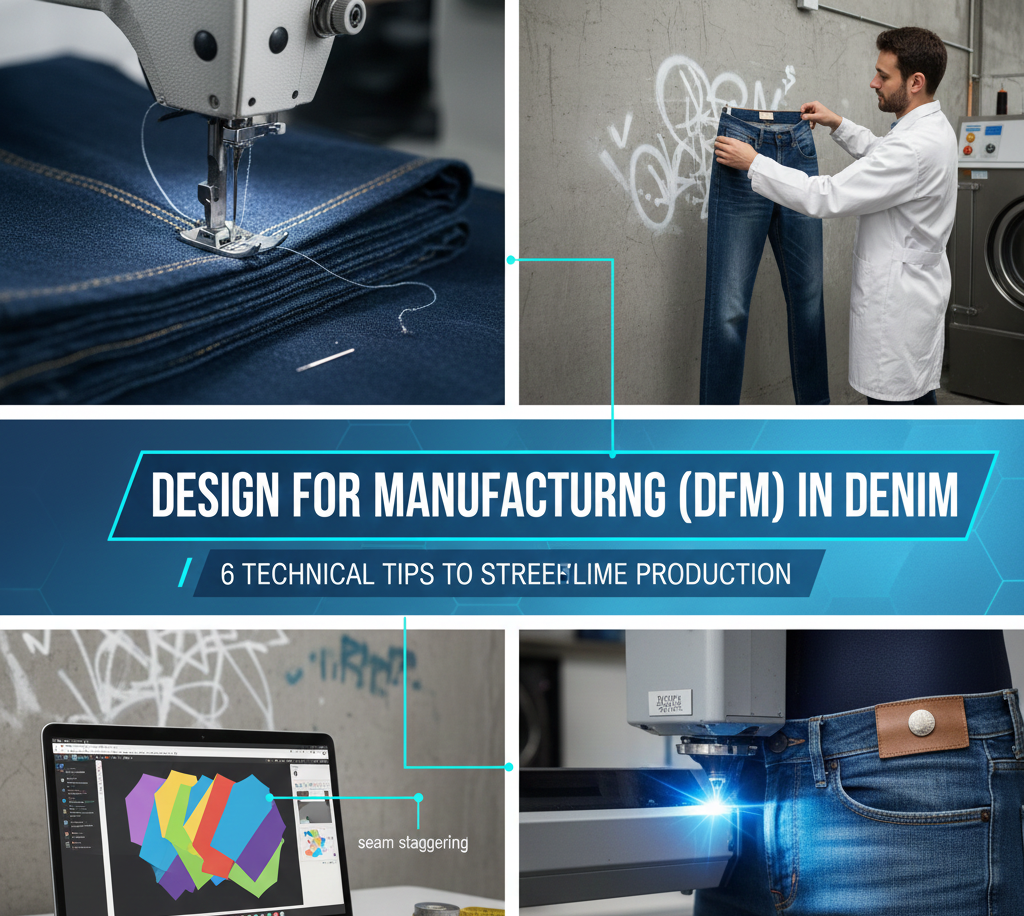
In the world of apparel, Denim is a beast of its own. Unlike a t-shirt or a silk dress, a pair of jeans is “alive”—it shrinks, twists, and changes color drastically after it is sewn.
Design for Manufacturing (DFM) is the practice of anticipating these factory challenges during the design phase. It isn’t just about saving money; it’s about preventing disaster. A non-DFM compliant design leads to needle breakages, high rejection rates, and delivery delays.
Here are 6 technical DFM tips to ensure your denim designs flow smoothly through the factory line.
1.Anticipate “Bulk” at Seam Junctions
Denim is heavy. When you fold it multiple times, it becomes like plywood. A common manufacturing defect is Needle Breakage or Skipped Stitches at areas where seams cross.
- The Problem: If you design a coin pocket that overlaps with the belt loop and the waistband join, you might have 8-10 layers of fabric in one spot.
- The DFM Tip:Stagger your seams.
- Move the coin pocket 1cm away from the waistband seam.
- Ensure belt loops are not placed directly over the thickest part of the back yoke seam.
- Result: The machine needle passes through easily, speed increases, and defects drop.
2.Engineer for “Shrinkage” Before Prototyping
Denim shrinks. Rigid denim can shrink 2-3%, but high-stretch denim can shrink 12-15% in the width. If you don’t design for this, your “Skinny Fit” will become a “Legging” that no one can put on.
- The DFM Tip: Don’t use a “Universal Block.”
- Group your fabrics by shrinkage capability (e.g., Low Shrink Group vs. High Shrink Group).
- Require your factory to perform a Shrinkage Test on the fabric roll before cutting the pilot sample.
- Adjust the pattern grading based on the specific “Dark Wash” vs. “Bleach Wash” recipe (heavy bleaching often causes more shrinkage than a simple rinse).
3.Standardization of “Machine Sets”
In a factory, changing a machine’s setup takes time. If Style A uses a “Single Needle Chain Stitch” for the hem and Style B uses a “Double Needle Lock Stitch,” the operator has to stop and re-thread or swap machines.
- The DFM Tip:Harmonize Stitch Types.
- Design your entire collection to use the same gauge (width) for topstitching (e.g., all 1/4 inch gauge).
- This allows the factory to set up a “line” that runs continuously without downtime for re-tooling.
4.Hardware: The “Common Parts” Strategy
Custom hardware is beautiful, but it is the #1 cause of supply chain delays. If your custom rivets arrive 3 days late, the entire sewing line stops.
- The DFM Tip: Use a “Platform” Approach for internal components.
| Component | Bad DFM Strategy | Good DFM Strategy |
| Zipper | Custom tape color for every wash. | Standard tape color (e.g., Navy) for all dark washes. |
| Tack Button | Different logo button for every fit. | One “Brand Icon” button used across all fits. |
| Pocket Bag | Unique print for every SKU. | One high-quality herringbone pocketing for the whole season. |
5.Design for Laser (Digital Finishing)
Traditional hand-sanding is an art, but it is inconsistent. One worker might sand the thigh heavily, while another is lighter. This leads to high variation in the final shipment.
- The DFM Tip:Design specifically for Laser Boosters.
- Create distress patterns (whiskers/chevrons) in digital files (bitmap/grayscale).
- Ensure your base fabric is “Laser Friendly” (some fabrics turn red or yellow when lasered; test this early).
- Laser allows for 100% identical replication, reducing QC (Quality Control) rejections.
6.The “Skewing” (Torque) Tolerance
Twill fabric naturally wants to twist (torque) in the direction of the weave during washing. This causes the side seam of the jeans to twist toward the front of the leg.
- The DFM Tip:
- Anti-Skew Patterning: Skilled pattern makers can cut the leg slightly “off-grain” to counteract the twist.
- Right-Hand vs. Left-Hand Twill: Be aware that Right-Hand Twill (standard) twists differently than Left-Hand Twill. Do not mix these fabrics in the same marker or production run, or your quality control will be a nightmare.
Successful denim brands don’t just design the look of the jean; they design the process of making it.
By considering seam thickness, shrinkage, and machinery constraints upfront, you move from being a “Designer” to a “Product Developer.” The result is a better product, delivered on time, with fewer headaches for your factory partner.