
For fashion brands and sourcing managers, there is nothing more frustrating than receiving a bulk shipment of jeans that do not match the approved “Gold Seal” sample. The culprit? Usually, it is poorly managed denim shrinkage.
As a high-quality denim jeans manufacturer in China, we know that denim is a “living” fabric. Because of its cotton composition and weave structure, it naturally wants to contract. However, in professional manufacturing, shrinkage is not a guessing game—it is a science.
Here is how we control stability and ensure your bulk orders maintain the perfect fit, wash after wash.
1.Understanding Why Denim Shrinks
Before we can control it, we must understand the cause. During the weaving process, cotton yarns are stretched under high tension to maximize efficiency. When the fabric is eventually wet processed (washed) or exposed to heat, the fibers relax and attempt to return to their original, shorter state.
- Warp Shrinkage: Shrinkage along the length (vertical). This affects the inseam and rise.
- Weft Shrinkage: Shrinkage along the width (horizontal). This affects the waist and thigh width.
2.The Foundation: Accurate Fabric Testing
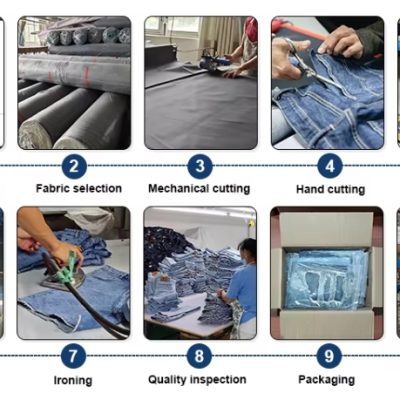
Quality control begins before the cutting table. Upon receiving denim rolls from the mill, we perform rigorous testing. We cannot rely solely on the mill’s data sheet; we must verify it.
- The Blanket Wash Test: We cut specifically measured squares of the raw fabric and put them through the exact industrial wash cycle the final jean will undergo.
- Calculation: We measure the fabric before and after washing to calculate the precise shrinkage percentage (e.g., -3% Warp, -1.5% Weft).
Manufacturer’s Note: Different washes (stone wash, enzyme wash, bleach) cause different shrinkage rates. We test per wash recipe, not just per fabric.
3.Pattern Engineering and CAD Adjustments
Once we have the exact shrinkage data, our pattern makers go to work. We do not use a “one size fits all” pattern for raw denim vs. heavily washed denim.
We utilize CAD (Computer-Aided Design) systems to scale the patterns up. If the fabric is proven to shrink 5% in length, the pattern is cut 5% longer. This ensures that after the laundry process, the jeans shrink down to the target measurement specification.
4.The Sanforization Process
For fabrics that require high stability (or for raw denim programs), we utilize Sanforization.
This is a mechanical finishing process used at the fabric mill stage. The fabric is fed into a machine that uses steam and rubber belts to compress the fibers, pre-shrinking the fabric before it is even cut. This drastically reduces residual shrinkage, often bringing it to less than 1% or 2%, which is considered the industry standard for “shrink-proof” denim.
5.In-Line Quality Control (QC)
Avoiding shrinkage issues requires constant monitoring. Our QC team implements checkpoints throughout the bulk production line:
- Pilot Run: We produce a small size set (10–20 units) before starting the massive bulk cut to verify the shrinkage calculations one last time.
- Post-Wash Measurement: After laundry, random samples are pulled and measured against the tech pack immediately.
- Steam Control: During the final ironing/pressing stage, we carefully control steam application to prevent accidental elongation or unexpected shrinkage.
Partner with Precision
Denim manufacturing is a blend of art and engineering. By strictly adhering to shrinkage testing protocols and pattern engineering, we protect our clients from sizing disasters.
Are you looking for a manufacturing partner in China who understands the technical intricacies of premium denim? Contact our team today to discuss your next collection.