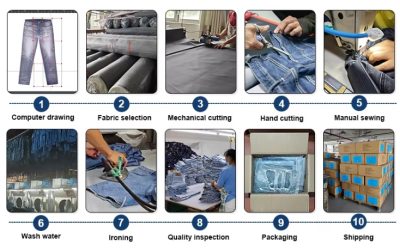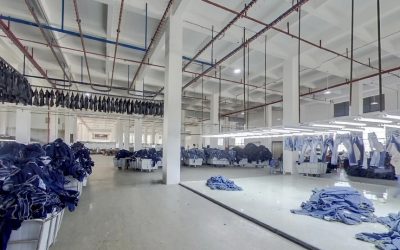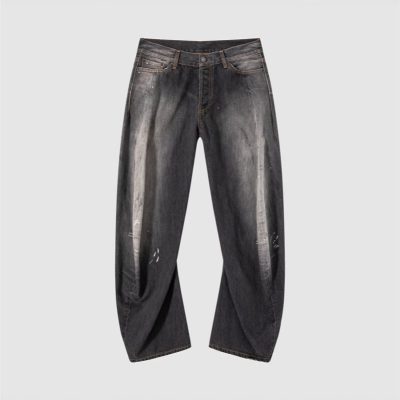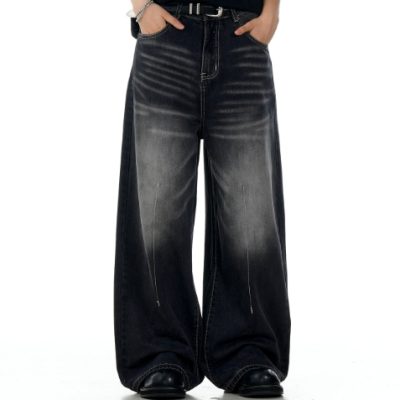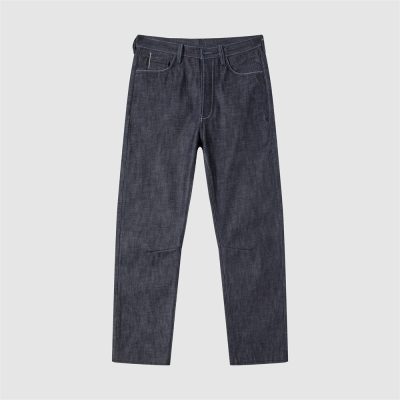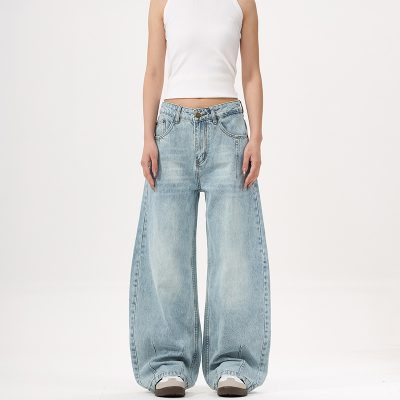
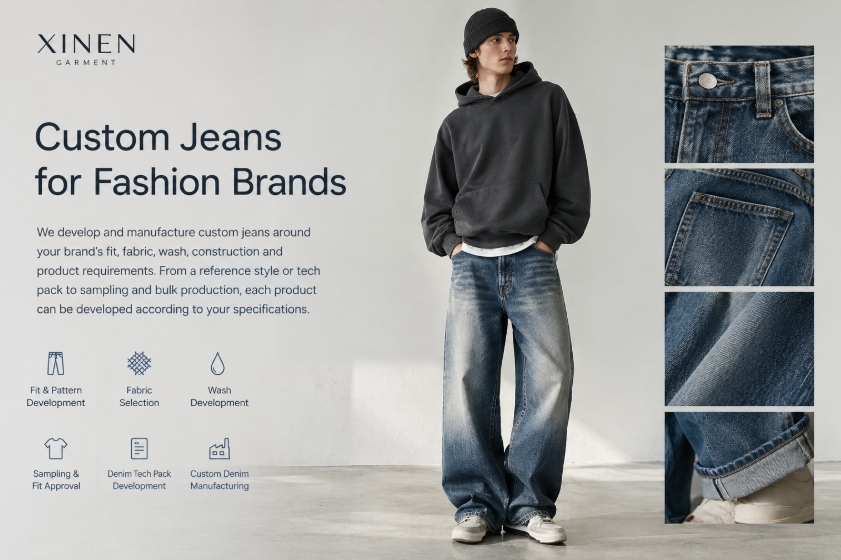
Developing custom jeans requires balancing pattern engineering, fabric selection, garment construction, and wet processing. Unlike standard off-the-shelf garments or basic private-label options, true custom denim manufacturing is built entirely around a brand’s specific product requirements. Every detail—from rise proportions and seam construction to fabric weight, shrinkage behavior, and wash target—is established through systematic development before proceeding to production.
At Xinen Garment, custom jeans are developed from your brand’s technical specifications, reference garments, or design concepts. Rather than making minor modifications to existing stock blanks, every style is built from the pattern level up to ensure the intended fit, aesthetic, and structural integrity are maintained across bulk manufacturing.
Custom Jeans Developed Around Your Product Requirements
Developing a custom jeans style involves multiple interdependent variables. Changing a single specification—such as switching from a rigid 14 oz denim to a stretch fabric, or altering a wash target from a light rinse to a heavy stone wash—directly impacts how other elements of the garment perform.
┌─────────────────────────────────────────────────────────┐
│              CUSTOM JEANS SPECIFICATIONS                │
├──────────────────┬───────────────────┬──────────────────┤
│ Fit & Silhouette │ Fabric & Weight   │ Wash & Finishing │
│ Measurements     │ Construction      │ Hardware & Trims │
└──────────────────┴───────────────────┴──────────────────┘
When building a custom denim style, key customizable elements include:
- Fit & Silhouette: Rise, seat, thigh, knee, and leg opening proportions, from slim and straight to oversized, wide-leg, or flared cuts.
- Measurements & Specs: Custom sizing charts, inseam lengths, and graded measurements across the entire size run.
- Denim Fabric: Raw material selection including cotton composition, weight (GSM / oz), weave structure (3×1 right-hand twill, left-hand twill, broken twill), rigid or stretch construction, and surface texture.
- Garment Construction: Front and back rise balance, yoke depth, waistband width, belt loop placement, fly closure type (button fly or zipper), pocket sizing, and internal finishing.
- Seam Engineering & Stitching: Thread weight (e.g., Tex 80, Tex 105), thread composition (core-spun vs. 100% cotton), stitch density (SPI), contrast or tonal thread colors, and specific seam types (chain stitching, lap seams, flat-felled seams).
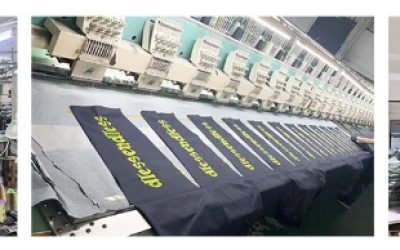
- Hardware & Trims: Custom shank buttons, rivets, burrs, leather or paper waistband patches, woven main labels, care labels, and hangtags.
- Wash & Surface Effects: Abrasion, whiskering, hand sanding, laser etching, ozone washing, tinting, resin treatments, or localized distressing.
Because fabric behavior and wash processing directly influence finished garment dimensions and drape, these components are evaluated together during initial technical preparation rather than as isolated choices.
Custom Jeans Fit and Pattern Development
A functional jeans pattern is more than a two-dimensional measurement chart. Denim garments experience unique structural stresses at key tension points such as the seat, crotch curve, knee, and waistband. Achieving a balanced silhouette requires precise alignment between the front and back rises, proper seam angles, and accurate allowances for fabric stretch or wash shrinkage.
                         Back Rise / Seat Balance
                                 │
                                 ▼
 Front Rise ────► [ Crotch Curve & Inseam Angles ] ◄──── Thigh & Leg Opening
                                 │
                                 ▼
                     Overall Silhouette & Drape
Pattern engineering accounts for all critical fit areas:
- Rise Height & Curve: Front and back rise angles determine where the waistband sits and how the seat contours to the body without pulling or gathering.
- Seat & Thigh Ratio: Establishes comfort, mobility, and the structural foundation of the leg shape.
- Knee to Leg Opening Transition: Controls the vertical taper, straight line, or flare from the thigh down to the hem.
- Grainline Alignment: Proper pattern piece alignment along the warp threads prevents leg twisting after washing.
Brands can begin development using a complete tech pack, an existing measurement spec, a physical reference garment, or a design draft. During the initial development phase, paper or digital patterns are drafted, cut, sewn into prototype samples, and washed to verify proportion and drape. Adjustments are made iteratively to refine the pattern before finalizing bulk production markers.
To learn more about how pattern geometry and physical fit adjustments are handled during development, review our guide on denim fit and pattern development.
Denim Fabric Selection for Custom Jeans
Fabric selection defines the weight, texture, durability, and aging characteristics of the finished jeans. The physical properties of the mill rolls directly influence how the garment behaves during cutting, sewing, and laundering.
┌─────────────────────────────────────────────────────────────┐
│                  DENIM FABRIC CHARACTERISTICS               │
├──────────────────┬──────────────────┬───────────────────────┤
│ Construction     │ Weight           │ Elastane Content      │
│ Rigid (100% Cotton) │ Lightweight (8–11 oz) │ Comfort Stretch (1–2%) │
│ Selvedge         │ Midweight (12–14 oz) │ High Stretch (3%+)    │
│ Open-End / Ring  │ Heavyweight (15 oz+) │ Recovery Rate        │
└──────────────────┴──────────────────┴───────────────────────┘
When evaluating fabric options for a custom style, key technical considerations include:
- Rigid vs. Stretch Construction: 100% cotton rigid denim provides traditional structure, distinct wash contrast, and long-term wear patterns. Stretch denim (blended with elastane or elastomultiester) offers flexibility but requires careful monitoring of elasticity, growth, and recovery rates after laundering.
- Fabric Weight: Ranging generally from lightweight (8–11 oz) for lighter trousers or summer styles, to midweight (12–14 oz) for standard modern denim, up to heavyweight (15 oz and above) for structured or workwear-inspired garments.
- Yarn Character & Weave: Ring-spun yarns create natural slub texture and linear fade characteristics, whereas open-end yarns provide a flatter, uniform surface.
- Shrinkage & Torque Potential: Raw denim shrinks in both warp and weft directions during wet processing. Fabrics also exhibit skewing (leg rotation) depending on whether the twill direction is balanced or stabilized during mill finishing (sanforization).
Because two different denim fabrics with identical weight ratings can behave completely differently when subjected to the same wash process, patterns are calibrated specifically to the chosen mill specification.
For detailed information on sourcing, mill options, and material testing, read our overview of denim fabric selection.
Custom Denim Wash and Finishing
Wet and dry processing transform rigid, raw denim into a finished garment with specific hand feel, color depth, and surface character. Wash development is an engineering process that balances aesthetic requirements against textile strength and garment dimensional stability.
Raw Garment Sewing ──► Dry Processing ──► Wet Processing ──► Neutralization & Drying
                         (Sanding, Laser)   (Stone, Enzyme)    (Final Measurement Check)
Common finishing steps evaluated during wash development include:
- Desizing & Scouring: Removing starch coatings applied to warp yarns during weaving, softening the fabric matrix.
- Enzyme & Stone Washing: Utilizing cellulase enzymes or pumice stones to reduce indigo intensity, expose yarn cores, and create subtle high-low contrast along seams.
- Dry Process Abrasion: Hand sanding, whiskering, and scraping applied manually or via laser before wet washing to recreate natural wear marks.
- Bleaching & Tinting: Chemical oxidation or resin/dye baths to alter base indigo undertones toward vintage grey, dirty cast, or lighter shades.
- Distressing & Detail Work: Pocket edge grinding, hem fraying, or targeted destruction.
The degree of washing directly affects final garment dimensions. Heavy washing or high-heat drying increases fabric contraction, while intense abrasion can alter seam strength if stitch parameters are not correctly specified. For these reasons, wash targets are established on actual sample garments using identical fabric batches prior to bulk execution.
Explore the full range of laundry techniques and wash targets on our page covering custom denim wash development.
Custom Jeans Sampling and Fit Approval
A physical sample serves as a development checkpoint. It enables designers, product managers, and technical developers to verify how fabric character, seam construction, wash intensity, and pattern measurements interact in a physical garment.
Tech Pack / Reference ──► Initial Sample (Fit/Raw) ──► Wash Target Sample ──► Pre-Production (PP) Sample
The sampling workflow generally progresses through distinct evaluation stages:
- First Fit Sample: Built using target pattern dimensions to evaluate silhouette, rise balance, pocket placement, and overall proportions.
- Wash / Aesthetic Sample: Used to test wet processing formulas, abrasion levels, tinting, and hand feel on the selected fabric.
- Pre-Production (PP) Sample: Constructed with final bulk fabric, correct thread weights, specified hardware, final labels, and approved wash parameters. The PP sample acts as the quality benchmark for mass production.
Because design complexity, fabric availability, and wash requirements vary from project to project, the number of sample revisions depends on the scope of development and how clearly technical requirements are established at the start.
For a step-by-step breakdown of sample evaluation criteria and approval workflows, visit denim sampling and fit approval.
What Types of Custom Jeans Can Be Developed?
Custom denim manufacturing supports a wide spectrum of silhouettes and product concepts. Rather than relying on rigid template styles, patterns and construction methods are adapted to the intended market positioning of the brand.
       [ Wide / Relaxed ]          [ Classic / Straight ]          [ Tapered / Slim ]
 ┌──────────────────────────┐    ┌──────────────────────────┐    ┌──────────────────────────┐
 │ • Baggy / Skater Cut     │    │ • Standard 5-Pocket      │    │ • Slim Straight          │
 │ • Wide-Leg Trouser Fit   │    │ • Vintage Straight       │    │ • Tapered Leg            │
 │ • Cargo & Utility Jeans  │    │ • Workwear / Double-Knee │    │ • Modern Slim Fit        │
 └──────────────────────────┘    └──────────────────────────┘    └──────────────────────────┘
Representative styles developed through custom manufacturing include:
- Straight Leg Jeans: Classic 5-pocket proportions with consistent leg widths from thigh to hem.
- Relaxed & Baggy Jeans: Fuller thigh and seat cuts with generous leg openings, common in contemporary streetwear and casual collections.
- Wide-Leg & Flare Jeans: Expanded leg volumes originating from the hip or knee, requiring precise hem balance to maintain proper drape.
- Cargo & Utility Jeans: Structural designs incorporating gusseted pockets, hammer loops, reinforced knees, or tactical seam placements.
- Distressed & Vintage-Washed Jeans: Styles focused on heavy manual abrasion, localized repairs, laser whiskering, and multi-stage laundry processing.
- Custom Slim & Tapered Jeans: Contoured fits engineered with stretch or rigid fabrics, calibrated to avoid binding along the calf and knee.
Custom Jeans From a Tech Pack or Reference Sample
Projects enter development through various types of technical documentation. Providing clear product parameters allows for accurate pattern drafting and material sourcing.
┌─────────────────────────────────────────────────────────────────┐
│                    PROJECT STARTING POINTS                      │
├────────────────────────────┬────────────────────────────────────┤
│ Full Tech Pack             │ Complete specs, BOM, and wash target │
│ Reference Garment          │ Physical sample for fit/construction│
│ Measurement Spec + Photos  │ Graded spec chart with visual targets│
│ Design Sketch / Concept    │ Initial concept requiring specs     │
└────────────────────────────┴────────────────────────────────────┘
Common starting points include:
- Complete Denim Tech Pack: Includes bill of materials (BOM), measurement charts with tolerances, seam construction details, thread specifications, hardware placements, and wash targets.
- Physical Reference Garment: An existing pair of jeans provided to replicate fit, fabric weight, or specific sewing details, paired with visual wash directions.
- Measurement Chart & Visual Target: Detailed measurement guidelines accompanied by clear reference imagery for color, wash intensity, and distressing.
- Design Concept / Early Sketch: Design layouts where pattern dimensions, fabric selections, and wash details are defined collaboratively during early technical review.
When initial technical documentation is incomplete, missing parameters (such as shrinkage allowances or seam structures) are clarified during initial pattern drafting and fabric selection.
Learn how to prepare technical documentation for factory submission on our page dedicated to denim tech pack development.
From Approved Sample to Bulk Custom Jeans Manufacturing
Once the pre-production sample and technical specifications receive final sign-off, the project transitions into mass manufacturing. Production follows a structured sequence designed to maintain consistency across all size runs and colorways.
Pattern Grading & Marker Making ──► Fabric Spreading & Precision Cutting
                                                 │
Final Assembly & Inspection    ◄── Wet Processing & Garment Finishing ◄── Industrial Sewing & Hardware
- Fabric & Trim Preparation: Inspection of bulk fabric rolls for width, shade consistency, and defect mapping. Hardware, labels, and thread inventory are staged.
- Pattern Grading & Marker Making: Digitizing approved patterns and grading measurements across all production sizes. Computerized markers are generated to optimize fabric yield.
- Spreading & Cutting: Bulk fabric is layered under controlled tension and cut using precision equipment according to the graded markers.
- Garment Assembly (Sewing): Components are assembled on specialized industrial sewing lines equipped for heavy denim operations (chain stitching, lap seaming, automatic pocket setters, and bar-tacking).
- Wet & Dry Processing: Bundles move to the laundry facility for manual distressing, stone/enzyme washing, bleaching, or dyeing according to approved wash formulas.
- Finishing & Trim Attaching: Installation of shank buttons, rivets, waistband patches, and final thread trimming.
- Quality Inspection & Packing: Final measurement auditing, appearance checks, pressing, folding, and polybagging for dispatch.
To understand factory operations, machinery capabilities, and line assembly workflows, read our overview of custom denim manufacturing and review the complete custom denim production process.
Quality Control for Custom Jeans
Quality control measures are integrated into each stage of development and bulk production to prevent defects and ensure structural consistency.
┌─────────────────────────────────────────────────────────────┐
│                 QUALITY CONTROL CHECKPOINTS                 │
├──────────────────┬───────────────────┬──────────────────────┤
│ Raw Materials    │ In-Line Sewing    │ Post-Wash & Finishing│
│ • Shade grouping  │ • Seam integrity  │ • Spec measurements  │
│ • Tensile strength│ • Stitch density  │ • Wash appearance    │
│ • Weight auditing│ • Trim placement  │ • Hardware pull test │
└──────────────────┴───────────────────┴──────────────────────┘
Key inspection parameters include:
- Material Inspection: Checking raw denim rolls for slubs, shading variations across lots, and weight consistency.
- Dimensional Auditing: Measuring finished garments against tech pack specs and approved tolerances across critical points (waist, hip, inseam, leg opening).
- Seam & Construction Integrity: Verifying stitch density (SPI), seam strength, back-tack reinforcement on stress points, and proper operation of zippers and shanks.
- Wash & Color Consistency: Comparing bulk production shade variations against the approved pre-production reference sample under standardized lighting.
- Hardware & Trim Security: Pull-testing rivets and shank buttons to confirm secure attachment without fabric tearing.
Inspection criteria, tolerance limits, and testing protocols are confirmed according to brand requirements prior to production kickoff.
Detailed information on inspection standards and testing methods is available under denim quality control.
What Should a Brand Provide When Starting a Custom Jeans Project?
To establish a clear development path and receive accurate cost estimations, brands should prepare key product details before starting a project.
┌─────────────────────────────────────────────────────────────┐
│                  PROJECT INTAKE CHECKLIST                   │
├─────────────────────────────────────────────────────────────┤
│  [ ] Product Concept / Target Silhouette                     │
│  [ ] Tech Pack or Detailed Measurement Spec                 │
│  [ ] Physical Reference Garment or High-Res Photos           │
│  [ ] Fabric Preferences (Weight, Composition, Rigid/Stretch) │
│  [ ] Wash Target & Abrasion References                       │
│  [ ] Branding Specifications (Labels, Hardware, Patches)     │
│  [ ] Size Range & Estimated Order Quantities                │
└─────────────────────────────────────────────────────────────┘
Providing clear details at the outset reduces sampling iterations and ensures alignment between initial development and final production output.
What Makes Custom Jeans Different From Stock or Private Label Jeans?
Understanding the technical distinction between custom denim production and stock/private label sourcing helps brands select the correct manufacturing model for their business.
| Feature / Aspect | Stock / Ready-Made Jeans | Private Label Adaptation | Custom Jeans Manufacturing |
| Pattern & Fit | Fixed factory pattern | Fixed factory pattern | Engineered specifically for the brand |
| Fabric Selection | Pre-selected inventory | Limited options from stock | Custom sourced by weight, weave, and composition |
| Wash Development | Standard factory shade | Selected from pre-set laundry options | Developed to custom visual targets and samples |
| Garment Details | Non-customizable | Basic logo or label placement | Custom hardware, pockets, stitching, and construction |
| Development Process | Catalog selection | Minor label application | Iterative sampling, fit testing, and approval |
Custom jeans manufacturing is designed for brands that require distinct silhouettes, proprietary fits, specific wash aesthetics, and full control over raw materials.
Custom Jeans Requirements by Brand Type
Technical priorities often vary depending on a brand’s market positioning and distribution strategy:
┌─────────────────────────────────────────────────────────────────┐
│                       BRAND REQUIREMENT FOCUS                   │
├──────────────────────────┬──────────────────────────────────────┤
│ Premium Denim Labels     │ Fabric hand feel, wash depth, consistency│
│ Streetwear Brands        │ Heavyweight denim, bold fits, distressing│
│ Independent Labels       │ Technical guidance, pattern development │
│ Established Apparel      │ Strict spec adherence, scale execution │
└──────────────────────────┴──────────────────────────────────────┘
- Premium Denim Brands: Primary focus centers on fabric character, specialized yarn compositions, precise wash execution, subtle distressing, and lot-to-lot consistency.
- Streetwear & Contemporary Labels: Frequently emphasize heavy fabric weights (14–16+ oz), exaggerated silhouettes (wide, oversized, or multi-panel cuts), intricate dry process work, and specialized hardware.
- Independent Fashion Labels: Often require technical support to translate design concepts, sketches, or vintage samples into complete technical specifications and production-ready patterns.
- Established Apparel Brands: Rely on strict adherence to established tech packs, standardized measurement tolerances, comprehensive QC reporting, and repeatable manufacturing execution.
When Is a Custom Jeans Product Ready for Bulk Production?
A custom style moves into mass manufacturing only after all technical specifications and sample details have been formally approved.
  Fabric Sign-off   ──► Fit & Spec Sign-off ──► Wash Sign-off ──► Trim / BOM Sign-off
                                                                        │
                                                                        ▼
                                                             BULK PRODUCTION RELEASE
Before releasing an order to the factory floor, the following items must be confirmed:
- Approved Pre-Production (PP) Sample: Physical sign-off covering fit, sewing details, and wash appearance.
- Finalized Measurement Spec & Grade Rules: Confirmed size chart including graded dimensions across all size options.
- Approved Fabric & Hardware: Bulk mill fabric lots and custom hardware samples verified for quality and color.
- BOM & Packing Specs: Verified bill of materials, label placements, polybagging, and master carton packing specifications.
Any modifications requested after bulk production authorization can impact pattern markers, fabric yields, and laundry formulas, requiring re-evaluation before proceeding.
Custom Jeans FAQ
1. Can you develop custom jeans from a physical reference sample?
Yes. A physical reference garment can be analyzed to extract pattern measurements, analyze seam construction, evaluate thread types, and identify fabric weight and composition.
2. Can custom jeans be developed from a tech pack?
Yes. A complete tech pack containing a measurement spec, bill of materials, stitch requirements, and wash references provides all necessary technical data to draft patterns and construct initial samples.
3. Is it possible to customize the fit and measurement chart?
Yes. Patterns are created from scratch or adapted specifically to your brand’s required rise, seat, thigh, knee, and leg opening specifications.
4. How is a custom denim wash target developed?
Wash targets are developed by comparing physical wash swatches or reference garments against target fabric rolls. Laundry technicians adjust enzyme formulas, stone wash durations, temperature, and dry process abrasion to match the target aesthetic.
5. Can I select specific denim fabrics for my project?
Yes. Fabrics can be selected based on weight (oz/GSM), composition (100% cotton, stretch blends), weave structure, texture, and indigo shade from mill offerings.
6. How does sampling work for custom jeans?
Sampling begins with pattern drafting and raw sample construction to evaluate fit. Once fit is approved, samples undergo target wash processing to confirm color, hand feel, and shrinkage before final pre-production samples are made.
7. What technical information is required before starting development?
Key details include design sketches or tech packs, reference garments (if available), target fabric parameters, wash references, branding details, and estimated size runs.
8. Can an approved custom jeans style be repeated in future production runs?
Yes. Approved patterns, shrinkage calculations, fabric specifications, and wash recipes are documented to maintain consistency across future repeat production orders.
Discuss Your Custom Jeans Project
If you have a tech pack, reference garment, measurement chart, or a clear product concept, send your available specifications to our team to review your development requirements.