Introduction: The Misconception of Simplicity
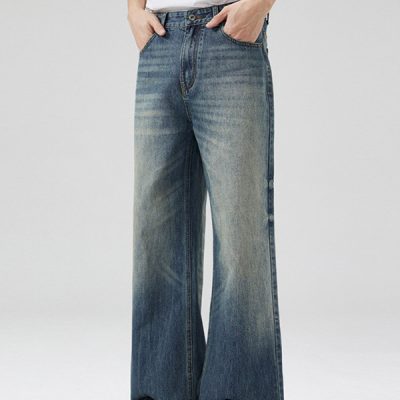
In the current global fashion landscape, the demand for relaxed, oversized, and “baggy” denim silhouettes has surged. For retail brands, capitalizing on this trend is essential. However, for sourcing managers and product developers, the transition from a design sketch to mass production reveals a critical challenge: the “baggy” fit is deceptively complex to manufacture well.
There is a misconception in the industry that loose-fitting garments are easier to produce because they require less precise tailoring than skinny jeans. This is false. In high-stakes manufacturing, creating a deliberate, aesthetically pleasing oversized silhouette requires significantly more engineering than a standard fit.
A quality baggy jean is not simply a smaller size scaled up with more fabric. It is an architectural achievement. The difference between a premium loose fit and a sloppy garment lies entirely in the technical foundation: experienced pattern engineering.
1.The “Baggy” Paradox: Controlling Volume vs. Chaos
When volume is added to a garment without precise structural control, the result is rarely desirable. Without expert patterning, mass-produced baggy jeans frequently suffer from critical defects that damage brand reputation:
- Lack of Structure: The garment “collapses” on the body, looking cheap rather than intentionally relaxed.
- Improper Break Points: The fabric pools awkwardly at the ankle instead of stacking cleanly.
- Leg Twist: A common issue in wider leg widths where the inseam rotates toward the front of the leg due to poor grainline alignment during cutting.
- Seat Sag: Excess fabric in the rear yoke and seat area that creates an unflattering, diaper-like effect.
To avoid these pitfalls, the pattern must be engineered to manage the weight and drape of the excess fabric.
2.The Engineering Behind the Drape
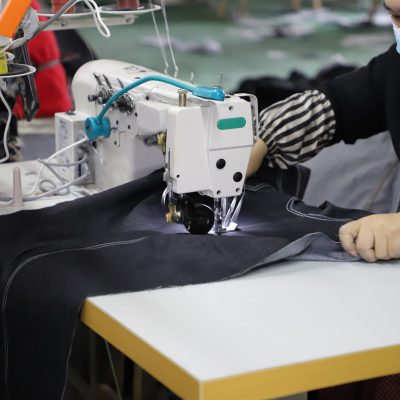
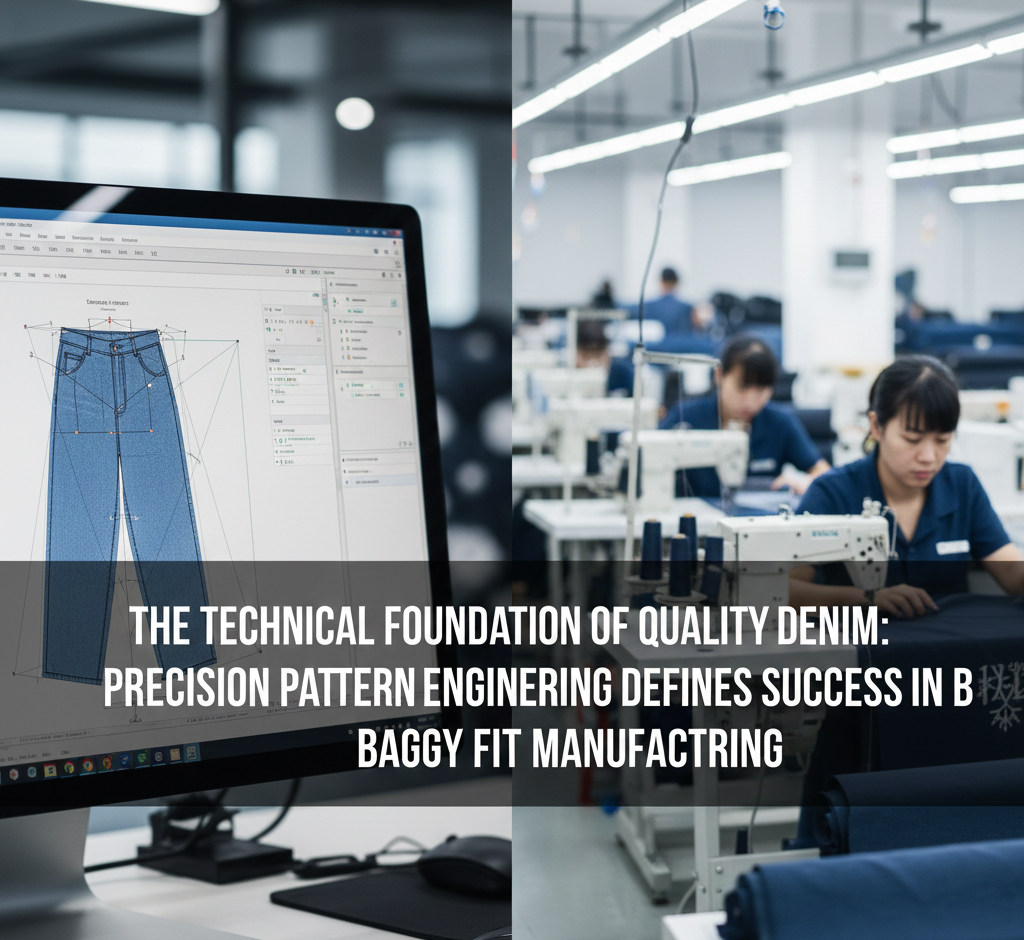
At our manufacturing facility, we view pattern making not as an art, but as industrial engineering. For complex oversized fits, our senior pattern engineers focus on critical technical geometric adjustments:
A. The Center of Gravity and Balance
A wider leg changes the garment’s center of gravity. An experienced pattern maker knows how to adjust the front and back rise ratios to ensure the jeans “hang” correctly from the hip bone, rather than relying on the waistband for support. This balance prevents the dreaded sagging effect.
B. Hip Block Geometry
To achieve a clean silhouette that is loose in the leg but fitted at the waist, the transition through the hip block must be mathematically precise. We utilize advanced CAD (Computer-Aided Design) systems to model this transition, ensuring that the extra volume begins exactly where intended—usually below the hip—to maintain a structured top block.
C. Strategic Grainline Alignment
Controlling drape requires mastering the fabric grain. For wide-leg jeans, slight deviations in aligning the pattern piece to the fabric grain during cutting will result in severe twisting post-wash. Our technical teams implement strict protocols for grainline placement that account for the specific torque inherent in denim twill whereby ensuring vertical stability.
3.Material Intelligence: Adapting the Pattern to the Fabric
Pattern engineering does not exist in a vacuum; it must react to the raw material. A 13oz rigid cotton denim behaves vastly differently than an 11oz comfort-stretch blend.
An inexperienced manufacturer might use the same “baggy” block pattern for different fabrics. We do not.
Our process involves predictive shrinkage analysis. Before finalising markers, we analyze the fabric’s weight, weave, and elasticity. Our engineers adjust the pattern dimensions to compensate for how that specific denim will shrink and settle after industrial washing. A rigid fabric requires a pattern engineered for structure; a softer fabric requires a pattern engineered to control drape.
Scalability Through Precision
For global brands, the goal is not just producing one perfect sample—it is producing 50,000 units with identical fit characteristics across a full size range.
Inconsistent sizing is the primary driver of e-commerce returns. By investing in high-level technical patterning at the pre-production stage, we establish a stable foundation for scalable manufacturing.
When you choose a manufacturing partner for complex fits like baggy denim, you are not just buying sewing capacity; you are acquiring technical expertise. Our commitment to precision pattern engineering ensures that your oversized concepts are translated into high-quality, reliable, and market-ready products.